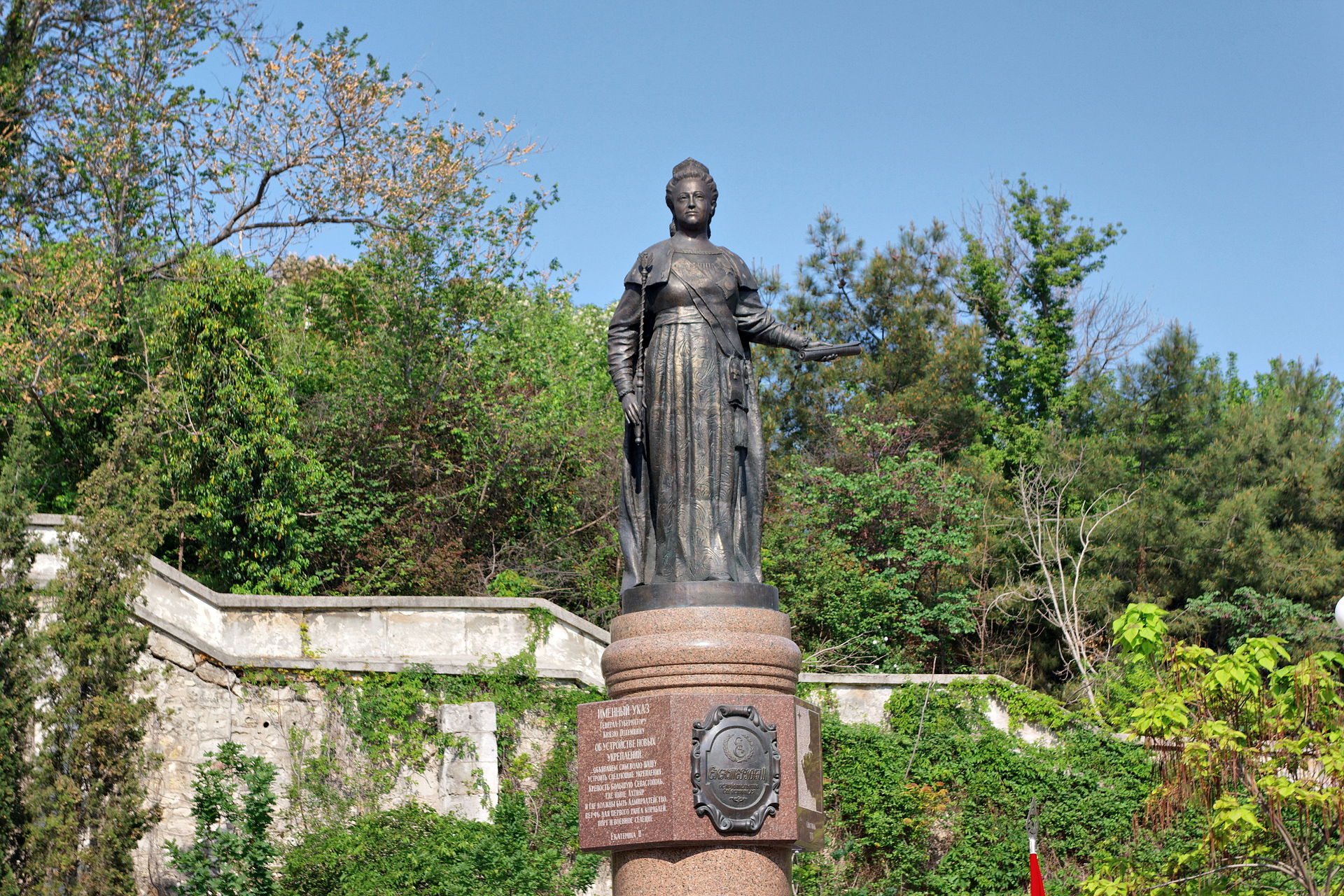
The monument to Catherine the Great in Sevastopol is one of those landmarks that do more than just decorate a city—they anchor it in history. Unveiled in 2008, it stands on a small square not far from the city’s central thoroughfare, a quiet yet commanding presence in the urban landscape. The bronze figure of the empress, poised on a granite pedestal, seems to bridge the centuries, evoking the era when Sevastopol was first conceived as a vital port and fortress of the Russian Empire.
The choice to honor Catherine here is far from arbitrary. It was her decree in 1783 that brought Crimea into the Russian fold, and a year later, she founded Sevastopol as a strategic stronghold for the Black Sea Fleet. The city was never meant to be just another coastal settlement; it was designed as a linchpin of imperial power, its fate intertwined with the empress’s vision. The monument, then, is more than a tribute to a historical figure—it’s a symbol of continuity, a reminder that Sevastopol’s identity was shaped by deliberate, far-reaching decisions.
The monument’s design is deliberate in its simplicity. Catherine is depicted in full regalia, holding the orb and scepter, her gaze directed into the distance as if surveying the city she brought into being. The granite pedestal lends the composition a sense of permanence, while the surrounding square, with its flowerbeds and benches, invites visitors to linger. It’s a place where history feels tangible, yet unobtrusive—a backdrop to everyday life rather than a spectacle demanding attention.
Sevastopol has always been a city where the past is never far away. From its ancient Greek roots to its role in the Crimean War and World War II, layers of history are visible at every turn. In this context, Catherine the Great isn’t just a name from a textbook; she’s part of the city’s living narrative. The monument underscores Sevastopol’s dual identity—as both a military bastion and a cultural hub, shaped by the ambitions of those who founded it. It’s a quiet assertion that the city’s significance goes beyond its strategic value.
The monument’s installation in the early 21st century wasn’t without controversy. For some, it was a long-overdue recognition of the city’s origins, a restoration of historical justice. For others, it stirred debates about Catherine’s complex legacy in Crimea, where her policies intersected with the destinies of many peoples. Over time, though, the monument has settled into the cityscape, becoming just another part of Sevastopol’s fabric. Today, it’s neither a lightning rod for debate nor a tourist attraction demanding reverence—it simply exists, as much a part of the city as the sea breeze or the sound of trams rattling down Lenin Street.
The square where the monument stands is one of those places where the rhythm of Sevastopol feels most palpable. Locals gather here in the evenings, chatting or enjoying the cool air, while festivals and public events occasionally bring the space to life. The monument isn’t just a photo opportunity; it’s woven into the daily life of the city. It doesn’t demand admiration or provoke strong reactions—it’s just there, as familiar and unremarkable as the old buildings lining the nearby streets.
Up close, the monument reveals details that often go unnoticed. The dates of Sevastopol’s founding and the monument’s installation are carved into the pedestal, a subtle reminder that history isn’t static. It’s a process, with each era leaving its mark. Catherine isn’t just a bronze figure here; she’s a symbol of the moment when Sevastopol began its journey toward becoming one of Russia’s most storied cities.
There’s no rush around the monument, no crowds jostling for the best view. It’s a place for quiet reflection, where you can sit on a bench and watch the world go by. The surrounding buildings, some dating back to the 19th century, add to the sense of timelessness. Sevastopol is a city where history isn’t confined to museums—it’s in the air, in the stones underfoot, in the monuments that dot the streets. The statue of Catherine the Great is just one of many markers, but it’s a reminder that the past isn’t just something to be studied—it’s something to be felt. It doesn’t ask for reverence, but it doesn’t let you ignore it either.