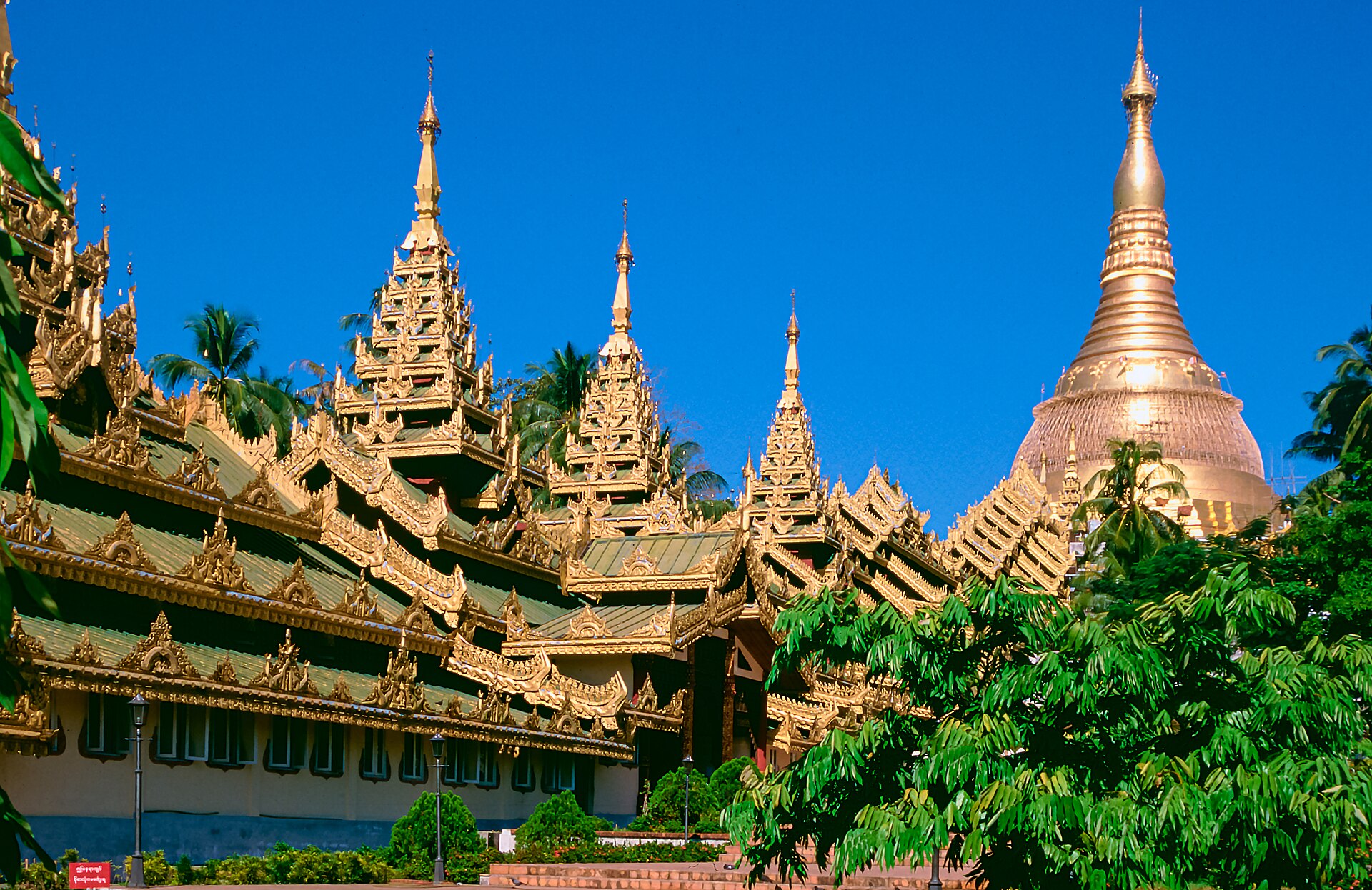
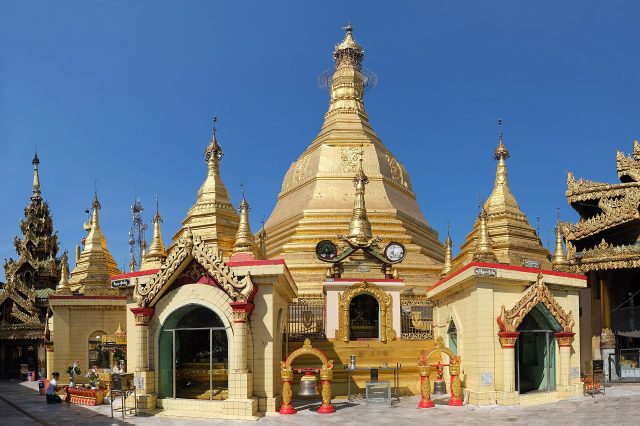
Shwedagon Pagoda rises above Yangon like a golden beacon, its stupa glowing against the sky long before you reach its base. This isn’t just another temple—it’s the spiritual heart of Myanmar, a place where history, faith, and daily life intertwine in ways that feel both ancient and immediate. The pagoda’s origins stretch back over two millennia, though the exact date of its founding is lost to legend. Some say it was built to enshrine eight hairs of the Buddha, brought to Myanmar by merchants from India. Others claim it predates even that story, its foundations laid when the land was still known as Suvarnabhumi, the Golden Land. What’s certain is that for centuries, rulers, pilgrims, and ordinary people have shaped its destiny, layering gold leaf, donations, and devotion onto its surface until the stupa became what it is today: a dazzling, almost weightless-looking structure that seems to float above the city.
The approach to Shwedagon is part of the experience. The pagoda sits on Singuttara Hill, a gentle rise that offers a quiet vantage point over Yangon’s sprawl. As you climb the steps, the noise of the city fades, replaced by the murmur of prayers and the scent of frangipani. Vendors line the path, selling flowers, candles, and small offerings—lotus buds, incense sticks, and squares of gold leaf for those who want to add their own mark to the pagoda’s surface. The tradition of gilding the stupa is one of the most visible acts of devotion here. Over the centuries, countless layers of gold have been pressed onto its surface, each one a personal act of merit-making. The result is a structure that shimmers in the sunlight, its golden hue deepening to amber as the day wears on.
At the center of the complex stands the main stupa, its spire reaching nearly a hundred meters into the sky. The stupa is crowned with a hti, an ornamental umbrella encrusted with thousands of diamonds, rubies, and other precious stones. The very top is said to hold a single 76-carat diamond, though in truth, the pagoda’s real value lies not in its jewels but in what it represents. The stupa is surrounded by a constellation of smaller shrines, pavilions, and statues, each with its own story. Some are dedicated to the days of the week—Myanmar’s astrological traditions assign each day a planetary guardian, and devotees often visit the shrine corresponding to their birth day to pray and pour water over the statue. Others honor the Buddha’s life, his teachings, or the nats, the spirits that still hold sway in Myanmar’s folk beliefs.
The pagoda’s architecture is a study in symmetry and symbolism. The main stupa is encircled by four smaller ones at the cardinal points, each marking the spot where one of the Buddha’s hairs is said to be enshrined. The base of the stupa is ringed with terraces, where pilgrims walk clockwise in a slow, meditative circuit. The walls and pillars are adorned with intricate carvings and glass mosaics, their colors reflecting the light in shifting patterns. Even the bells scattered throughout the complex have a purpose—they’re rung by visitors as an act of merit, their deep, resonant tones carrying across the pagoda grounds. The design isn’t just decorative; it’s a physical manifestation of Buddhist cosmology, a map of the universe rendered in stone and gold.
Shwedagon isn’t just a place of worship; it’s a living part of Yangon’s daily rhythm. Locals come here to pray, to socialize, to escape the heat for a few hours. In the early morning, monks in maroon robes glide silently across the marble floors, their alms bowls ready for the day’s offerings. By midday, the terraces fill with families, students, and elderly devotees, some sitting in quiet contemplation, others chatting in small groups. In the evening, the pagoda takes on a different mood. The golden stupa is illuminated from within, casting a warm glow over the complex. The air is thick with the scent of incense, and the sound of chanting drifts from the prayer halls. It’s a time when the boundaries between the sacred and the ordinary blur, when the pagoda feels less like a monument and more like a gathering place for the city’s soul.
The pagoda has also been a witness to Myanmar’s turbulent history. It was here, in 1920, that students gathered to protest British colonial rule, sparking the country’s first nationalist movement. Decades later, in 1988, it became a rallying point for pro-democracy demonstrators, its steps filled with crowds calling for change. Even today, the pagoda remains a symbol of resilience. During times of political unrest, it has been a sanctuary, a place where people could gather in peace. The authorities know this, which is why the pagoda has often been off-limits during crackdowns. Yet, no matter what happens outside its walls, Shwedagon endures, its golden spire a constant reminder of the faith that has sustained Myanmar through centuries of upheaval.
Visiting Shwedagon is less about ticking off a landmark and more about stepping into a different pace of life. There’s no rush here, no agenda beyond being present. The pagoda operates on its own time, a cycle of devotion that has continued uninterrupted for generations. If you’re lucky, you might witness a novitiation ceremony, where young boys dressed in elaborate costumes are initiated into monastic life. Or you might stumble upon a group of nuns leading a chant, their voices rising and falling in hypnotic rhythm. Even the act of walking barefoot across the cool marble floors feels like a small ritual, a reminder of the humility that underpins Buddhist practice.
The pagoda’s significance extends beyond Myanmar’s borders. It’s one of the most revered Buddhist sites in the world, a place that draws pilgrims from across Asia and beyond. Yet, despite its fame, Shwedagon retains a sense of intimacy. It’s not a museum piece but a place where faith is lived, where every corner holds a story, and where the line between the sacred and the everyday is beautifully, effortlessly blurred. Whether you come for the history, the architecture, or simply to sit in the shade of a bodhi tree and watch the world go by, the pagoda has a way of leaving its mark. It’s not just a destination; it’s an experience that lingers long after you’ve left its golden glow behind.