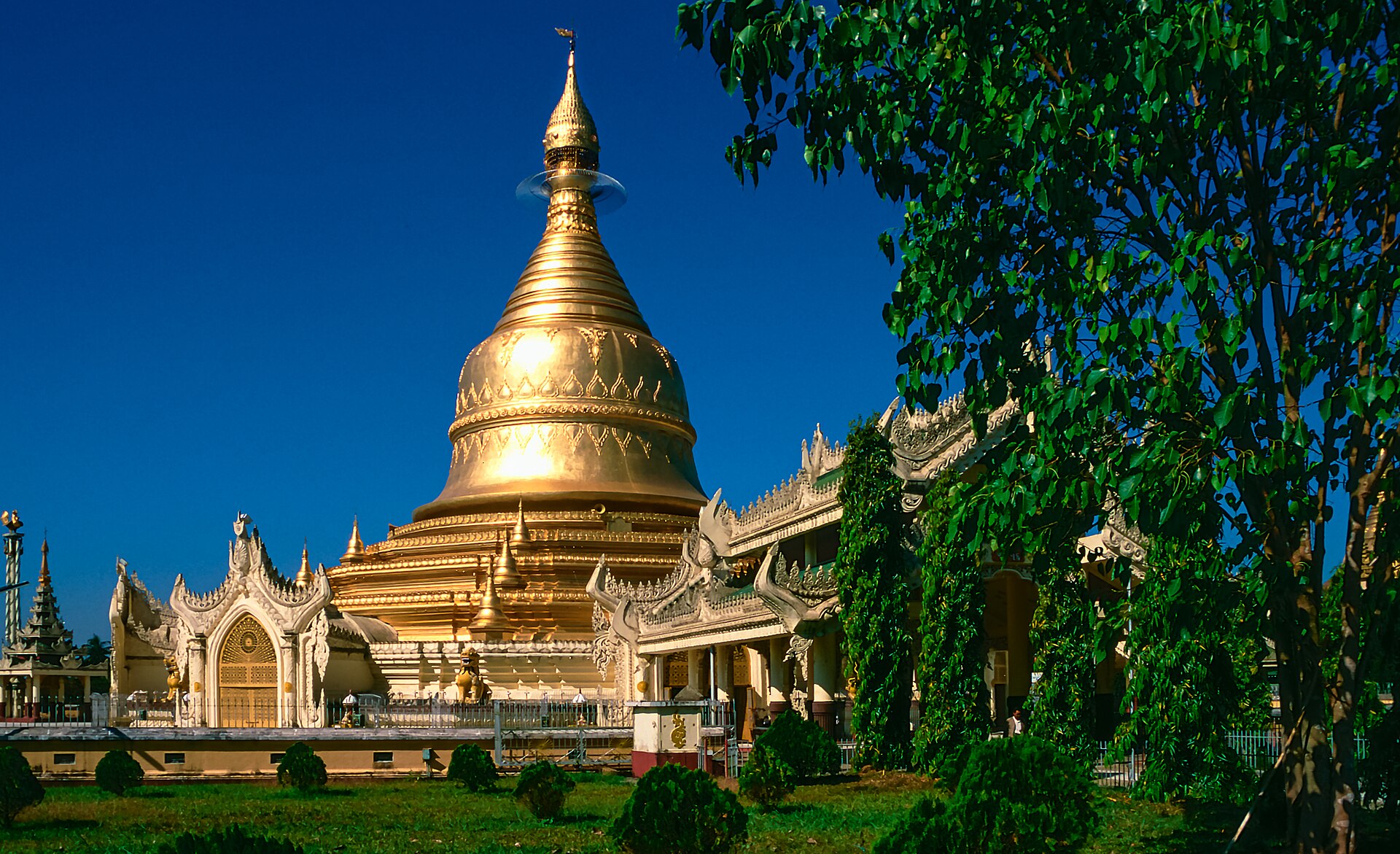
Maha Wizaya Pagoda stands on a quiet hill in Yangon, a place that feels both new and deeply familiar. Built in 1980, it’s a latecomer to Myanmar’s long tradition of sacred architecture, yet it carries the weight of centuries in its design. The government of the time envisioned it as a unifying space, a place where the country’s diverse religious and cultural threads could intertwine without friction. There’s no ancient mystique here, no layers of legend built up over generations—just a deliberate attempt to create harmony, both in its structure and its purpose.
From the outside, the pagoda follows the classic Burmese form, but with a precision that betrays its modern origins. The main stupa rises above the surrounding greenery, its white dome catching the sunlight while the gilded tip glows even on overcast days. Smaller pagodas, Buddha statues, and decorative motifs encircle it, all arranged with a symmetry that feels almost geometric. Unlike older temples, where time has softened edges and blurred lines, Maha Wizaya presents itself with a kind of polished clarity, as if the architects wanted to distill tradition into something both beautiful and accessible.
Inside, the space is airy and bright, a contrast to the dim, labyrinthine interiors of many ancient shrines. The central hall is lined with murals depicting scenes from the Buddha’s life, rendered in a contemporary style that avoids the stiffness of older religious art. Light filters through high windows, casting gentle shadows over the statues of the Buddha in various poses, each one representing a different moment in his journey. There’s no sense of confinement here—just an openness that invites quiet reflection rather than solitary meditation.
The pagoda plays an active role in Myanmar’s religious life, hosting ceremonies that draw monks, pilgrims, and ordinary worshippers alike. Unlike older temples, where rituals can feel rigid and prescribed, Maha Wizaya allows for a more personal kind of devotion. People come not just to pray, but to sit in silence, to escape the noise of the city, or simply to be in a place where time slows down. On festival days, the grounds fill with the murmur of chants, the scent of incense, and the soft rustle of footsteps, creating a rhythm that feels both communal and intimate.
Perched on its hill, the pagoda offers a view of Yangon stretching out below. On clear days, the spires of other temples punctuate the skyline, while the distant hum of the city drifts upward. Locals often come here for walks, drawn by the fresh air and the quiet. The gardens around the pagoda are meticulously kept, with manicured lawns and flowering trees that add to the sense of tranquility. It’s a place where the city’s chaos feels far away, even if it’s just beyond the horizon.
What makes Maha Wizaya unusual is its ambition to be more than just a religious site. The design incorporates elements from different regions of Myanmar—Shan patterns, Mon motifs—creating a visual language that speaks to the country’s diversity. It’s as if the pagoda itself is a reminder that, despite its many differences, Myanmar remains bound by a shared spiritual heritage. This inclusivity might explain why it resonates so deeply with locals. It doesn’t belong to one group or tradition; it belongs to everyone.
Visiting the pagoda is refreshingly uncomplicated. There are no strict rules about footwear or dress, no labyrinthine corridors where a wrong turn might offend. Respect is expected, of course, but the atmosphere is welcoming rather than restrictive. You can wander freely, take photographs (as long as you’re mindful of others), or sit on one of the benches lining the walls. For travelers, it’s a rare chance to explore without feeling like an outsider, to move at your own pace without the pressure of rigid customs.
Time moves differently here. Even when the grounds are crowded, the interior retains a sense of calm. The high ceilings and open spaces create a feeling of expansiveness, as if the building itself is breathing. Perhaps that’s why people linger—because the pagoda doesn’t demand anything from them. There are no grand relics to venerate, no ancient legends to unravel. Instead, it offers something simpler: a moment of stillness, a pause in the rush of life.
Maha Wizaya isn’t the oldest or most revered temple in Myanmar. It doesn’t have the mythic aura of Shwedagon or the historical weight of Bagan’s ruins. But that’s part of its charm. It’s a place where the past and present coexist without tension, where tradition is honored but not fossilized. Whether you come for the view, the quiet, or the chance to see how a modern Myanmar interprets its own heritage, the pagoda leaves an impression—not through grandeur, but through its quiet, unassuming presence. In a city that’s always changing, it feels like a steadying hand, a reminder of what endures.