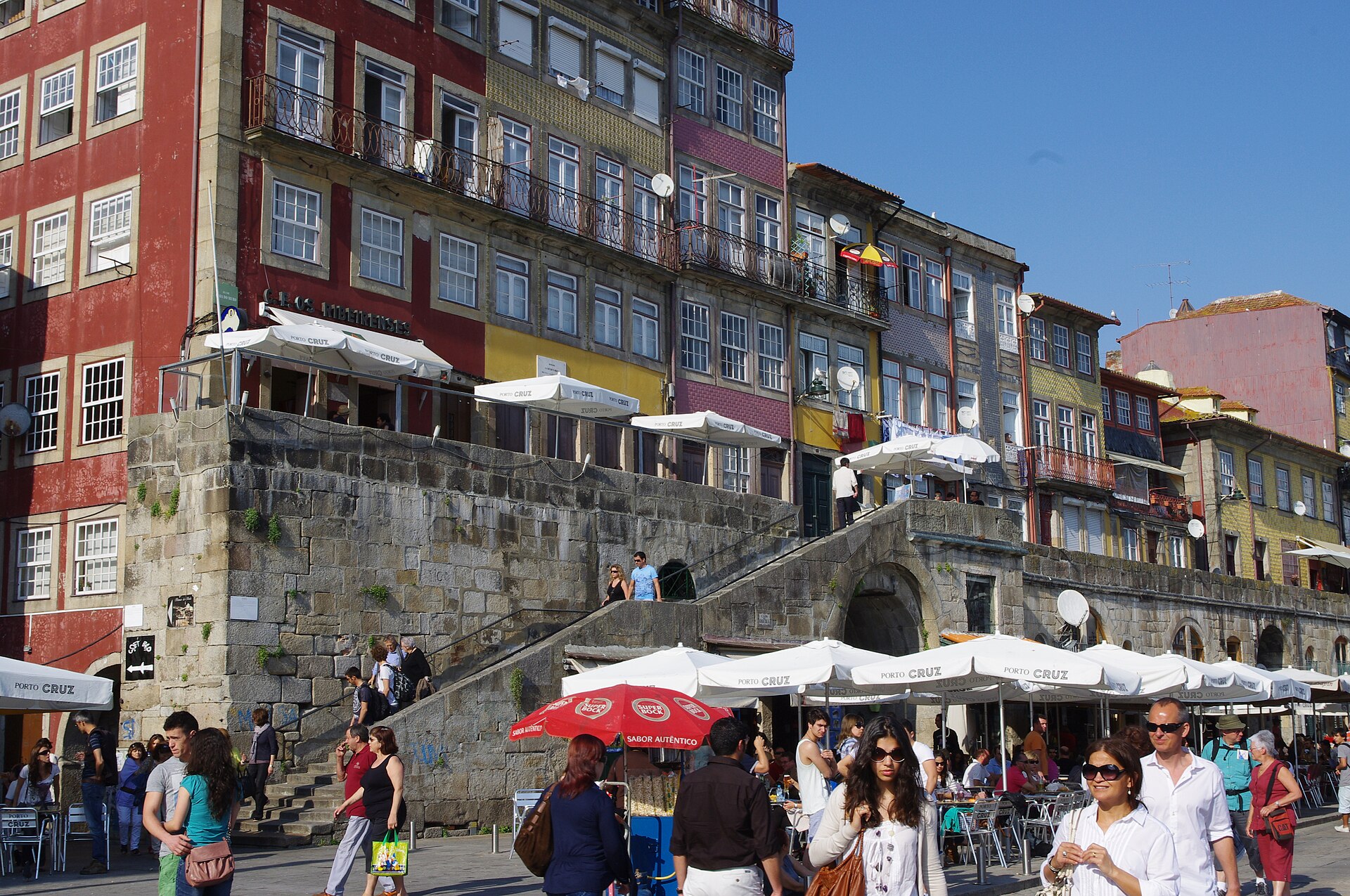
The city’s oldest district spills down to the Douro River in narrow streets and houses painted in ochre, terracotta, and cobalt. These buildings have stood for centuries, their facades patched after fires and floods, their balconies sagging under time. Some bear blue-and-white azulejo tiles showing Porto’s past—sailors setting off, merchants haggling over wine barrels, or scenes of daily life now faded. The tiles record how the city has changed, and how it hasn’t.
The river was Porto’s lifeline. In the Middle Ages, ships from England, the Netherlands, and the colonies unloaded goods and loaded port wine for distant markets. The granite quays, worn smooth by dockworkers and fishermen, still show those marks. Today, tourist boats and *rabelos*—flat-bottomed vessels once used for wine barrels—dot the water. The air carries the scent of salt and grilling sardines, and the sound of Portuguese chatter mixes with clattering plates from riverside cafés.
Architecture here mixes influences. Gothic arches hide behind Baroque facades, and fishermen’s houses stand beside merchant mansions. The simplest buildings often stand out: those with laundry between windows or a single azulejo panel of a saint or ship. The Church of São Francisco, a short climb from the waterfront, contrasts with the humbler structures. Its Gothic exterior opens to an interior covered in gold leaf, a reminder of Porto’s wealth during the Age of Exploration.
Life in Ribeira moves slowly. In the mornings, fishermen mend nets while shopkeepers sweep cobblestones. By afternoon, glasses clink in taverns. In summer, the waterfront becomes an open-air dining room, with tables along the river and musicians playing fado late into the night. Winter brings rain and woodsmoke, but locals still gather under awnings to play cards or sip coffee. The glow of streetlamps reflects off the water like scattered coins.
Have you seen the Ponte de Dom Luís I? Its double-decked iron arch, designed by a student of Gustave Eiffel, spans the Douro, connecting Porto to Vila Nova de Gaia. The upper level offers a view of the river, the old town’s rooftops, and Gaia’s wine cellars, where port has aged for centuries. At night, the bridge’s lights shimmer in the water, doubling its presence.
Ribeira was the starting point for Portugal’s Age of Discoveries. In the 15th and 16th centuries, ships sailed from here to Africa, India, and Brazil. The wind funnels through the streets, and the river pulls everything toward the horizon. Stand by the water at dusk, and you might hear the creak of wooden hulls.
Wander without a plan. The charm lies in details: a courtyard where bougainvillea spills over a crumbling wall, a tiny chapel between two houses, or a staircase worn smooth by footsteps. One leads to the Igreja de São Francisco, its gilded interior a contrast to the streets below. Another takes you to a square where old men play dominoes under a plane tree.
Ribeira isn’t just a postcard. History and daily life overlap here. A fisherman might share a bench with a tourist, and the past isn’t preserved—it’s lived. Crowds thin in the early evening, leaving the waterfront to locals. That’s when Ribeira feels like itself: rough around the edges, worn, but full of stories. The river will still be there tomorrow, and so will the stones underfoot, holding memories of everyone who passed this way.