The Dom Luís I Bridge is one of Porto’s most striking landmarks, a double-deck iron arch spanning the Douro River to connect the city with Vila Nova de Gaia. Designed by Théophile Seyrig, a former collaborator of Gustave Eiffel, its structure carries a faint echo of Parisian engineering, though its bold, sweeping arc is entirely its own. When completed in 1886, the bridge’s 172-meter span was the longest of its kind in the world, a testament to the ambition of the era.
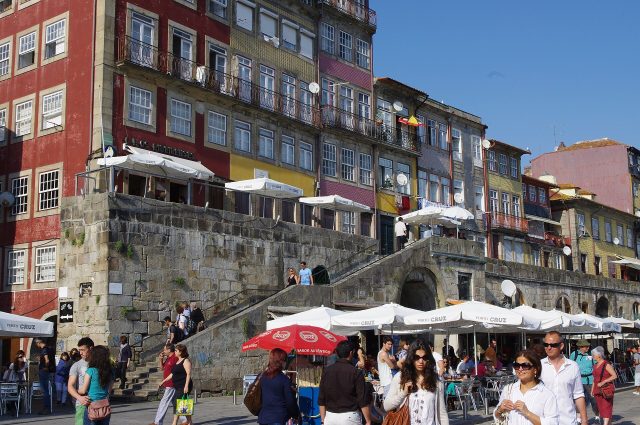
The bridge’s two levels serve different purposes. The upper deck, perched high above the river, carries the city’s metro line and a pedestrian walkway, offering sweeping views of Porto’s historic Ribeira district, the Douro’s gentle currents, and the wine cellars of Gaia on the opposite bank. Below, the lower deck accommodates cars and pedestrians, hugging the water’s edge where the riverbanks are lined with cafés and docks for the traditional *rabelo* boats. The contrast between the two levels is striking—one a quiet, shaded passage, the other an open, wind-swept promenade.
Walking across the upper deck is a rite of passage for visitors. The height is exhilarating, especially on a clear day when the city unfolds in layers: the terracotta rooftops of Ribeira, the pastel facades of Gaia, and the river itself, dotted with boats. On the Gaia side, the bridge leads to the Serra do Pilar Monastery, where a circular cloister and a panoramic terrace offer what many consider the finest view in Porto. The monastery’s dome, rising above the river, is a perfect counterpoint to the bridge’s industrial lines.
At water level, the atmosphere is entirely different. The lower deck feels more intimate, sheltered by the bridge’s massive arch. Here, the river’s presence is immediate—you can hear the lapping of water against the stone embankments and see the reflections of the bridge’s ironwork shimmering on the surface. Small boats depart from the docks for short cruises along the Douro, passing beneath Porto’s six bridges, each with its own character. The most famous of these, the Maria Pia Bridge, was designed by Eiffel himself and stands just downstream, a quieter, more utilitarian counterpart to the Dom Luís I.
The bridge takes its name from King Luís I, who reigned during its construction. It was a period of transformation for Porto, as the city expanded and modernized, and the bridge became a symbol of that progress. Today, it remains a vital artery, not just for transport but for the city’s identity. Locals cross it daily, whether by metro, car, or on foot, while visitors pause to take in the views, snap photos, or simply stand for a moment, watching the river flow beneath.
In the evening, the bridge comes alive with lights. The ironwork glows softly against the darkening sky, and the reflections dance on the water below. It’s a scene that appears on countless postcards, though no photograph quite captures the way the light plays across the river or the sense of scale when you stand on the upper deck, the wind tugging at your sleeves. The bridge is free to cross at any hour, though the upper level can be blustery, with low railings that make some visitors grip a little tighter.
Summer brings crowds, especially at sunset, when the bridge and the riverbanks hum with activity. Tourists gather on the Gaia side for wine tastings in the cellars, where the air is thick with the scent of aging port. The lower deck, shaded by the bridge’s arch, offers respite from the heat, while the upper level basks in golden light. In winter, the bridge is quieter, the wind sharper, and the views starker—Porto’s skyline stripped of its summer haze, the river running high and fast.
Getting to the upper deck from Ribeira is straightforward, with a lift or stairs available for the ascent. The descent on foot is gentler, winding down to the riverbank where the city’s rhythm slows. Whether you cross it by day or night, in solitude or among a crowd, the Dom Luís I Bridge is more than a way to get from one side of the Douro to the other. It’s a vantage point, a piece of history, and a reminder of how a city can grow around a single, enduring structure.