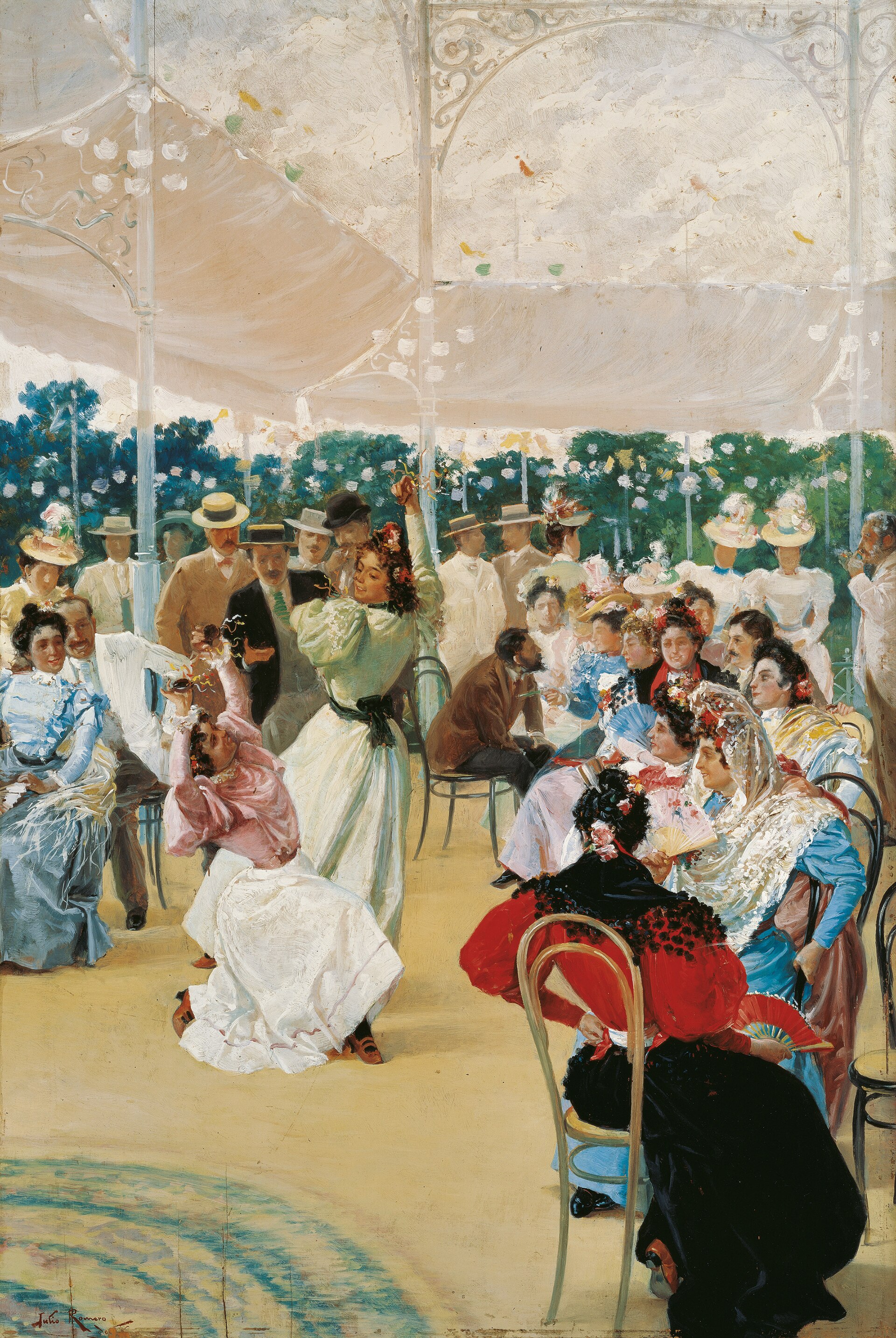
The Julio Romero de Torres Museum sits quietly in the heart of Córdoba, tucked inside a building that carries its own weight of history. Once the Hospital de la Caridad, founded in the sixteenth century, it served as a refuge for the poor and sick, its walls bearing witness to countless lives over the centuries. Today, those same walls house the works of one of Andalusia’s most distinctive painters, a man whose canvases captured the soul of a region at a turning point in time. The old hospital’s arched ceilings and sunlit courtyards, where the footsteps of nuns and patients once echoed, now offer a space for visitors to linger among paintings that feel less like art and more like fragments of a living past.
Julio Romero de Torres is a name inseparable from the image of early twentieth-century Andalusia. His paintings are steeped in passion, melancholy, and a quiet mysticism, portraying the women of Córdoba and southern Spain at a moment when tradition still held its ground against the encroaching modern world. He didn’t paint them as ethnographic studies or idealized figures but as real people—proud, sorrowful, enigmatic. His gypsies, peasant women, nuns, and city dwellers emerge from the canvas with an almost tangible presence, as if each carries a story older than the city itself. The museum doesn’t just display his work; it invites you into the atmosphere of an era when art and life were deeply intertwined.
The building itself is worth pausing over. The Hospital de la Caridad is a fine example of Córdoba’s Renaissance architecture, with its characteristic patios framed by columned galleries. One of these courtyards, shaded by orange trees, was once a gathering place for patients, and now it offers visitors a moment of respite from the city’s bustle, the soft murmur of a fountain blending with the rustle of leaves. Inside, the high ceilings, heavy wooden doors, and old ceramic tiles preserve the feel of another time. There’s a sense that within these walls, the hours move more slowly, as if the past lingers just beneath the surface.
The museum’s collection spans Romero de Torres’ entire career, from his early realist works to his later, more symbolic pieces. His most famous paintings—*La chiquita piconera*, *La saeta*, *Naranjas y limones*—are not just portraits but intimate studies of women with distinct personalities. He had a gift for capturing the play of light and shadow, the texture of fabric, the gleam in a subject’s eyes, making them feel almost alive. There’s no idealization in his work, only a raw, honest understanding of human nature. Each painting tells a story, not just of the person depicted but of the world they inhabited.
Romero de Torres was more than a painter; he was a chronicler of his time. His canvases bring to life the Córdoba of the early 1900s—a city of contrasts, where grand palaces stood alongside impoverished neighborhoods, and ancient traditions clashed with new ideas. He painted scenes of everyday life: women sewing, street musicians playing, processions winding through the streets. His work is both art and historical record, offering a glimpse into the lives, dreams, and values of the people who lived then. You can almost hear the distant strum of a guitar or the murmur of a conversation in the background of his paintings.
Beyond the paintings, the museum holds personal artifacts that offer a deeper look into the artist’s process. His brushes, palettes, sketches, and letters are displayed alongside the finished works, revealing how his ideas took shape. The sketches are particularly fascinating—they show the artist experimenting with expressions, gestures, and compositions, the raw energy of creation still visible in the lines. These fragments of his process feel almost like a conversation with the artist himself, a chance to see how he transformed ordinary moments into something enduring.
Visiting the museum is less about ticking off a list of artworks and more about stepping into Romero de Torres’ world. There’s no rush here, no tour guide hurrying you along. You can stand in front of a painting for as long as you like, studying the details, losing yourself in the expressions of the people he painted. The rooms are quiet, the atmosphere contemplative. It’s a place for those who appreciate the slow, deliberate act of looking, who want to do more than see art—to feel it.
Córdoba is a city where history is never far away, and the Julio Romero de Torres Museum is one of those places where the past feels especially close. There’s nothing flashy about it, no attempt to impress with grandeur. It’s understated but deeply moving. This isn’t a museum for the sake of appearances; it’s one for the soul. It doesn’t tell you what to think or how to feel—it simply offers the space to experience something quietly profound. And when you leave, you carry with you more than just the memory of beautiful paintings; you take a piece of the city’s spirit with you.