Gulu’s War Memorial is a quiet testament to Uganda’s painful recent past. It stands not as a grand monument to victory, but as a place of remembrance for those who suffered during the decades-long conflict that tore through the country’s north. For many in Gulu and the surrounding villages, the war left deep scars—families torn apart, childhoods stolen, entire communities displaced. The memorial doesn’t try to make sense of the violence or glorify its end. Instead, it offers a space to acknowledge what happened, to honor those who were lost, and to reflect on the fragile peace that followed.
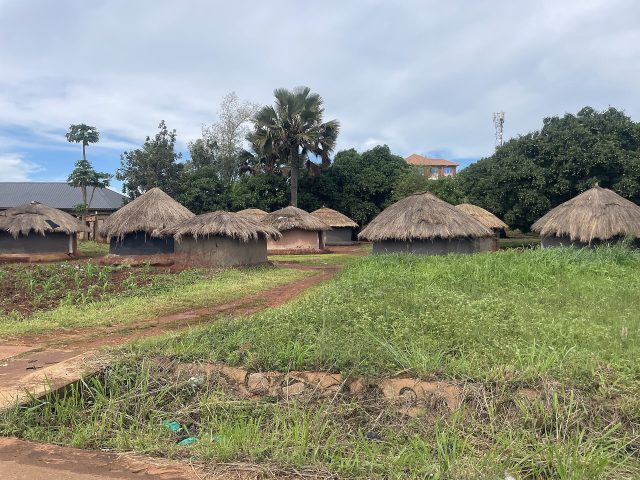
The memorial is easy to miss if you’re not looking for it. Tucked into the heart of the city, where the hum of daily life carries on around it, it doesn’t demand attention with towering statues or polished marble. A few low granite slabs bear the names of the dead, enclosed by a simple fence. Trees planted in memory of the missing stand nearby, their leaves rustling in the breeze. There are no grand inscriptions, no heroic poses—just the weight of history pressing quietly against the present. Even amid the noise of passing motorbikes and street vendors, the place feels set apart, as if the air itself is heavier here.
Gulu was at the center of the conflict, a city that bore the brunt of the Lord’s Resistance Army’s brutal campaign. For over twenty years, Joseph Kony’s rebels waged a war that defied easy explanation—kidnapping children to serve as soldiers or laborers, burning villages, and forcing hundreds of thousands into squalid displacement camps. The war wasn’t just fought on battlefields; it was waged in homes, in schools, in the spaces between one day and the next. The memorial doesn’t try to capture the full horror of those years. It doesn’t need to. The names on the stones, the trees planted in silence—they speak for themselves.
The design of the memorial is deliberately understated. There are no sweeping arches or dramatic sculptures, no attempts to impose meaning where none may exist. The simplicity isn’t a lack of thought, but a choice. The focus is on the people, not the monument itself. A single slab carries words urging peace and unity, though they feel more like a whisper than a proclamation. On certain days—anniversaries, national holidays—locals leave flowers or light candles. For some, it’s a ritual. For others, it’s a way to keep the past alive, to ensure that those who came after will understand what was lost.
Today, Gulu is a city in recovery. The war ended years ago, but its echoes linger in the stories people tell, in the way some flinch at loud noises, in the empty spaces where families used to be. The memorial plays a role in that healing, not by offering easy answers, but by providing a place to pause. School groups visit, listening as teachers recount events that many of them know only secondhand. Adults stop by on their way to work or the market, sometimes to remember, sometimes just to sit. The memorial isn’t a relic of the past; it’s part of the city’s present, a reminder that history isn’t something that stays neatly in the past.
Life moves around the memorial in the same way it moves everywhere else in Gulu. Vendors sell mangoes and roasted maize from stalls nearby. Children dart between the trees, laughing as they chase each other. Elders gather on benches, talking about the price of fuel or the latest news from Kampala. The memorial isn’t cordoned off from the city’s rhythm; it exists within it. That might be why it feels so natural here—not as a somber interruption, but as a thread in the fabric of daily life. It doesn’t ask for reverence. It simply exists, as the city does, carrying its memories forward.
For visitors, the memorial might not seem like an obvious stop. There are no guided tours, no gift shops, no dramatic views to photograph. But that’s part of what makes it worth visiting. It’s not a place for spectacle, but for quiet reflection. If you find yourself in Gulu, it’s worth spending a few minutes here—not to check a box or snap a picture, but to stand still for a moment. To listen to the wind in the trees, to read the names on the stones, to think about what it means to rebuild after something so devastating. The memorial doesn’t offer closure. It offers something rarer: a chance to sit with the weight of history, and to carry a little of it with you when you leave.