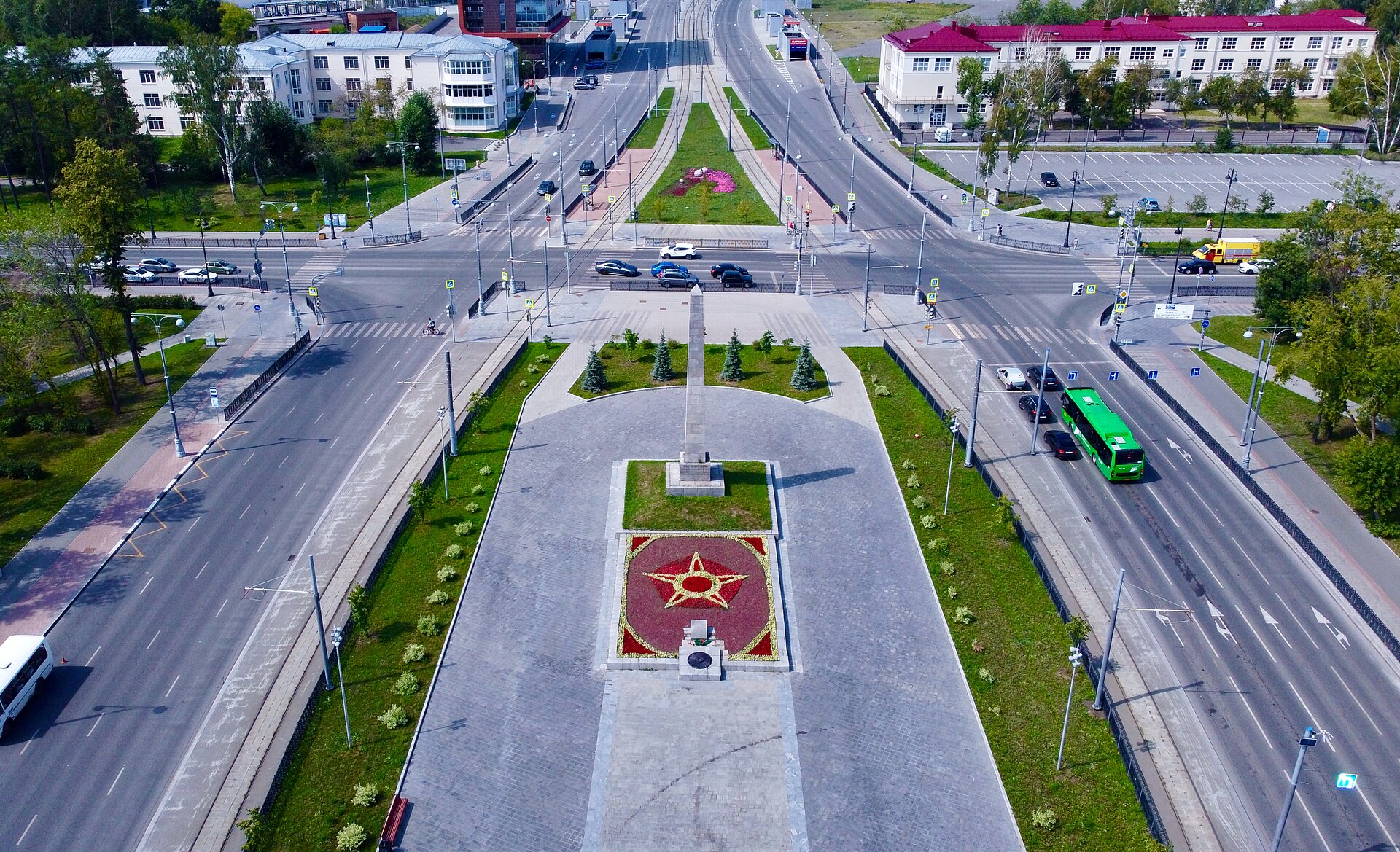
The Memorial of Glory in Uralsk is one of those quiet places where the past lingers without demanding attention. Perched on a gentle rise, it overlooks the city from a distance, its dark granite silhouette standing out against the trees that surround it. On clear days, sunlight catches the polished stone, softening its severity, while the paths leading to the central stele remain empty more often than not. There are no grand speeches here, no forced solemnity—just the names of those who never returned, carved into the wall, and the occasional visitor sitting on a bench, lost in thought.
Uralsk, like many Soviet-era cities, built its war memorial in the decades following the Great Patriotic War, when the scale of loss was still fresh in collective memory. Thousands from the West Kazakhstan region had left for the front, and many never came back. The memorial was unveiled in the 1970s, a time when such monuments were becoming a standard feature of urban landscapes across the USSR. Over the years, it has settled into the city’s rhythm, hosting official ceremonies on Victory Day and serving as a backdrop for schoolchildren learning about the war. But beyond the formalities, it remains a place where people come to remember in their own way.
The design is unadorned, almost austere. The central stele, made of dark granite, bears an inscription about eternal memory, its letters worn smooth by time. The wall beside it lists the names of the fallen, arranged without fanfare—just rows of surnames, some familiar to locals, others known only to those who pause to read them. The surrounding park is simple: well-kept lawns, flowerbeds that bloom in summer, and trees that cast long shadows in the evening. In winter, snow dusts the memorial, muting its edges and making the place feel even more still, as if the outside world moves at a different pace here.
Uralsk itself is a city of contrasts, where old brick buildings stand alongside Soviet-era apartment blocks and newer developments. The memorial sits near the center, not far from the Chagan River, which winds through the city. The location isn’t remote—people pass by on their way to work, or stop to walk their dogs, or simply sit by the water. The memorial isn’t cut off from daily life; it’s woven into it, a quiet presence that doesn’t demand reverence but earns it over time.
For many in Uralsk, the Memorial of Glory is more than a monument. It’s where veterans gather on May 9th, where families bring flowers on anniversaries, and where older residents sometimes come alone, tracing their fingers over names they recognize. Younger generations, who never knew the war firsthand, visit too, though their reasons are different. Some come out of curiosity, others out of a sense of duty, but most leave with a quieter understanding of what the place represents. It’s not just about the war—it’s about how memory binds people together, how history seeps into the present whether we notice it or not.
In recent years, the memorial has seen small changes. A eternal flame was added, lit on holidays, and the paths have been repaved. But the core of the place remains unchanged. There are no crowds here, no tour groups snapping photos. Mostly, it’s individuals—an elderly man walking slowly along the wall, a mother pointing out names to her child, a student sitting on a bench with a book, glancing up now and then. The atmosphere isn’t somber so much as reflective, a space where people can confront the past without being overwhelmed by it.
What makes the Memorial of Glory different from other war monuments is its lack of grandeur. There are no towering statues, no dramatic sculptures, no sweeping narratives about heroism. Instead, it offers something more personal: a chance to stand in silence, to read a name, to feel the weight of what was lost. It doesn’t tell visitors how to feel; it simply gives them room to feel whatever they need to.
Uralsk is a city with a long history, shaped by trade, migration, and the slow passage of time. The memorial fits into that history naturally, not as a relic of the past but as a living part of it. It reminds those who pass by that war wasn’t something distant—it happened here, to people who walked these same streets, who lived in these same houses. And while the world around it changes, the memorial endures, a quiet witness to both loss and resilience.
In the end, the Memorial of Glory isn’t just about remembering the dead. It’s about how a city carries its history forward, how it honors the past without letting it overshadow the present. It’s a place where the weight of memory is felt, but not forced—a rare kind of monument, one that doesn’t impose meaning but lets it emerge on its own.