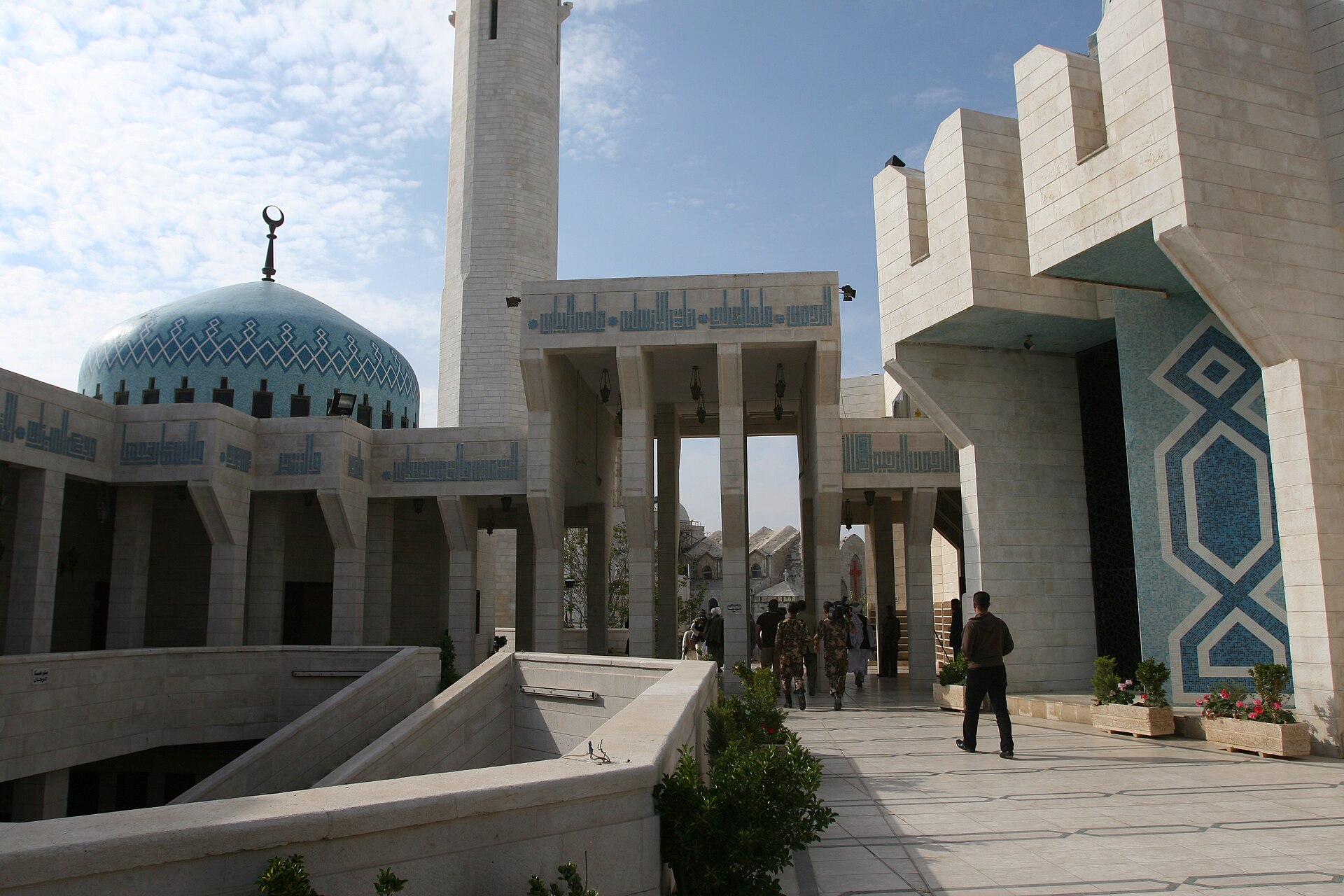
Perched on one of Amman’s central hills, the King Abdullah I Mosque stands out against the city’s skyline with its striking blue dome—a landmark that has become synonymous with the Jordanian capital. Built between 1982 and 1989, the mosque was conceived as a tribute to Abdullah I, the nation’s first monarch and a pivotal figure in Jordan’s modern history. More than just a place of worship, it was designed to embody the country’s unity and progress, blending traditional Islamic architecture with contemporary engineering. The result is a structure that feels both timeless and distinctly of its era, a quiet statement of national identity in a city where ancient ruins and modern buildings coexist.
The mosque’s most iconic feature is its vast dome, nearly thirty meters in diameter, covered in shimmering blue mosaic tiles that catch the light at different angles throughout the day. On clear mornings, the dome seems to glow, while in the late afternoon, it casts long shadows across the surrounding park. Inside, the space is expansive and luminous, with high columns and intricate carvings that draw the eye upward. The prayer hall can accommodate up to seven thousand worshippers, making it one of the largest mosques in Jordan. The design prioritizes openness, with natural light filtering through arched windows and reflecting off the polished marble floors, creating an atmosphere of serenity.
Architecturally, the mosque pays homage to classical Islamic styles while incorporating modern innovations. The exterior is adorned with geometric patterns and Arabic calligraphy, a nod to centuries-old traditions, while the minarets rise gracefully above the city, serving as both a spiritual beacon and a visual anchor. The structure was built to withstand Jordan’s seismic activity, a practical consideration that doesn’t detract from its elegance. Inside, the details continue to impress: handwoven carpets from across the country cover the floors, and ornate chandeliers hang from the ceiling, their designs echoing the craftsmanship of earlier eras.
Beyond its religious significance, the King Abdullah I Mosque serves as a cultural and educational space. Unlike many mosques that restrict access to non-Muslims, this one welcomes visitors outside of prayer times, offering a rare opportunity to explore Islamic architecture and learn about Jordan’s history. Guided tours provide context, explaining the symbolism behind the designs and the role of the mosque in the community. Visitors are asked to dress modestly—women are encouraged to cover their heads and shoulders—and to maintain a respectful silence, especially during prayer. These guidelines aren’t just about etiquette; they reflect the mosque’s dual role as both a sacred space and a place of hospitality.
The mosque’s story is deeply intertwined with that of King Abdullah I, whose leadership shaped modern Jordan. After World War I, he played a crucial role in the country’s push for independence, becoming its first monarch in 1946. His reign was marked by efforts to modernize Jordan while preserving its cultural heritage, a balance that the mosque itself embodies. Named in his honor, the building is more than a memorial; it’s a living testament to the ideals he championed. The surrounding area reinforces this connection to history, with the mosque situated near Amman’s Citadel and Roman Theater, two sites that trace the city’s layers of civilization.
Amman is a city of contrasts, where the past and present often collide in unexpected ways. The King Abdullah I Mosque acts as a bridge between these worlds, its blue dome visible from many parts of the city. The mosque’s hilltop location makes it a natural starting point for exploring the capital, with the nearby park offering a quiet respite from the urban bustle. Locals often gather here, whether for prayer, conversation, or simply to enjoy the view. The park’s shaded paths and benches make it a popular spot for families, while the mosque’s courtyard attracts those looking for a moment of reflection.
Visiting the mosque offers more than just a chance to admire its architecture; it’s an opportunity to observe the rhythms of daily life in Amman. On any given day, you might see worshippers arriving for prayers, children playing in the park, or tourists snapping photos of the dome against the cityscape. The mosque’s presence is felt in small, everyday moments—the call to prayer echoing through the streets, the way the light shifts across its walls as the sun moves. Even for those who aren’t religious, the space exudes a sense of calm, a reminder of the quiet beauty that can be found in the midst of a busy city.
The mosque’s appearance changes with the seasons. In winter, the dome can appear muted under a soft haze, while in summer, it gleams under the intense Middle Eastern sun. At night, when the exterior lights are turned on, the building takes on a different character, its outlines sharp against the dark sky. For many Ammanis, the mosque is more than just a landmark; it’s a part of their daily lives, a place where they come not only to pray but to connect with their community. Whether it’s a student taking a break from studies in the park or an elderly man pausing to rest on a bench, the mosque and its surroundings serve as a gathering point for people from all walks of life.
Ultimately, the King Abdullah I Mosque is more than a tourist attraction or a religious site—it’s a living piece of Jordan’s identity. In a world where cities are constantly evolving, it stands as a reminder of the importance of preserving cultural heritage while embracing the future. A visit here offers a glimpse into the country’s soul, from its architectural traditions to the values that shape its society. Whether you’re drawn by the history, the artistry, or simply the chance to experience a different side of Amman, the mosque leaves an impression that lingers long after you’ve walked away. It’s a place where the past feels present, and where the spirit of the city reveals itself in quiet, unexpected ways.