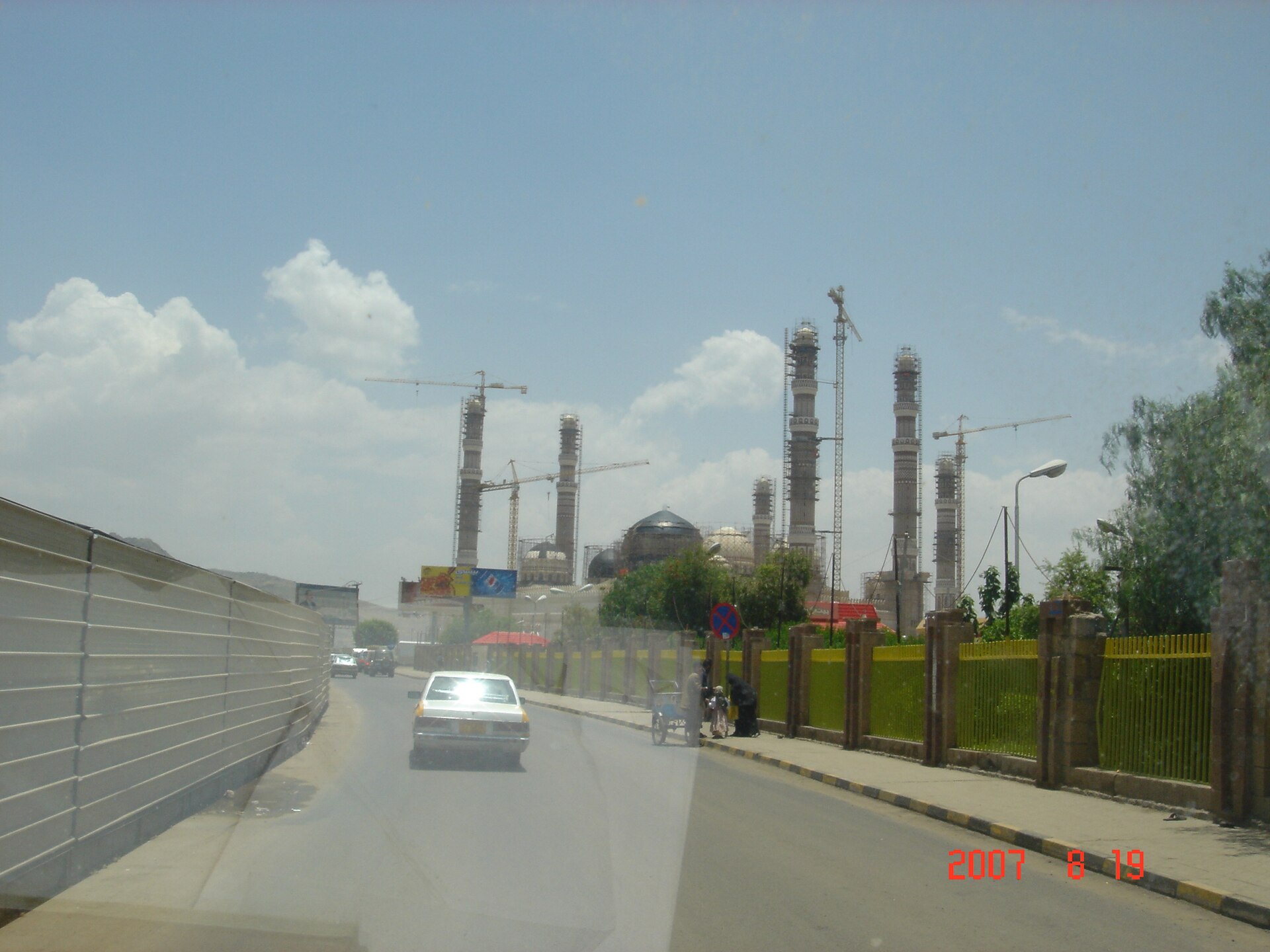
Sanaa’s skyline has long been defined by its ancient tower houses and the delicate minarets of centuries-old mosques, but in recent decades, a new silhouette has emerged—one that commands attention without overshadowing the city’s heritage. The Al-Saleh Mosque, completed in 2008, stands as one of Yemen’s most ambitious modern architectural projects, a place where tradition and contemporary design intersect in unexpected ways. Unlike the low-slung, mud-brick structures that dominate the old city, this mosque rises with a sense of grandeur, its white domes and towering minarets visible from nearly every corner of the capital. Yet despite its size and prominence, it feels less like an imposition and more like a natural evolution of Sanaa’s spiritual landscape.
The mosque was commissioned by Yemen’s former president, Ali Abdullah Saleh, whose name it now bears, and its construction was part of a broader effort to modernize the capital while reinforcing its Islamic identity. The scale of the project was immense, requiring years of planning and labor, and the result is a space that accommodates up to 44,000 worshippers—one of the largest capacities in the country. The design blends elements of Yemeni architectural tradition with influences from across the Islamic world, creating a structure that feels both familiar and novel. The central dome, for instance, echoes the forms of historic Yemeni mosques, while the intricate geometric patterns and calligraphic inscriptions draw from broader Islamic artistic traditions.
Stepping inside, the first impression is one of vastness. The prayer hall stretches out beneath a soaring ceiling, its space uncluttered by the columns that often break up the interiors of older mosques. Natural light filters through stained-glass windows, casting colored patterns across the marble floors, while the mihrab—the niche indicating the direction of Mecca—is framed by elaborate tilework in deep blues and golds. The acoustics are carefully calibrated; even when the mosque is full, the imam’s voice carries clearly without the need for amplification. This attention to detail reflects a broader philosophy: that modernity should serve faith, not overshadow it.
The mosque’s exterior is equally striking, though in a more restrained way. The white stone facade gleams under the Yemeni sun, its clean lines contrasting with the weathered textures of the old city nearby. Four minarets, each over 100 meters tall, rise from the corners of the complex, their height making them visible from miles away. At night, they are illuminated, transforming the mosque into a beacon in the heart of Sanaa. The surrounding plaza, paved with local stone, provides a gathering space for worshippers and visitors alike, though its scale can feel overwhelming when the crowds thin out.
What makes the Al-Saleh Mosque particularly interesting is how it fits—or sometimes doesn’t—into the fabric of Sanaa. The city’s historic center, a UNESCO World Heritage site, is a maze of narrow alleys and multi-story tower houses, their facades adorned with intricate qamariya windows and white gypsum decorations. The mosque, by contrast, sits on the edge of this labyrinth, its wide avenues and open spaces a world away from the intimacy of the old city. Some locals see it as a symbol of progress, a necessary counterpoint to the crumbling infrastructure of Sanaa’s past. Others view it with ambivalence, noting that its grandeur stands in stark contrast to the struggles of a country plagued by conflict and economic hardship.
The mosque’s role in the community extends beyond worship. It houses a library, a Quranic school, and spaces for cultural events, making it a hub for education and social gatherings. During Ramadan, the plaza fills with families breaking their fast, while the mosque’s halls host lectures and religious discussions. Yet its significance is not just local. The Al-Saleh Mosque has become a point of reference for Yemen’s place in the Islamic world, a statement of the country’s enduring faith despite its challenges. Pilgrims and scholars from across the region visit, drawn by its reputation as a center of learning and devotion.
Architecturally, the mosque is a study in contrasts. The use of modern materials—reinforced concrete, steel, and imported marble—sits alongside traditional craftsmanship, such as the hand-carved wooden screens and the locally sourced stone. The result is a building that feels both timeless and of its time. The domes, for example, are not the shallow, hemispherical forms of Ottoman mosques but deeper, more elongated structures that recall the architecture of Yemen’s highlands. The minarets, too, are a fusion: their height and slender proportions are modern, but their decorative bands echo the patterns found on the minarets of Sanaa’s Great Mosque, which dates back to the 8th century.
Visiting the Al-Saleh Mosque is not just about admiring its architecture or its scale. It’s about understanding how a place like this comes to exist in a city as layered as Sanaa. The mosque is a product of its era—a time when Yemen was seeking to assert its identity on the world stage, even as it grappled with internal divisions. It is also a reminder of the resilience of faith in a country that has seen more than its share of turmoil. Whether you come to pray, to study, or simply to observe, the mosque offers a space for reflection, both on the history of Yemen and on the role of religion in shaping its future.
For those who take the time to explore beyond the main prayer hall, the mosque reveals smaller, more intimate details. The women’s prayer area, for instance, is tucked away on an upper level, its design just as thoughtful as the men’s space below. The courtyards, shaded by palm trees, provide a quiet retreat from the bustle of the city. And the calligraphy that adorns the walls—verses from the Quran rendered in elegant Arabic script—serves as a reminder of the mosque’s primary purpose: to inspire and uplift. In a city where the past and present are often at odds, the Al-Saleh Mosque stands as a bridge between the two, a place where tradition and modernity coexist, if not always seamlessly.