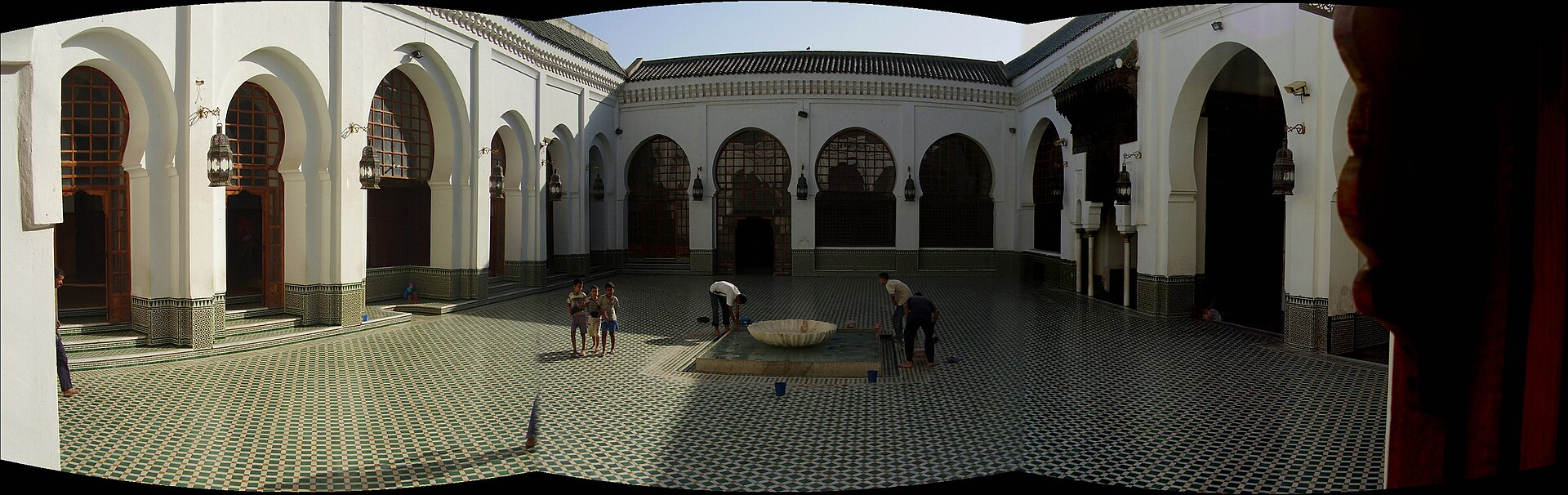
Al-Andalus Mosque in Fez is one of those rare places that feels untouched by time. Tucked away in the labyrinth of the medina’s narrow streets, it stands as a quiet witness to centuries of history, where the pace of life slows to the rhythm of another era. Built in the 9th century, when Fez was the heart of Morocco and a beacon of Islamic scholarship, the mosque is more than just a place of worship—it’s a fragment of a world where knowledge, faith, and daily life intertwined seamlessly.
The architecture here carries the unmistakable influence of Al-Andalus, the Muslim-ruled Iberia that once stretched across modern-day Spain and Portugal. Refugees fleeing the Reconquista brought with them a style that blended Islamic artistry with the craftsmanship of the Mediterranean. The mosque itself is modest in size compared to Fez’s grander religious sites, but its elegance lies in its proportions. The mihrab, adorned with intricate stucco carvings and zellige tiles, is a masterpiece of medieval design, while the wooden ceiling, patterned with geometric motifs, seems to echo the hands of long-gone artisans. The central courtyard, with its ablution fountain, offers a moment of cool respite from the North African sun, its stillness broken only by the murmur of water and the occasional footsteps of worshippers.
Fez has always been a city of layers, where cultures and traditions have overlapped for centuries. In its golden age, Muslims, Christians, and Jews lived side by side, and places like Al-Andalus Mosque were not just spiritual centers but hubs of learning. Scholars gathered here to debate theology, astronomy, and medicine, their voices lingering in the air long after the discussions ended. Today, stepping into the mosque’s courtyard, you can almost hear the echoes of those conversations—the same ones that once filled the city’s madrasas and libraries. It’s a reminder that Fez was never just a political capital; it was an intellectual one, where ideas flowed as freely as the water in its fountains.
What makes Al-Andalus Mosque special is its lack of tourist crowds. Unlike the more famous mosques of Morocco, it remains a place where locals come to pray, reflect, and connect. Between prayers, men sit on the stone benches in the courtyard, chatting or resting, while children dart around the fountain and elderly worshippers recite the Quran under the shade of the arches. The scene is timeless, unchanged in its essence for generations. There’s no performance here, no curated experience—just the quiet, unhurried rhythm of life in the medina.
From the outside, the mosque is unassuming. Its low walls of earthen brick, green-tiled roof, and slender minaret blend into the surrounding neighborhood, standing out only because of its spiritual significance. In a city where grand mosques like the Karaouine dominate the skyline, Al-Andalus feels intimate, almost secret. Yet that’s where its charm lies. The beauty here isn’t in scale or opulence but in the details—the delicate tracery on the doors, the way light filters through the latticework, the faint scent of incense that drifts from within. It’s a place that rewards those who take the time to look closely.
The mosque sits in a part of Fez that was once home to Andalusian refugees, and the neighborhood still bears their imprint. The houses here share the same architectural language as those in Córdoba or Granada, with inner courtyards, carved wooden balconies, and wrought-iron grilles. Wandering the nearby streets, you’ll stumble upon small workshops where artisans shape clay into pottery or embroider fabrics by hand, just as they have for centuries. The area feels like an open-air museum, where every alleyway tells a story of migration, adaptation, and resilience.
Al-Andalus Mosque isn’t the kind of place you’ll find on most tourist itineraries, and that’s precisely why it’s worth visiting. There are no rigid rules for visitors, but a little respect goes a long way. It’s best to come outside of prayer times and dress modestly, covering shoulders and knees. If you’re lucky, you might hear the call to prayer echoing from the minaret, a sound that carries over the rooftops of the medina like a thread connecting past and present. That moment alone can make the visit unforgettable.
Time moves differently here. There’s no need to rush, no pressure to capture every detail on camera. Just sitting on one of the courtyard benches, listening to the water in the fountain and watching the sunlight shift across the walls, is enough. In those quiet moments, you begin to understand why Fez is called Morocco’s spiritual capital. It’s not just about the city’s age or its monuments; it’s about the way history lingers in the air, how the present and the past coexist without conflict. And sometimes, the smallest places—like this unassuming mosque—hold the deepest stories.