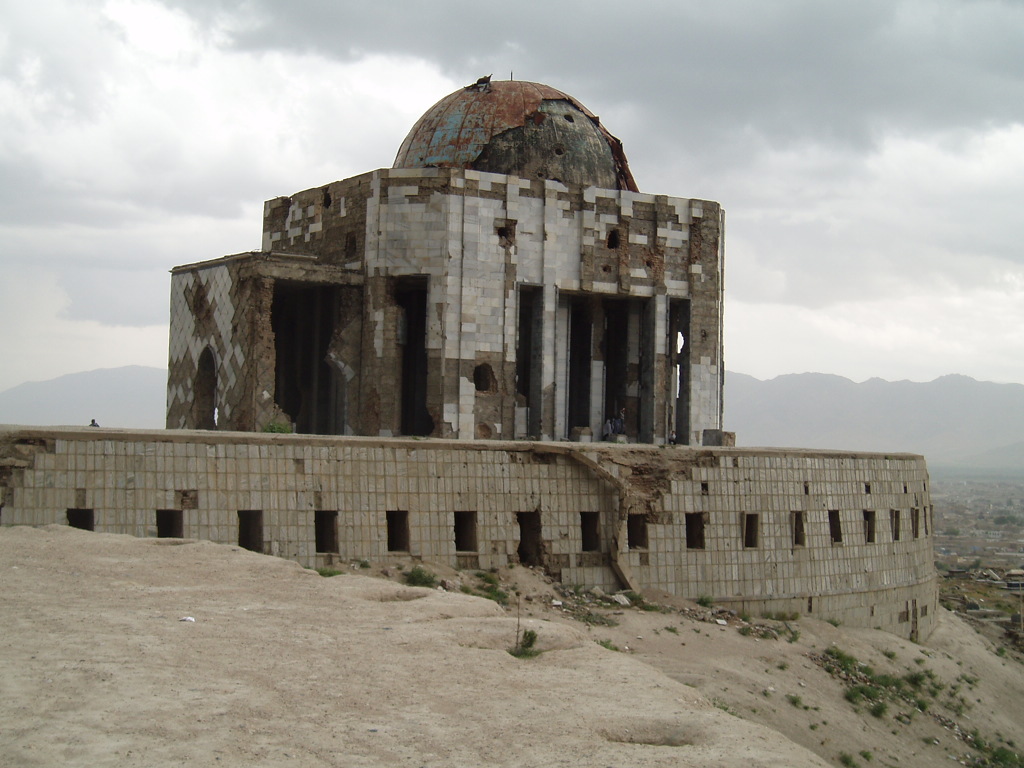
The Mausoleum of Nadir Shah stands quietly in the heart of Kabul, a modest yet striking monument to one of Afghanistan’s most complex historical figures. Built in the mid-20th century, it houses the remains of Mohammad Nadir Shah, the king who ruled Afghanistan from 1929 until his assassination in 1933. The structure itself is unassuming compared to the grand mausoleums of other regions, but its significance lies not in its scale, but in the turbulent era it represents—a time when Afghanistan was navigating the tensions between tradition and modernity, stability and upheaval.
The mausoleum is a simple, square building with a domed roof, constructed from pale stone that blends into the cityscape. Its architecture reflects a blend of traditional Afghan styles with subtle modernist influences, a nod to the period in which it was built. The dome, a common feature in Islamic funerary architecture, rises gently above the surrounding walls, while the entrance is marked by a small portico supported by slender columns. Inside, the space is sparse, with the tomb itself covered in a green cloth, a color often associated with reverence in Islamic culture. The simplicity of the design feels deliberate, as if to emphasize the weight of history over ornate decoration.
Nadir Shah’s reign was brief but pivotal. He came to power after a period of violent unrest, following the fall of Amanullah Khan, whose ambitious reforms had alienated conservative factions. Nadir Shah, a former general, restored a degree of stability, though his rule was marked by political repression and the suppression of dissent. His assassination in 1933, during a school ceremony, shocked the nation and set the stage for the long reign of his son, Zahir Shah. The mausoleum, therefore, is not just a resting place but a symbol of an era when Afghanistan was still defining its path forward.
Visitors to the mausoleum today will find it situated in a quiet part of Kabul, away from the bustle of the city’s main thoroughfares. The surrounding area is unremarkable, with a mix of residential buildings and small shops, but the site itself carries a sense of solemnity. There are no grand ceremonies or crowds here; instead, it feels like a place where history is quietly observed. The mausoleum is not a major tourist attraction, and those who come are often locals paying their respects or travelers with a keen interest in Afghanistan’s past.
The atmosphere inside is one of quiet reflection. The tomb is well-maintained, though the space is small and unadorned beyond the essentials. There are no elaborate carvings or inscriptions, just the simple markers of a burial site. For those familiar with Afghan history, the mausoleum offers a moment to consider the legacy of Nadir Shah—a ruler who brought stability at a cost, whose death left a lasting impact on the country’s political trajectory. His reign was a bridge between the reformist ambitions of Amanullah Khan and the more cautious, conservative rule of his successors.
The mausoleum also serves as a reminder of how Afghanistan’s history is often overshadowed by more recent conflicts. In a city that has seen decades of war and upheaval, places like this offer a connection to an earlier time, when Kabul was a different kind of capital—one still grappling with its identity but not yet consumed by the violence that would later define it. The site is not a destination for those seeking grand monuments or dramatic stories, but for those who appreciate the quiet weight of history, it holds a certain resonance.
For Afghans, the mausoleum is part of a broader narrative about their country’s past. Nadir Shah’s rule, though controversial, is remembered as a period of relative calm after years of chaos. His policies, which included the reversal of some of Amanullah Khan’s reforms, were seen by some as necessary pragmatism and by others as a betrayal of progress. The mausoleum, in its understated way, encapsulates these contradictions—a place where history is neither celebrated nor condemned, but simply acknowledged.
The surrounding neighborhood has changed little over the decades, and the mausoleum remains a fixed point in a city that has otherwise transformed dramatically. It is not a place that demands attention, but for those who take the time to visit, it offers a glimpse into a chapter of Afghan history that is often overlooked. In a country where the past is frequently overshadowed by the present, the Mausoleum of Nadir Shah stands as a quiet testament to the complexities of leadership, legacy, and the enduring weight of history.