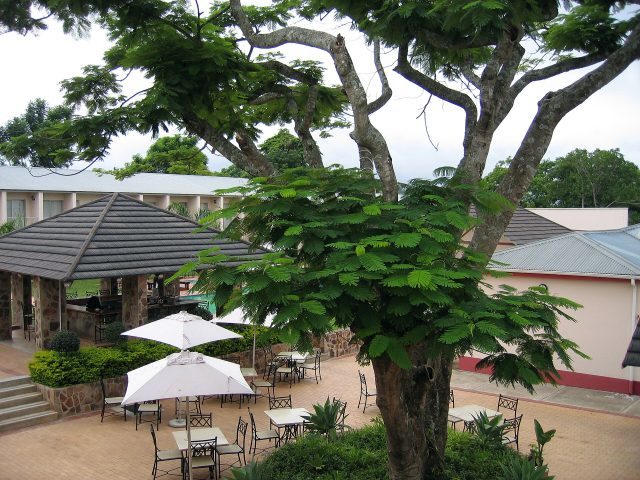
Manzini Town Hall stands in the heart of Eswatini, where the country’s past and present meet. Built in the mid-20th century, when Eswatini was Swaziland under British protection, the building arrived as Manzini grew into a commercial and transport hub. The town needed a center for local governance—somewhere to make decisions and gather for both official business and everyday conversations. The Town Hall became that place.
The architecture shows the era’s mix. Colonial influence appears in the clean lines, symmetrical facades, and high ceilings meant to cool the air. Yet the building also feels local: practical, unpretentious, made from materials tied to the land. It doesn’t stand out, but it fits here, in this city, not some idealized version of a government building. Inside, offices remain functional, where the work of running the city continues, though most people never see beyond the doors.
The square in front makes the Town Hall more than just an administrative building. On any day, you might see vendors setting up stalls, children playing under the trees, or groups debating the latest news. During festivals or national holidays, the area changes—music plays, food stalls appear, and the scent of traditional dishes fills the air. This is where the official and the informal mix, where the town’s rhythms unfold in real time.
Manzini differs from the capital, Mbabane, where government offices and diplomatic missions dominate. Here, life spills onto the streets—no luxury hotels or conventional tourist attractions. The Town Hall anchors this landscape, a reminder that even in a small country, every city has its own story. It’s not a place you’d travel far to see, but if you’re in Manzini, it offers a glimpse of the city’s character, shaped by trade, movement, and daily interactions.
Walk a few blocks from the Town Hall, and the city’s layers appear. Nearby, market stalls sell fabrics and hand-carved wooden crafts, while small cafés serve strong local coffee and flatbreads. The streets hum with activity, a mix of old and new. The Town Hall is the heart of this, a point where the city’s energy spreads outward. You wouldn’t linger for hours, but it makes you pause and notice how Manzini fits together.
Historically, the building has seen changes. When Eswatini gained independence in 1968, many institutions moved to Mbabane, but Manzini kept its economic role. The Town Hall stood through these shifts, witnessing decisions about infrastructure, trade, and local development. At one point, there was talk of relocating some government functions here, though Mbabane remained the capital. The building’s endurance reflects Manzini’s resilience—a city that adapted without losing its identity.
For travelers, the Town Hall isn’t a typical destination. You won’t find it in guidebooks or must-see lists. But if you wander into Manzini, it can be a starting point. Here, you might see elders debating under a tree or a vendor arranging goods as the morning sun rises. It’s a reminder that Eswatini isn’t just about wildlife reserves and royal ceremonies—it’s also about the people who live here, going about their days.
The Town Hall’s value isn’t in grandeur or history, but in how it reflects Manzini’s spirit. It’s where the formal and informal coexist, where the past is visible in the architecture but the present plays out in the square. For those who want to see Eswatini beyond the usual trail, it offers a small but real insight. The most revealing places aren’t always the ones that try to impress—they’re the ones where life simply happens. The Town Hall is one of those places.