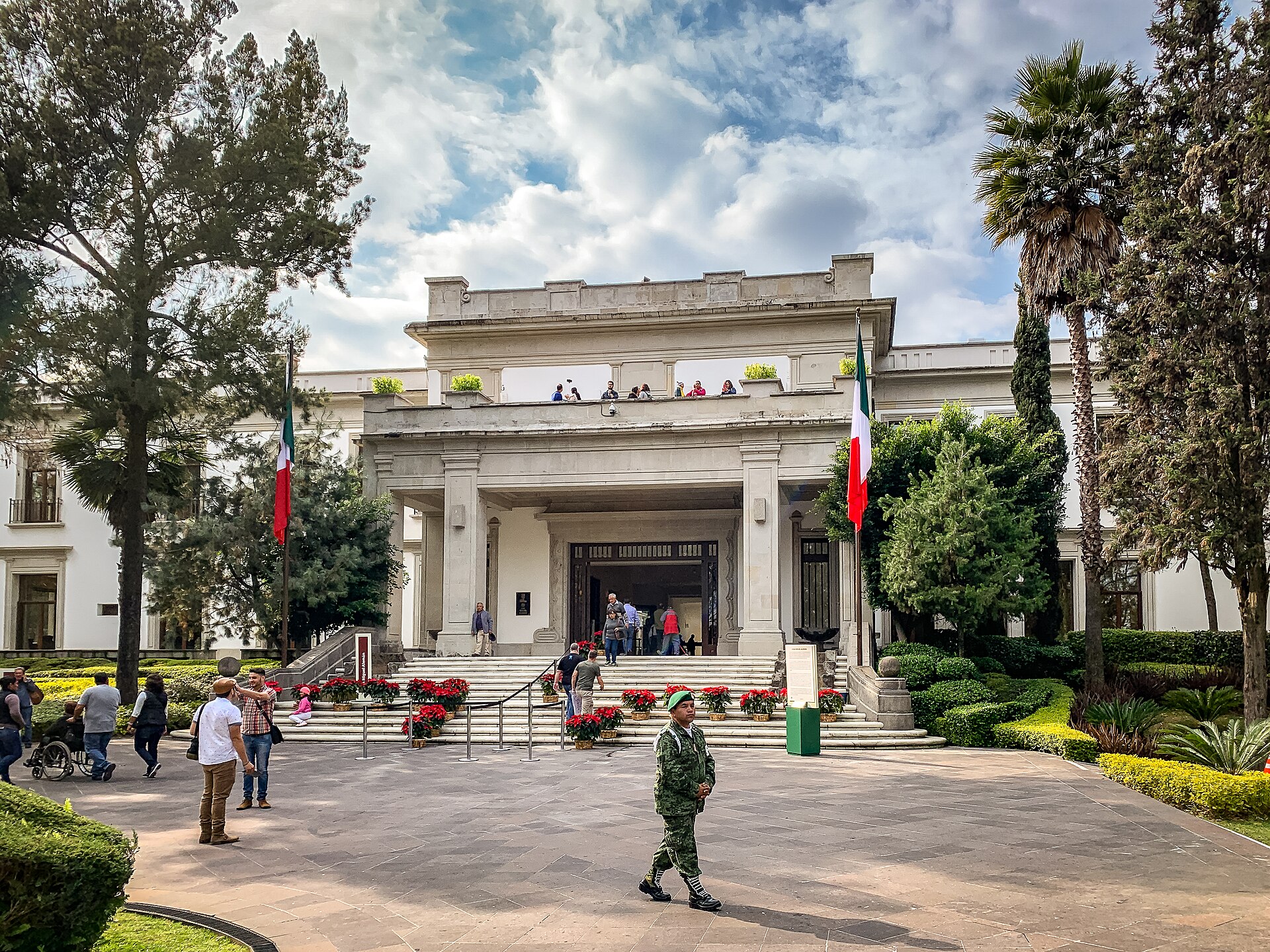
Los Pinos is one of those places in Mexico City that feels like a quiet secret tucked inside a city of twenty million people. For decades, it was hidden behind high walls and guarded gates, known only as the official residence of Mexico’s presidents. Now, it’s open to anyone who wants to walk its paths, explore its buildings, or simply sit under the shade of its old trees. The change is striking—not just in the way the space is used, but in what it represents. Here, the weight of political history meets the everyday life of the city, and the result is something far more interesting than a typical museum or park.
The story of Los Pinos begins in the 1930s, when President Lázaro Cárdenas decided to move the presidential residence out of the National Palace. He chose this spot in Chapultepec Forest, a place that had once been a private estate before passing through the hands of colonial landowners. Cárdenas, known for his modest lifestyle, rejected the idea of a grand palace. Instead, he picked a simple house, one that reflected his vision of a government closer to the people. That house, along with the land around it, became Los Pinos—a name that would come to symbolize the power and decisions shaping Mexico for nearly eighty years.
The architecture of the complex tells its own story, one of shifting tastes and priorities. The main building, Casa Miguel Alemán, was built in the mid-20th century with clean lines and a no-nonsense design, a reflection of the era’s focus on functionality. This was where presidents held press conferences, met foreign dignitaries, and made announcements that would ripple across the country. Nearby stands Casa Lázaro Cárdenas, the older residence, which feels more like a home than a seat of power. Its rooms and furnishings have been preserved, offering a glimpse into a time when Mexico was still finding its footing as a modern nation. The contrast between the two buildings is subtle but telling—one built for show, the other for living.
When Andrés Manuel López Obrador took office in 2018, he made a decision that surprised many: he would not live in Los Pinos. Instead, he opened the gates to the public, turning the former presidential residence into a cultural space. The move was symbolic, a break from the past and a nod to transparency. Almost overnight, a place that had been synonymous with secrecy became a venue for art exhibitions, concerts, and public debates. Visitors can now wander through the rooms where presidents once worked, see their personal belongings, and even browse a small museum dedicated to the history of the complex. The change wasn’t just about access—it was about redefining what this place could mean to Mexicans.
One of the most intriguing parts of Los Pinos is the former presidential library. For years, it held rare books, documents, and archives that chronicled Mexico’s 20th-century history. Now, it’s open to researchers and curious visitors alike. The collection includes everything from official correspondence to personal diaries, offering a rare look at the private thoughts and public decisions of the country’s leaders. For historians, it’s a treasure trove. For everyone else, it’s a chance to see history not as a series of dates and events, but as something lived and breathed by real people.
The park surrounding the buildings is just as much a part of Los Pinos as the structures themselves. It’s a green expanse in the middle of one of the world’s largest cities, filled with oak, pine, and eucalyptus trees, some of which have stood here for nearly a century. The paths wind past fountains and benches, offering a quiet escape from the noise of the streets just beyond the walls. On weekends, families come to picnic, students read under the trees, and musicians set up in the open spaces. In the summer, outdoor film screenings draw crowds, while winter brings holiday markets and festivals. The atmosphere is peaceful, almost hard to believe given how close it is to the chaos of downtown.
What makes Los Pinos special isn’t just its history or its architecture, but the way it bridges the past and present. Walking through its grounds, you can see how Mexico’s ideas about power have evolved—from the revolutionary ideals of Cárdenas to the more recent push for openness and accountability. For many Mexicans, the transformation of Los Pinos is a symbol of change, a reminder that institutions once seen as untouchable can become places for everyone. It’s not just a tourist attraction; it’s a living part of the city, one that continues to adapt and reflect the country’s shifting identity.
Today, Los Pinos is still finding its rhythm as a public space. Some days, it feels like a museum, with visitors carefully reading plaques and taking photos. Other days, it’s more like a community center, with workshops, lectures, and performances filling the air. There are exhibitions on human rights, discussions about indigenous cultures, and even art installations in the former presidential quarters. The park hosts everything from yoga classes to book fairs, making it a place where different generations and backgrounds intersect. It’s this mix of the official and the everyday that gives Los Pinos its unique character.
If you visit, don’t rush. Take time to sit on one of the benches and watch the city move around you. Listen to the rustle of the trees, the laughter of children playing, the distant hum of traffic. Los Pinos is more than a collection of buildings or a patch of green—it’s a place where history feels alive, where the past isn’t just remembered but reimagined. And in a city as vast and complex as Mexico City, that’s something worth experiencing.