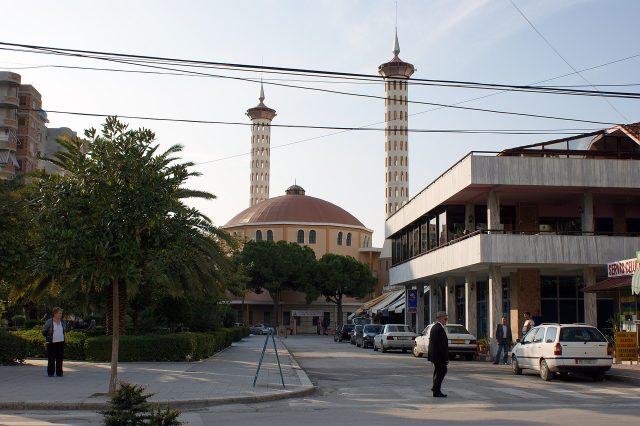
Fier’s Cultural Center is one of those places that doesn’t announce itself loudly, yet quietly holds the story of a city in its walls. Built in the mid-20th century, when Fier was transitioning from a small settlement into an industrial hub of Albania, the building was among the first in the region to blend administrative functions with cultural life. It wasn’t just an office or a hall—it was a statement, a sign of the changes sweeping through the country, even if those changes weren’t always smooth. The architecture reflects that era: practical, unadorned, with clean lines and large windows that let in light but don’t demand attention. There’s no grand facade or marble staircase here, just a space designed to be useful, adaptable—a place where exhibitions, concerts, and discussions can happen without pretension.
Inside, the center feels like a living archive of the city. The walls are lined with photographs that capture Fier across the decades: streets lined with low, tiled-roof houses, the first factories rising on the outskirts, crowds gathered for protests or celebrations. These images aren’t polished or romanticized; they show the city as it was, with all its struggles and small triumphs. For many locals, these photos aren’t just historical records—they’re personal memories, fragments of family stories passed down through generations. The center doesn’t try to curate a perfect narrative; it lets the past speak for itself, even when that past is messy.
The programming here is varied but never random. There are exhibitions of contemporary Albanian artists, concerts by local musicians, and readings by poets and writers. Sometimes, the center screens old films or documentaries about the region, offering a glimpse into how Fier has changed—or stayed the same—over time. Educational projects play a big role, too: workshops on traditional crafts, lectures on local history, and discussions about ethnography. What’s striking is how accessible it all feels. Most events are free, and there’s no sense that culture here is something reserved for an elite. It’s not about impressing visitors or ticking boxes; it’s about keeping culture alive in a way that feels natural, even necessary, to the people who call Fier home.
Fier isn’t a tourist destination, and the center doesn’t try to be one. It exists first and foremost for the city’s residents, and that’s evident in the atmosphere. There’s no rush, no forced hospitality, no attempt to cater to outsiders. People come because they want to—whether it’s a group of schoolchildren on a field trip, an elderly couple lingering over old photographs, or young people attending a concert by a band they’ve never heard of. The center doesn’t need to be flashy; it just needs to be there, a place where the city’s stories can unfold without pressure.
The building itself is easy to miss if you don’t know where to look. It sits on one of Fier’s central streets, flanked by shops, cafes, and apartment blocks. There’s no grand plaza out front, no ornate entrance—just a door that leads into a space that feels like an extension of the city itself. That unassuming quality is part of its charm. The center doesn’t try to be monumental or imposing; it’s content to be what it is—a place where culture isn’t something distant or untouchable, but a part of everyday life.
Like many cultural institutions in smaller cities, the center faces its share of challenges. Funding isn’t always reliable, the building requires upkeep, and younger generations don’t always engage with traditional forms of culture in the way older residents might hope. But rather than resisting change, the center adapts. New formats emerge—digital archives, collaborations with schools, events that blend old and new. The goal isn’t to preserve the past in amber, but to keep it relevant, to show that history isn’t just something that happened long ago, but something that continues to shape the present.
For visitors, the center offers a different kind of experience than the usual tourist attractions. There are no glossy brochures or souvenir stands, just the chance to see Fier through the eyes of those who live here. You might wander into an exhibition, overhear conversations in the foyer, or flip through old newspapers in the reading room. It’s not a place for grand gestures or picture-perfect moments, but that’s precisely why it resonates. Here, culture isn’t performed—it’s lived, in all its imperfect, evolving reality.
What makes Fier’s Cultural Center special isn’t any single event or artifact, but the way it bridges the gap between past and present. There are no masterpieces here, no priceless relics—just the quiet, persistent work of keeping a city’s memory alive. It’s a place where culture isn’t something you observe from a distance, but something you can touch, discuss over coffee, or pass on to the next generation. In a world where so much feels curated and staged, that authenticity is rare—and all the more valuable for it.