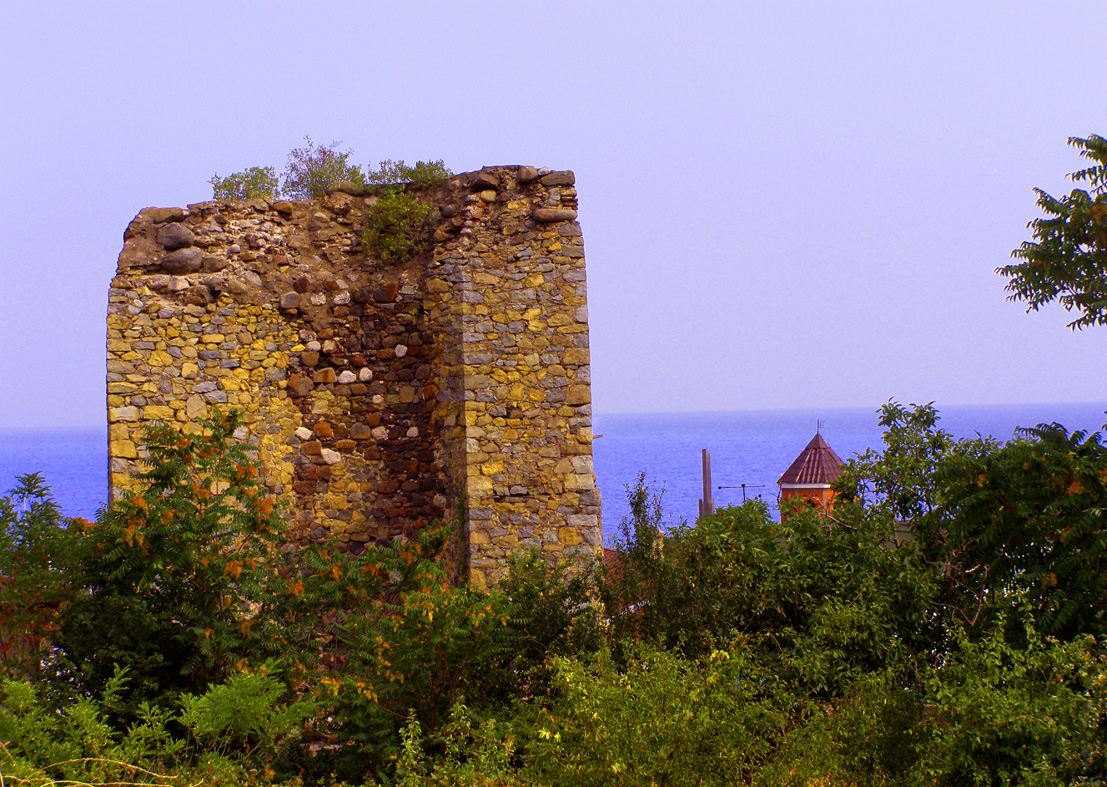
Aluston Fortress sits on a hill in Alushta. The climb up the uneven steps is short, but the view from the top makes it worth it: the sea stretches to the horizon, the town spreads below, and the air feels thick with time. There are no grand reconstructions here, no polished displays. Just stones and silence.
The fortress through the ages
Aluston was built in the 6th century under Byzantine Emperor Justinian I. It was small but strategically placed, guarding Crimea’s southern coast where mountains meet the sea. From its hilltop, sentries could spot threats on the plains and monitor coastal routes. The walls were thick, the towers sturdy, and the moat deep. For a while, it was a key part of Byzantium’s Crimean defenses. Today, little of that era remains.
The Genoese took over in the 13th century, reinforcing the walls and adding new towers. They turned Aluston into a trade and military hub. You can still see their influence in the square towers with narrow arrow slits. But by the 15th century, the Ottomans arrived, shifting focus to other ports. Aluston was left to fade.
What’s left to see
Now, only fragments remain: a scattering of walls and the base of the Commandant’s Tower. The rest is gone, leaving space for imagination. The central courtyard, now overgrown with grass and wildflowers, was once the fortress’s heart—where soldiers trained, merchants traded, and life carried on behind the walls. The stones are rough, their edges worn by centuries of wind and rain.
From the hill, the view tells a story of contrasts. Modern Alushta with its hotels and palm-lined promenades sits beside the wild greenery of the hills and the endless blue of the sea. It’s a place where past and present overlap.
A quiet refuge
The hill has become a local park, shaded by pines and cypresses. There are no crowds, no rushed tours. Visitors wander, sit on the low walls, or soak in the sun. The atmosphere is still, as if the fortress has let go of its old stories and now just exists, letting the sea breeze carry the rest.
You might find yourself staying longer than planned, watching the light shift over the water or listening to the distant sounds of the town below.
No grand displays, just stones
Aluston isn’t like Crimea’s more famous fortresses. There are no restored battlements, no museums, no signs explaining every stone. Some might see that as a lack. Others will find it freeing. The absence of modern touches leaves room for curiosity. You can trace the walls with your fingers, guess where the main gate once stood, or imagine a Genoese marketplace in the empty clearing.
The past here isn’t handed to you. You have to look for it.
Legends and lingering presence
Every old ruin has its stories. Locals talk about buried treasures hidden in the walls or Genoese merchants who still wander the ruins at night. Whether they’re true doesn’t matter—they add a layer of mystery. Even without them, Aluston has a way of making itself felt. It’s humble, refusing to be anything more than what it is: stones that have seen empires rise and fall.
Alushta is a town where history layers itself quietly. Aluston is one of its clearest reminders. Byzantine masons, Genoese traders, Ottoman soldiers, and Russian settlers all left their mark here, not in grand monuments, but in the persistence of stone. The fortress has survived wars, neglect, and time. It stands in ruins, but it hasn’t disappeared.
Visiting Aluston isn’t about ticking off a landmark. It’s about slowing down. You might come for the history, but you’ll stay for the view, the quiet, the way the wind carries salt and pine. When you leave, the fortress won’t just be a place you saw. It’ll be a place you felt.