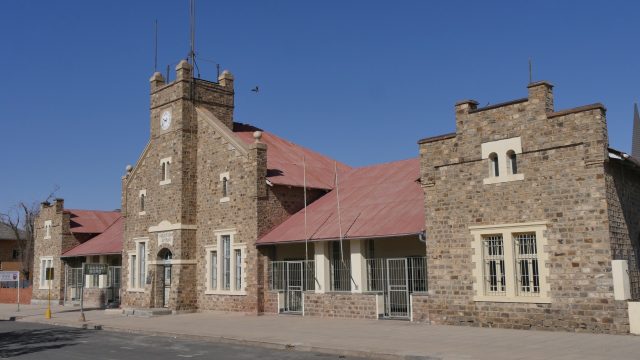
Keetmanshoop’s small but quietly compelling museum sits on the edge of town, a modest building that holds fragments of a region shaped by time, trade, and the slow pulse of desert life. It doesn’t draw crowds, and that’s part of its charm. Here, history isn’t staged for spectacle; it’s preserved in the everyday—tools, photographs, letters, and objects that tell the story of southern Namibia in a way that feels personal rather than grand.
The museum occupies what was once the town’s first post office, a low-slung structure with thick walls and a corrugated iron roof, built in the early 1900s when Keetmanshoop was little more than a dusty outpost on the edge of German South West Africa. The building itself is unassuming, but its age shows in the way the floorboards creak underfoot and the light slants through high, narrow windows. Inside, the exhibits are arranged without fuss, as if the curators trusted visitors to piece together the narrative themselves. There are no flashy displays or interactive screens—just glass cases, wooden shelves, and the occasional handwritten label.
The collections focus on three broad themes: the indigenous Nama people, the colonial era, and the development of Keetmanshoop as a regional hub. The Nama exhibits are among the most moving, offering a glimpse into a culture that has endured despite displacement and marginalization. There are woven baskets with intricate patterns, leatherwork, and tools made from bone and stone. A display of traditional clothing—long, flowing dresses for women, leather aprons for men—hints at a way of life adapted to the harsh beauty of the Kalahari. Photographs from the late 19th and early 20th centuries show Nama families in posed studio portraits, their faces often unsmiling, their postures stiff with the weight of a changing world.
The colonial section is where the museum’s tone shifts, becoming more ambiguous. German settlers arrived in the 1890s, drawn by the promise of land and trade, and Keetmanshoop became a key administrative center. The museum doesn’t shy away from this history, but it doesn’t sensationalize it either. There are uniforms, rifles, and documents bearing the imperial eagle, alongside mundane items like a typewriter, a cash register, and a set of scales used in the old post office. A particularly striking photograph shows a group of German officers and Nama leaders standing together in 1905, their expressions unreadable. The caption is brief, leaving the viewer to wonder about the tensions beneath the surface.
One of the most interesting exhibits is a reconstruction of a typical early 20th-century shop, complete with wooden counters, glass jars of sweets, and shelves stocked with tinned goods, bolts of fabric, and farming tools. It’s a reminder of how Keetmanshoop grew—not as a glamorous colonial capital, but as a practical place where farmers, traders, and missionaries came to buy supplies, send letters, and catch up on news. The shop’s ledger books, open to random pages, reveal the names of local families and the prices of everyday items, grounding the past in something tangible.
The museum also touches on the town’s role in Namibia’s struggle for independence, though this part of the story is told with restraint. There are photographs of protests, newspaper clippings, and a few personal accounts from local activists. One display case holds a tattered Namibian flag, its colors still vivid, alongside a handwritten note from a student who participated in the 1970s uprisings. It’s a quiet but powerful reminder that history isn’t just about distant events—it’s made by people who lived, worked, and fought in places like this.
Outside, the museum’s courtyard is a small oasis of green in an otherwise arid landscape. A few benches sit beneath the shade of a thorn tree, and the air is often filled with the sound of birds. It’s a good place to pause after walking through the exhibits, to let the stories settle. The town itself is visible beyond the low fence—wide, empty streets, a few colonial-era buildings, and the vast, open sky that defines so much of southern Namibia.
What makes the Keetmanshoop Museum worth visiting isn’t its size or its polish, but its honesty. It doesn’t try to be more than it is: a local institution run by people who care about preserving the past, even if that past is complicated. There’s no attempt to romanticize or dramatize; instead, the museum offers something rarer—a sense of place, of continuity, of lives lived in a landscape that has seen empires rise and fall. For travelers passing through, it’s a chance to step off the main road and see Namibia not as a postcard, but as a place with layers, contradictions, and quiet resilience.