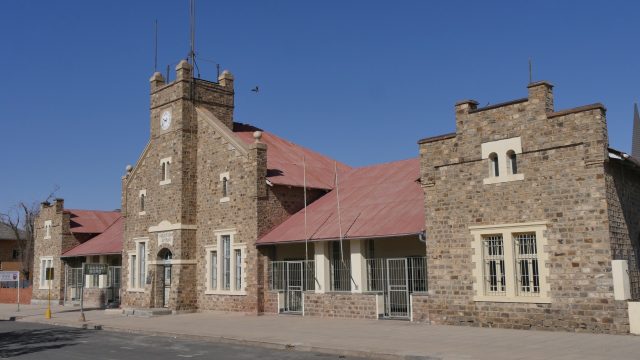
Keetmanshoop is one of those places that feels like it exists slightly out of time, a quiet outpost in southern Namibia where the vastness of the landscape seems to stretch into infinity. The town itself is unassuming, a grid of low buildings under the relentless sun, but it holds a few surprises for those who take the time to look. Among them is the Church of St. John the Baptist, a structure that stands as a quiet testament to the region’s layered history and the enduring presence of faith in a land shaped by both human ambition and natural forces.
Built in the early 20th century, the church was part of a wave of missionary activity that swept through Namibia during German colonial rule. The country’s history is complex, marked by shifting powers and cultural encounters, and this small church is one of the tangible remnants of that era. Its architecture reflects the practical yet earnest approach of the missionaries who built it—simple, sturdy, and designed to withstand the harsh climate of the southern Namib. The building is made of local stone, its walls thick enough to keep the interior cool during the scorching days and warm when the desert nights grow cold.
The church’s design is unpretentious, a far cry from the grand cathedrals of Europe. There are no soaring spires or intricate stained glass here, just a modest rectangular structure with a pitched roof and a small bell tower. The windows are narrow, allowing slivers of light to filter in without letting in too much heat. Inside, the space is equally understated, with wooden pews, a plain altar, and whitewashed walls that have absorbed decades of quiet prayers and hymns. It’s the kind of place where the simplicity of the surroundings invites reflection, a contrast to the dramatic landscapes that lie just beyond its doors.
What makes the Church of St. John the Baptist interesting isn’t just its age or its architecture, but the way it fits into the broader story of Keetmanshoop and Namibia as a whole. The town was named after Johann Keetman, a German industrialist who funded the construction of a railway line through the area in the late 19th century. The railway was part of a larger effort to connect the interior of the country with the coast, facilitating trade and movement in a region that had long been isolated. The church arrived not long after, a symbol of the new order that was taking shape. For the local Nama people, who had inhabited this land for generations, the arrival of missionaries and settlers brought profound changes, some welcome, others less so.
Today, the church is still an active place of worship, though its congregation is small. The town itself has never been large, and its population has ebbed and flowed over the decades, shaped by economic shifts and the challenges of life in a semi-arid environment. Yet the church endures, a quiet anchor in a place where change often feels slow and incremental. Visitors who stop by are usually those with an interest in history or a curiosity about the lesser-known corners of Namibia. There’s no grand tour or visitor center here, just the building itself, standing as it has for over a century.
The surrounding area adds to the church’s sense of place. Keetmanshoop sits in a region known for its stark beauty, where the land is a patchwork of rocky outcrops, dry riverbeds, and wide-open spaces. The nearby Quiver Tree Forest, with its surreal, otherworldly trees, is one of the most famous sights in southern Namibia, and it’s easy to imagine the early missionaries and settlers gazing out at the same landscapes, trying to make sense of a place that must have felt both awe-inspiring and unforgiving. The church, in its own way, is a response to that landscape—a human attempt to create meaning and permanence in a world that often feels transient.
For those who take the time to visit, the Church of St. John the Baptist offers more than just a glimpse into the past. It’s a reminder of the quiet resilience of communities in places where life doesn’t always come easy. The desert doesn’t give up its secrets easily, and neither does this small town or its church. There’s a sense of stillness here, a pause in the relentless march of time, where the past and present coexist without fanfare. It’s not a place that demands attention, but for those who notice, it offers something rare—a moment of connection to a history that is both personal and shared, a story written in stone and silence.