Caral is one of those places that make you realize how little we truly understand about ancient civilizations. Tucked away in the Huaura Valley, a few hours north of Lima, this archaeological site is believed to be one of the oldest cities in the Americas. At nearly five thousand years old, it predates the Inca Empire by millennia and stands as a contemporary of Egypt’s pyramids and Mesopotamia’s earliest settlements. Yet despite its age, Caral was only rediscovered in the mid-20th century, and serious excavations didn’t begin until the 1990s. Before then, its existence was known mostly to locals, who saw it as little more than a cluster of overgrown hills.
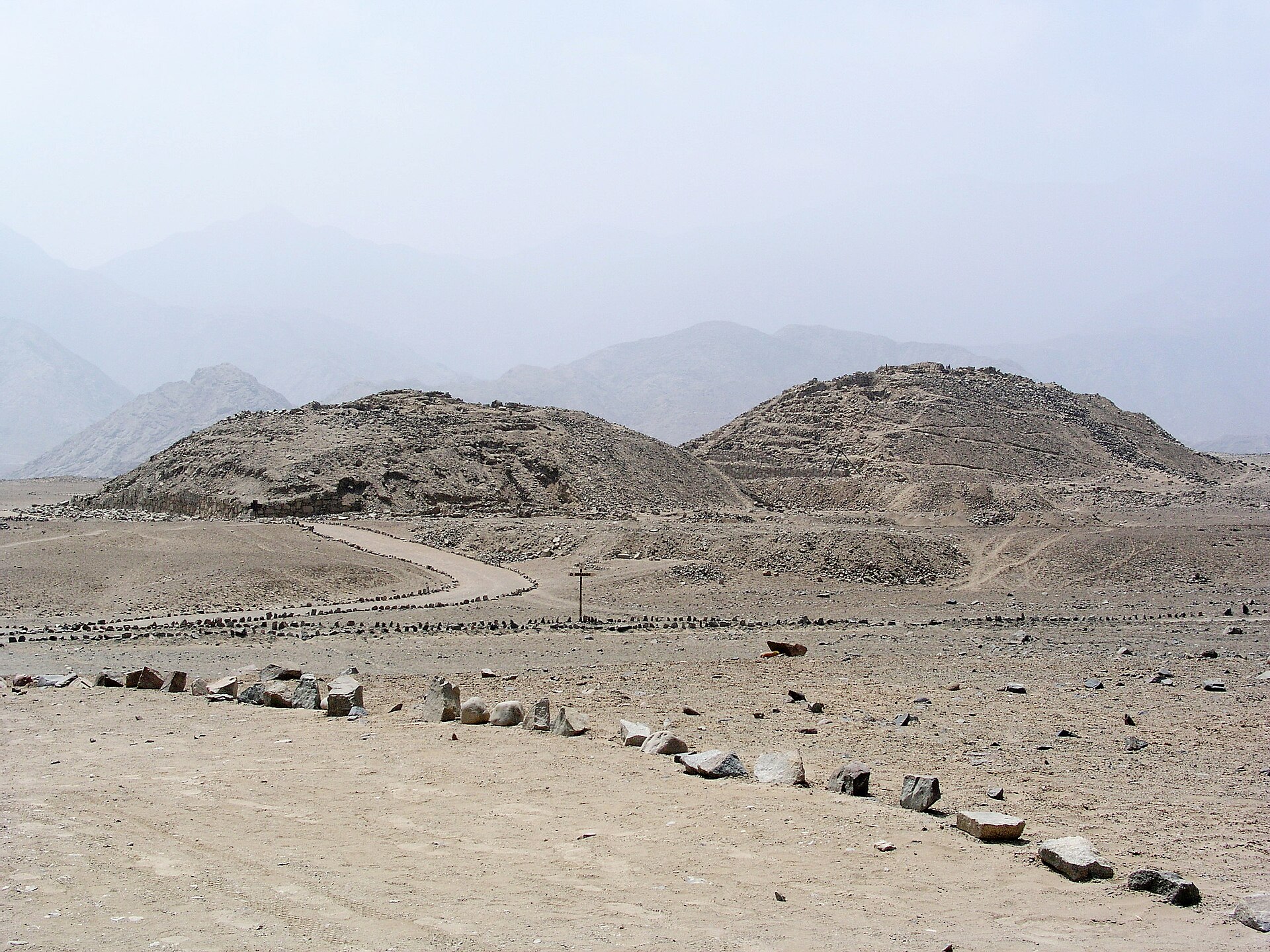
The city sprawls across roughly sixty hectares, a carefully planned urban center with towering pyramids, residential districts, a public amphitheater, and an intricate network of irrigation canals. The largest structure, the Pirámide Mayor, dominates the landscape with a base stretching 150 meters and a height of over twenty meters. Unlike the tombs of Egypt, however, Caral’s pyramids weren’t built to house the dead. Instead, they served as administrative and ceremonial hubs, where rulers, priests, and artisans lived and worked. Excavations have uncovered workshops, storage rooms, and even musical instruments—flutes carved from the bones of pelicans and condors—hinting at a society that valued both practicality and culture.
What makes Caral particularly fascinating is how it was constructed without the use of pottery. Ceramics only appeared in the region later; here, everything was made from stone, wood, and plant fibers. The buildings were assembled from sun-dried bricks and fieldstones held together with clay. Over time, structures collapsed and were rebuilt in the same locations, suggesting a culture that valued continuity. Even more intriguing is the absence of evidence for warfare. There are no fortifications, no weapons, and no signs of violent conflict in the remains found here. Some researchers speculate that Caral’s people thrived not through conquest, but through trade, agriculture, and cooperation.
The Supe Valley, where Caral sits, was an ideal setting for an ancient civilization. The river provided a steady water supply, while the fertile soil supported crops like cotton, beans, and squash. The climate, mild and stable, was perfect for farming. But Caral’s influence extended far beyond the valley. Archaeologists have found seashells from the coast, minerals from the Andes, and even artifacts linked to the Amazon, evidence of a vast trade network that connected different regions of South America. This wasn’t an isolated settlement, but a key player in a complex economic system.
Though Caral faded into obscurity for centuries, its legacy hasn’t entirely disappeared. The descendants of its builders still live in the surrounding valleys, preserving traditions that may stretch back to Caral’s time. Some farming techniques and craftsmanship in the region bear striking similarities to those of the ancient city. In recent years, the Peruvian government has made efforts to protect the site, offering guided tours that explain its history and significance. Unlike Machu Picchu or Cusco, Caral remains relatively quiet, allowing visitors to explore its ruins without crowds.
A visit to Caral is more than just a walk through ancient ruins. It’s a chance to step into a world that existed long before the empires we usually associate with South America. There are no souvenir stalls, no tour groups jostling for photos—just the wind rustling through the dry grass and the silent pyramids, standing as they have for five thousand years. The atmosphere is one of quiet reflection, as if the place itself encourages you to slow down and consider what it means to be human.
If you find yourself in Peru, Caral is worth the detour. The drive from Lima takes about three hours, winding through valleys and desert-like hills with the Andes looming in the distance. Along the way, you’ll pass small towns where vendors sell fresh fruit and local cheese. There are no restaurants or cafes at the site, so it’s best to bring water and snacks. Tours usually start early to avoid the midday heat, and the lack of crowds makes it easy to imagine what life here might have been like.
Caral challenges the way we think about history. There are no golden temples or dramatic tales of conquest, but there is something far more compelling: proof that humans, thousands of years ago, could build sophisticated cities, engage in long-distance trade, and live in balance with their environment. The real mystery of Caral isn’t how it was built, but why it was abandoned. Theories range from climate shifts to economic changes, but the truth remains buried beneath the sand. What’s certain is that this place offers a rare glimpse into a civilization that flourished without war—a reminder that humanity’s story is far richer and more varied than we often assume.