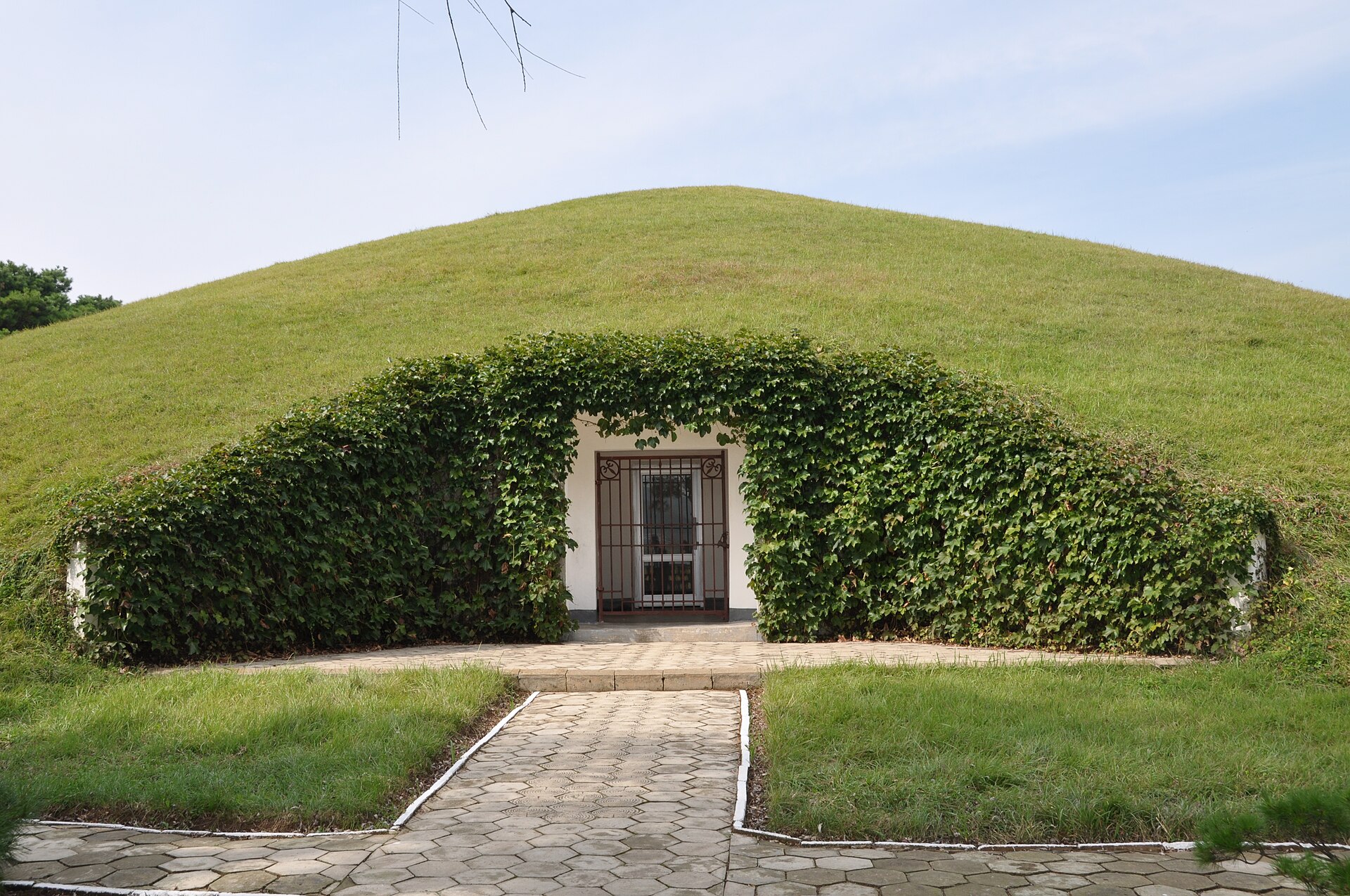
Perched on a gentle hillside near Nampo, the Kangso Three Tombs offer a quiet encounter with one of Korea’s oldest civilizations. From this vantage point, the Taedong River winds through the plains below, its slow curves unchanged since the days when the Koguryo kingdom ruled these lands. The tombs themselves are modest earthen mounds, their stone perimeters weathered but still distinct, as if time has only lightly touched them. They were built between the fifth and sixth centuries, serving as resting places for the kingdom’s elite, and though they’ve stood for over a thousand years, they retain a sense of discovery, as though archaeologists might still be brushing away the last layers of soil.
What makes these tombs remarkable is their preservation. Unlike many ancient burial sites on the Korean Peninsula, the Kangso tombs have survived with much of their original structure intact. The most striking feature lies within Tomb No. 3, where faded but vivid murals cover the walls. These paintings depict scenes of aristocratic life—feasts with musicians and dancers, hunters on horseback, and celestial symbols that hint at the Koguryo people’s beliefs about the afterlife. The artistry is both delicate and bold, a rare glimpse into a culture that valued both earthly pleasures and cosmic order. The murals are among the few surviving examples of Koguryo wall painting, and their survival feels almost miraculous.
The architecture of the tombs follows the Koguryo style: earthen mounds reinforced with stone, concealing underground chambers accessed by narrow passageways. Originally sealed, the entrances were later breached, though access remains restricted. The mounds are unassuming in height, yet their placement on the hillside suggests careful consideration of the landscape. The Koguryo people often chose burial sites that harmonized with nature, and here, the tombs seem to rise naturally from the earth rather than dominate it. Even now, the site carries a sense of reverence, the silence broken only by the rustle of grass or the distant call of a bird.
Koguryo was one of the Three Kingdoms of Korea, a powerful state that flourished from the third century BCE to the seventh century CE. It was known for its military strength, sophisticated governance, and rich cultural traditions, all of which left a lasting mark on the Korean Peninsula. The Kangso tombs are a small but significant part of that legacy. The murals, in particular, reveal a society that saw art as more than decoration—they were a language of symbols, connecting the living with the dead and the earthly with the divine. The recurring motifs of the sun, moon, and stars suggest a worldview where the cosmos played a central role in both life and death.
In 2004, the Kangso Three Tombs were designated as part of the UNESCO World Heritage Site encompassing the Koguryo tombs. This recognition underscores their global significance, not just as historical artifacts but as windows into a civilization that shaped Korea’s early identity. Visiting the site today feels like stepping into a different era. There are no modern buildings in sight, no crowds, just the quiet expanse of fields and hills that have remained largely unchanged for centuries. It’s easy to imagine this place as it was in the sixth century, when the tombs were freshly built and the Koguryo kingdom was at its height.
Access to the tombs is tightly controlled, and visitors can only enter as part of an organized tour. This isn’t a place for spontaneous exploration; the site is guarded, and the number of visitors is limited. For those who do make the journey, however, the experience is uniquely intimate. There are no souvenir stalls or tourist buses, just the stillness of the tombs and the occasional whisper of the wind. The lack of crowds only deepens the sense of connection to the past, as if the centuries between then and now have momentarily dissolved.
The Kangso tombs are more than just ancient burial sites. They are a testament to a kingdom that once thrived here, a civilization that left its mark not just in stone but in the very culture of the Korean Peninsula. They remind us that history isn’t always recorded in books—sometimes it’s preserved in the earth, in the pigments of a mural, or in the careful arrangement of stones. For North Korea, these tombs hold a special significance, linking the present to a time when the foundations of Korean identity were being laid. Standing among them, it’s impossible not to feel the weight of that legacy.