- Home
- South Africa
- Kimberley
- St Cyprian's Cathedral
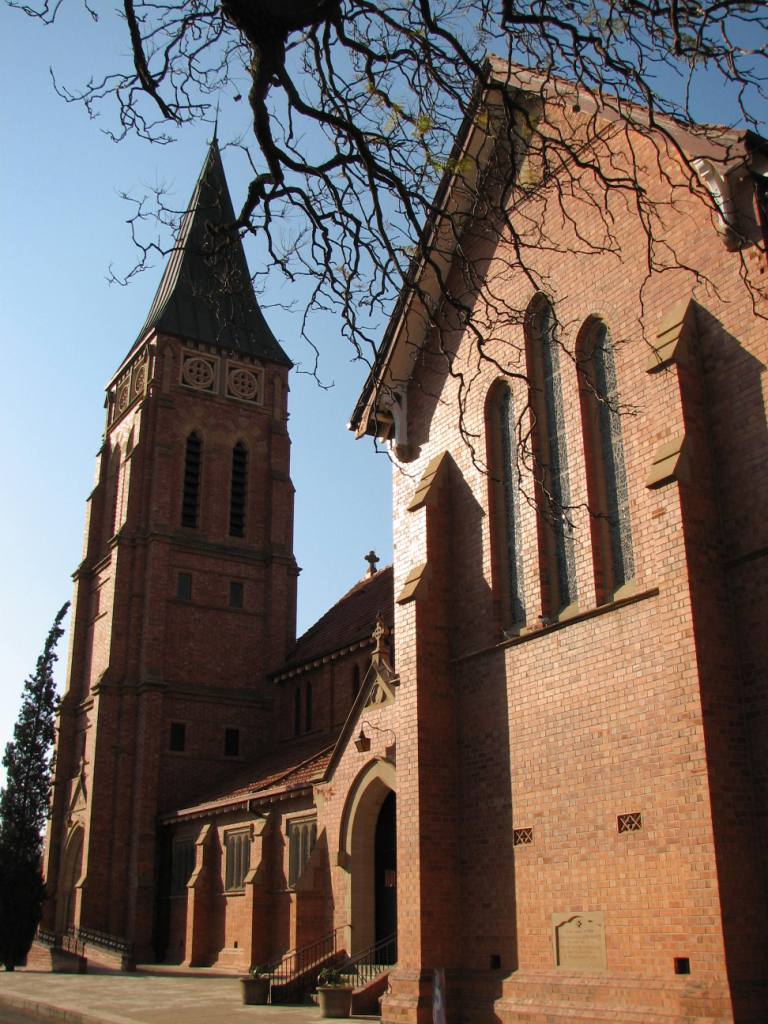
Photo: Blarcrean, CC BY 3.0
St Cyprian's Cathedral
out of 5 0 ratingsSt Cyprian’s Cathedral in Kimberley is the kind of place that doesn’t demand attention at first glance, yet lingers in the mind long after you’ve left. Tucked away on the corner of Douglas and Hofmeyr streets, it sits quietly in what was once the heart of South Africa’s diamond rush—a time when Kimberley was more than just a mining town, but a magnet for fortune-seekers, dreamers, and those chasing a new beginning. Today, the cathedral feels like a pocket of stillness in a city that has seen its share of upheaval, a reminder of an era when this corner of the world was alive with possibility.
Built in the late 19th century, the cathedral rose alongside Kimberley’s explosive growth. The discovery of diamonds in 1871 transformed a dusty settlement into a bustling, chaotic hub where prospectors, merchants, missionaries, and adventurers from across the globe converged. The Anglican community swelled with the city’s population, and the small chapel that had once served the faithful soon proved too cramped for the growing congregation. The decision to construct a cathedral was more than a practical one—it was a statement of permanence in a place defined by transience. Here, amid the feverish pursuit of wealth, the church offered something enduring.
The architecture of St Cyprian’s reflects both its European influences and the realities of its surroundings. The building is a blend of neo-Gothic design and local adaptation, its red brick exterior softened by white stone accents. The pointed arches and tall, narrow windows are classic Gothic elements, but the scale is more modest, suited to the city’s character rather than the grand cathedrals of Europe. Inside, the simplicity is striking—wooden pews, a stone floor, and stained-glass windows depicting saints. There’s no ornate decoration, no gilded excess, just a quiet dignity that makes the space feel welcoming rather than imposing.
The cathedral’s history is woven into the fabric of Kimberley and, by extension, South Africa itself. In the late 19th and early 20th centuries, as the country took shape, the church played a role far beyond Sunday services. It was a center for education, a refuge for the marginalized, and a gathering place for a community that was as diverse as it was divided. Kimberley’s population was a patchwork of English settlers, Dutch farmers, Portuguese traders, and African laborers, and the cathedral became a rare space where these groups intersected. Services were held in multiple languages—English, Afrikaans, Xhosa—echoing the city’s cosmopolitan past.
Today, St Cyprian’s continues to serve its congregation, though Kimberley has changed dramatically since the days of the diamond rush. The mines have long since closed, and the city’s population has dwindled, but the cathedral remains. It’s still a place of worship, with Sunday services drawing a faithful crowd, but it’s also a quiet retreat for those who need a moment of reflection. On weekdays, you might find parishioners lighting candles or sitting in contemplation, while occasional concerts, lectures, and exhibitions keep the space alive with activity. The cathedral has become a bridge between past and present, a place where history isn’t just remembered but lived.
The area around the cathedral offers a glimpse into Kimberley’s colonial past. The streets nearby are lined with buildings from the late 1800s, their architecture a mix of Victorian and Edwardian styles that hint at the city’s former wealth. Just a short walk away is the Big Hole, the massive open-pit mine that stands as a testament to Kimberley’s diamond boom. Once the site of backbreaking labor and desperate hope, it’s now a museum where visitors can learn about the lives of the miners who shaped the city. The contrast between the cathedral’s serenity and the raw, industrial history of the Big Hole is striking—one a symbol of faith, the other of human ambition.
St Cyprian’s is more than just a historic building; it’s a living record of the people who passed through Kimberley. Its walls have absorbed the stories of those who sought solace, community, or simply a moment of peace in a town that was often anything but. The echoes of hymns sung in different languages, the murmur of prayers, the footsteps of generations—all of it lingers here. The cathedral has witnessed the rise and fall of fortunes, the shifting tides of politics, and the quiet resilience of a community that refused to be defined by its struggles.
Visiting St Cyprian’s doesn’t require any special preparation. There’s no need to book a tour or follow a set path—just step inside, take a seat, and let the space speak for itself. The light filtering through the stained glass casts gentle patterns on the stone floor, and the air carries the faint scent of old wood and candle wax. Unlike many tourist sites, there are no crowds here, no rush to move on to the next attraction. It’s a place where time seems to slow down, where the weight of history feels tangible but not overwhelming.
For some, the cathedral will be a brief stop on the way to other sights in Kimberley. For others, it might be a moment of unexpected connection—a reminder of how fragile and yet enduring human life can be. Either way, St Cyprian’s offers something rare: a chance to step outside the noise of the present and listen to the quiet voices of the past. It’s a piece of Kimberley’s story, one that’s still being written with every person who walks through its doors.
Day around this place
Where else to go on the same day
Building the day…
Where it is
-28.74250, 24.77060