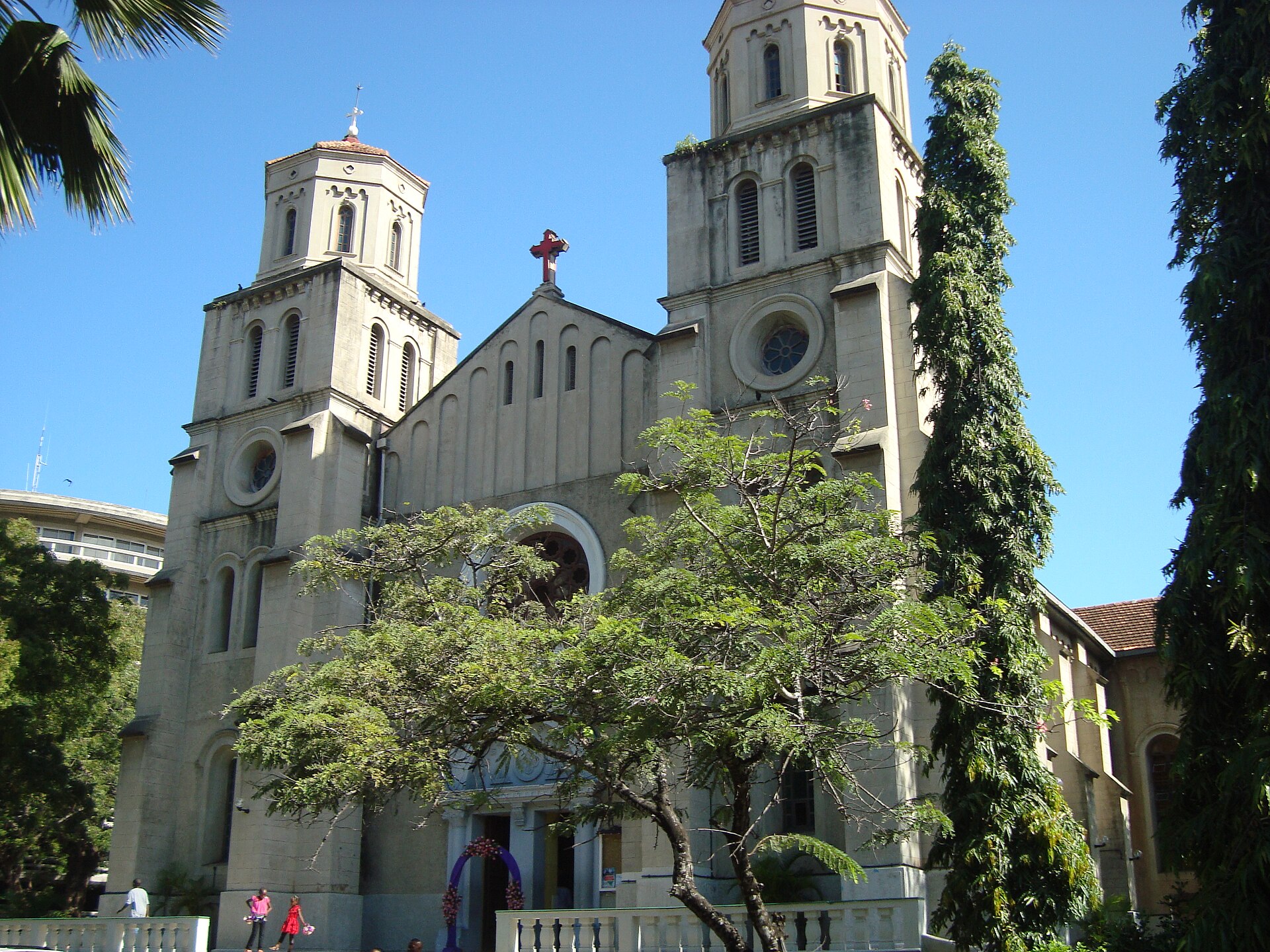
Photo: Zahra Abdulmajid, CC BY-SA 3.0
Mombasa Cathedral
out of 5 0 ratingsMombasa’s Holy Ghost Cathedral
Mombasa’s Holy Ghost Cathedral is where the city’s layered past feels tangible. Built in the late 19th century, it was the first Catholic cathedral on Africa’s eastern coast. Mombasa’s position on the route between Europe and India made it a prize for colonial powers. The cathedral’s construction marked a religious milestone and a political one. The site had once been home to a Portuguese fort. When the fort’s walls came down, the cathedral rose in their place, symbolizing a shift from military dominance to Christian influence.
The building’s architecture reflects this blend. Its pointed arches and vaulted ceilings echo Gothic traditions. The roof, covered in terracotta tiles, withstands heavy tropical rains. The walls are made of coral stone, a material as much a part of the Swahili coast as the ocean itself. Inside, the space is cool and dim, the air thick with the scent of old wood and incense. Light filters through stained-glass windows, casting colored patterns on the stone floors. For a moment, the outside world feels distant.
What makes the cathedral stand out is how it embodies the cultural collisions that shaped Mombasa. By the time it was built, the city was already a melting pot of Arabs, Indians, Europeans, and Africans. The wooden carvings on the pews and confessionals show traces of Arab craftsmanship. The patterns on the stained glass hint at Indian design. Mass is celebrated in Swahili, English, and sometimes Latin, reflecting the city’s languages. The result is a space that feels neither entirely European nor entirely African, but Mombasan.
Outside, life moves at a different pace. The old town’s narrow streets wind past stalls selling spices, kangas, and silver jewelry. Vendors call out prices in Swahili and Arabic. The port, just a short walk away, hums with activity as dhows and cargo ships load and unload goods. On ordinary days, the cathedral is quiet. During holidays—Christmas, Easter, or the feast days of local saints—it comes alive. Families fill the pews, children fidget in their best clothes, and hymns sung to the rhythm of drums and stringed instruments spill into the streets.
The cathedral has witnessed much of Mombasa’s history. During the struggle for Kenyan independence, it served as a refuge for those fleeing violence. Priests organized food and medical aid. Even after independence, the cathedral remained a constant in a changing city. Today, it’s still a place of worship and draws visitors curious about Mombasa’s past. Tourists wander the aisles, photographing the altar’s carved wooden panels or the old organ, one of the oldest in East Africa, still filling the space with music on special occasions.
The interior holds details that tell larger stories. Paintings on the walls depict biblical scenes reimagined through an African lens—Saints with dark skin, landscapes resembling the savanna. The altar, crafted by local artisans, is adorned with motifs common in Swahili homes. In the side chapels, statues of European saints stand alongside those of African martyrs. The effect is less like a museum and more like a living record of how belief adapts.
From the outside, the cathedral is unassuming. No towering spires or grand facades announce its importance. It sits modestly among the old town’s low-slung buildings, its coral-stone walls weathered by time and salt air. It doesn’t demand attention; it simply exists, as much a part of Mombasa as the markets or the ocean. There are no guided tours or gift shops, just the occasional visitor stepping inside to escape the heat or light a candle.
To spend time here is to understand Mombasa. The city has always been a gateway—a place where people arrived, stayed, and left their mark. The cathedral stands at the heart of that story. Walking its aisles, you hear the voices that have filled this space over the decades: the prayers of sailors far from home, the hymns of newly converted locals, the arguments of colonial officials, the laughter of children at Christmas. The building doesn’t just preserve history; it carries it forward.
Day around this place
Where else to go on the same day
Building the day…
Where it is
-4.06355, 39.67159