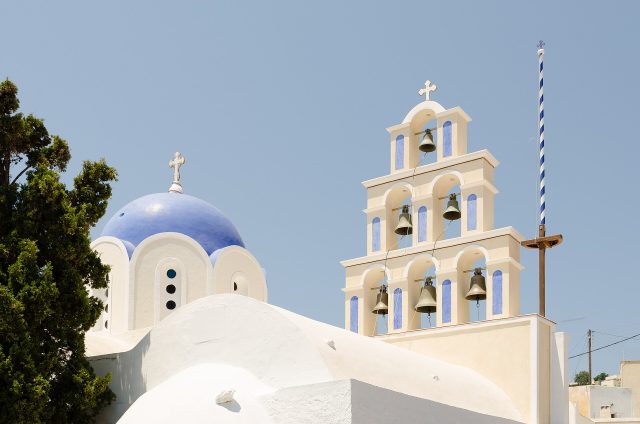
Oia sits on the northern edge of Santorini, where the island’s dramatic cliffs drop sharply into the caldera below. The village is a cascade of whitewashed houses, blue-domed churches, and winding staircases clinging to the rock face. This is the image most people picture when they think of Greece—the one that has appeared on countless postcards and travel guides. But beyond the postcard perfection, Oia has a quiet, almost timeless quality, as if the village itself is holding its breath against the weight of its own beauty.
The caldera is the heart of Santorini’s story. It was formed around 1600 BC by one of the most powerful volcanic eruptions in recorded history, an event so violent it reshaped the island and may have inspired the legend of Atlantis. The explosion buried the Minoan settlements that once thrived here, leaving behind a landscape of layered ash and pumice that still feels raw, even after thousands of years. The cliffs rise like a fortress wall, their striations of red, black, and ochre telling the story of fire and upheaval. When you stand at the edge, looking out over the deep blue water, it’s easy to imagine the force that carved this place from the earth.
Sunset in Oia is less an event and more a ritual. As the day cools, the village fills with people drifting toward the old Venetian castle at the western tip. Some arrive an hour or more early, claiming a spot on the low stone walls or the steps leading down to the water. The crowd is a mix of locals, travelers, and photographers, all waiting for the same thing: the moment when the sun dips below the horizon, painting the sky in shades of gold, pink, and violet. When it finally happens, there’s a collective pause, a shared breath, and then—almost always—applause. It’s a strange, almost theatrical moment, as if the village itself is putting on a show.
The houses here were built into the rock, their foundations carved directly into the soft volcanic tuff. In the past, these cave-like dwellings served as storage spaces and shelters, their thick walls keeping out the heat in summer and the cold in winter. Today, many have been transformed into boutique hotels and guesthouses, their interiors cool and quiet, with private terraces overlooking the water. Some still have the original domed ceilings, their curves softened by time. Staying in one of these places feels like stepping into another era, where the outside world fades into the background.
Getting down to the port of Ammoudi is an adventure in itself. A steep staircase of nearly three hundred steps cuts through the cliffside, winding past bougainvillea and the occasional stray cat. Some take the descent on foot, while others opt for the traditional donkey ride, a slow, swaying journey that feels both absurd and oddly charming. At the bottom, the water is a deep, almost unreal blue, and the air smells of salt and grilled fish. A handful of tavernas line the shore, their tables set right at the water’s edge. The food is simple—fresh octopus, fried anchovies, tomatoes still warm from the sun—but it tastes like something out of a dream.
Oia is small, and in the height of summer, it can feel overwhelmingly crowded. The narrow streets, barely wide enough for two people to pass, become rivers of movement, with tourists flowing in both directions. The best time to explore is early in the morning, before the day-trippers arrive, or late in the evening, when the village empties out and the only sounds are the wind and the occasional clink of glasses from a half-empty café. Even then, the place retains a sense of intimacy, as if it’s letting you in on a secret.
The view from Oia is one of the most sought-after in Greece, and it comes with a price. Hotels and apartments with caldera-facing terraces are booked months in advance, often at rates that reflect their exclusivity. But the view isn’t just for those who can afford it. The public paths along the cliffside offer just as breathtaking a perspective, and the old castle ruins, though crumbling, provide a vantage point that feels almost stolen. The wind here is constant, even in the middle of summer, tugging at clothes and hair, a reminder that this is a place shaped by forces far greater than human hands.
The village is a maze of steps and slopes, with almost no flat ground to speak of. Every turn leads either up or down, past tiny shops selling handmade jewelry, galleries displaying local art, and cafés where the coffee is strong and the chairs are arranged just so to catch the light. In winter, Oia is a different place—quieter, slower, with many of the hotels and restaurants closed until spring. But the view remains the same, the cliffs just as dramatic, the sea just as blue. The crowds thin out, and the village feels like it’s finally able to breathe.
From Fira, Santorini’s capital, Oia is a twenty-minute bus ride or a two-and-a-half-hour walk along the caldera trail. The path is well-trodden but not easy, winding along the edge of the cliff with nothing but a low stone wall between you and the drop below. The views are worth the effort, though, especially in the late afternoon, when the light turns the entire landscape golden. The buses back to Fira after sunset are always packed, with people standing in the aisles, still buzzing from the day’s experiences. It’s a small inconvenience, a minor footnote in a place that leaves a much larger impression.
Oia is more than just a pretty face. It’s a place where history, geology, and human ingenuity collide, where every stone and staircase has a story to tell. The beauty here is undeniable, but it’s the layers beneath the surface—the way the light changes with the seasons, the way the wind carries the scent of the sea, the way the village seems to exist in its own time—that make it unforgettable. It’s a place that demands to be seen, not just photographed, and once you’ve been, it stays with you long after you’ve left.