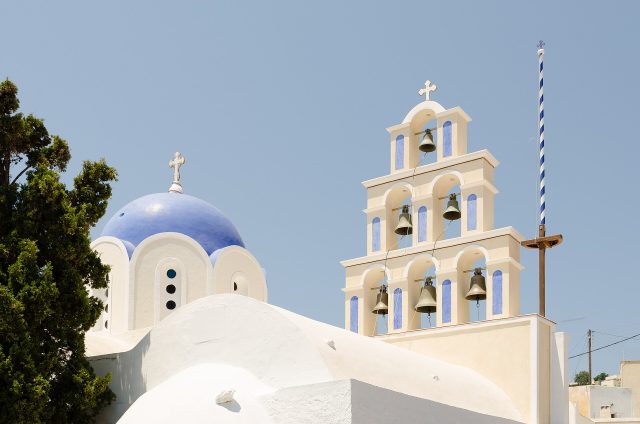
Fira isn’t just the capital of Santorini—it’s the place where the island’s raw, dramatic beauty comes into sharp focus. Perched on the edge of the caldera, the village clings to the cliffside as if defying gravity, its whitewashed houses and blue-domed churches cascading down toward the endless blue of the Aegean. The narrow, winding streets feel like a maze designed by time itself, each turn revealing another breathtaking view—whether it’s the volcanic islands of Nea Kameni and Palea Kameni rising from the sea or the slow burn of a sunset painting the sky in shades of pink and gold. There’s nothing generic about Fira. It doesn’t have the polished veneer of a typical resort town, with its wide promenades and crowded beaches. Instead, it feels like stepping into a scene from an old Greek film, where life moves at its own unhurried pace.
The story of Fira is inseparable from the cataclysm that shaped Santorini. Around 1600 BCE, one of the most powerful volcanic eruptions in history tore the island apart, leaving behind the crescent-shaped caldera we see today. The village grew on the edge of this precipice, its houses built into the cliffside as if holding on for dear life. By the 19th century, Fira had become the island’s administrative hub, and traces of that era remain in its neoclassical buildings—elegant structures that stand in contrast to the traditional Cycladic architecture. Among them is the former governor’s palace, now home to the Museum of Prehistoric Thera, where artifacts from the buried city of Akrotiri offer a glimpse into life before the eruption.
The architecture of Fira tells a story of resilience and adaptation. The houses, built from local stone and whitewashed to reflect the harsh Mediterranean sun, were designed to withstand the island’s relentless winds and scorching summers. The narrow streets weren’t just charming—they served a purpose, shielding residents from the gusts that sweep across the caldera. Even the iconic blue domes of the churches had a practical side: the color, symbolic of the sky and sea, also helped repel insects. One of the most striking is the Church of Agios Ioannis the Baptist, built in the 18th century. Its bell tower rises above the village, offering a panoramic view of the island and the sea beyond.
Life in Fira moves to the rhythm of the caldera. Mornings are quiet, with only the occasional local opening a café or sweeping the steps of a shop. By midday, the streets fill with visitors—some browsing the boutiques for local wine or volcanic stone jewelry, others pausing to take photos against the whitewashed walls. But it’s in the evening that Fira truly comes alive. Restaurants hum with conversation, and the viewpoints along the cliffside become stages for the day’s grand finale: the sunset. August brings an extra layer of magic with the Festival of Ifigenia, a celebration of the island’s patron saint. For a few days, the village is adorned with flowers, and processions carry icons through the streets, blending devotion with the timeless beauty of the place.
The main street of Fira is more than just a thoroughfare—it’s the village’s beating heart. Stretching along the edge of the caldera, it connects the different parts of town while offering a taste of local life. Here, you can find everything from bottles of Santorini’s crisp white wine to handmade jewelry crafted from volcanic stone. But the real draw isn’t the shopping; it’s the atmosphere. Street musicians strum bouzoukis, vendors offer samples of ripe figs, and the air is thick with the scent of grilled fish and spices. A climb up the steps leads to a viewpoint overlooking the sea, while a descent toward the old port reveals the donkeys that ferry tourists up and down the steep path—a reminder of how life here has adapted to the landscape.
Fira isn’t just a place to wander; it’s a gateway to the rest of Santorini. Buses depart from here to villages like Oia, Imerovigli, and Pyrgos, while rental cars and scooters offer the freedom to explore the island’s black sand beaches at Perissa or Kamari. For those who prefer the water, ferries head to the volcanic islands at the center of the caldera, where steam still rises from the earth. Yet many visitors find themselves lingering in Fira, content to spend an evening at a cliffside restaurant, savoring dishes made from local ingredients—fresh seafood, sun-ripened tomatoes, and the island’s famous white eggplants, a delicacy found nowhere else.
Life in Fira hasn’t always been easy. In the mid-20th century, the island faced decline after a devastating earthquake in 1956 drove many residents away. The village emptied, and for a time, it seemed as though Santorini’s golden age had passed. But in the 1970s, tourists began to rediscover the island, and Fira slowly came back to life. Today, it remains the heart of Santorini—a place where the past and present coexist. You might see an elderly woman weaving a basket on her doorstep, her hands moving with the quiet precision of tradition, while just a few steps away, a young couple poses for a photo against the backdrop of a sunset. Fira doesn’t try to be trendy or polished; it simply exists, and that’s what makes it special.
If you visit Fira for the first time, resist the urge to rush from one sight to the next. Instead, find a quiet café on the edge of the caldera, order a freddo coffee, and watch as the light shifts over the sea. Or take an evening stroll through the winding streets, where the glow of lanterns casts long shadows on the white walls and the air is filled with music and laughter. Fira doesn’t reveal itself all at once. It takes time to feel its rhythm, to understand why this village—and this island—has a way of staying with you long after you’ve left. And when you do, you’ll realize it wasn’t just the views that captivated you, but the way the place makes you slow down and simply be.