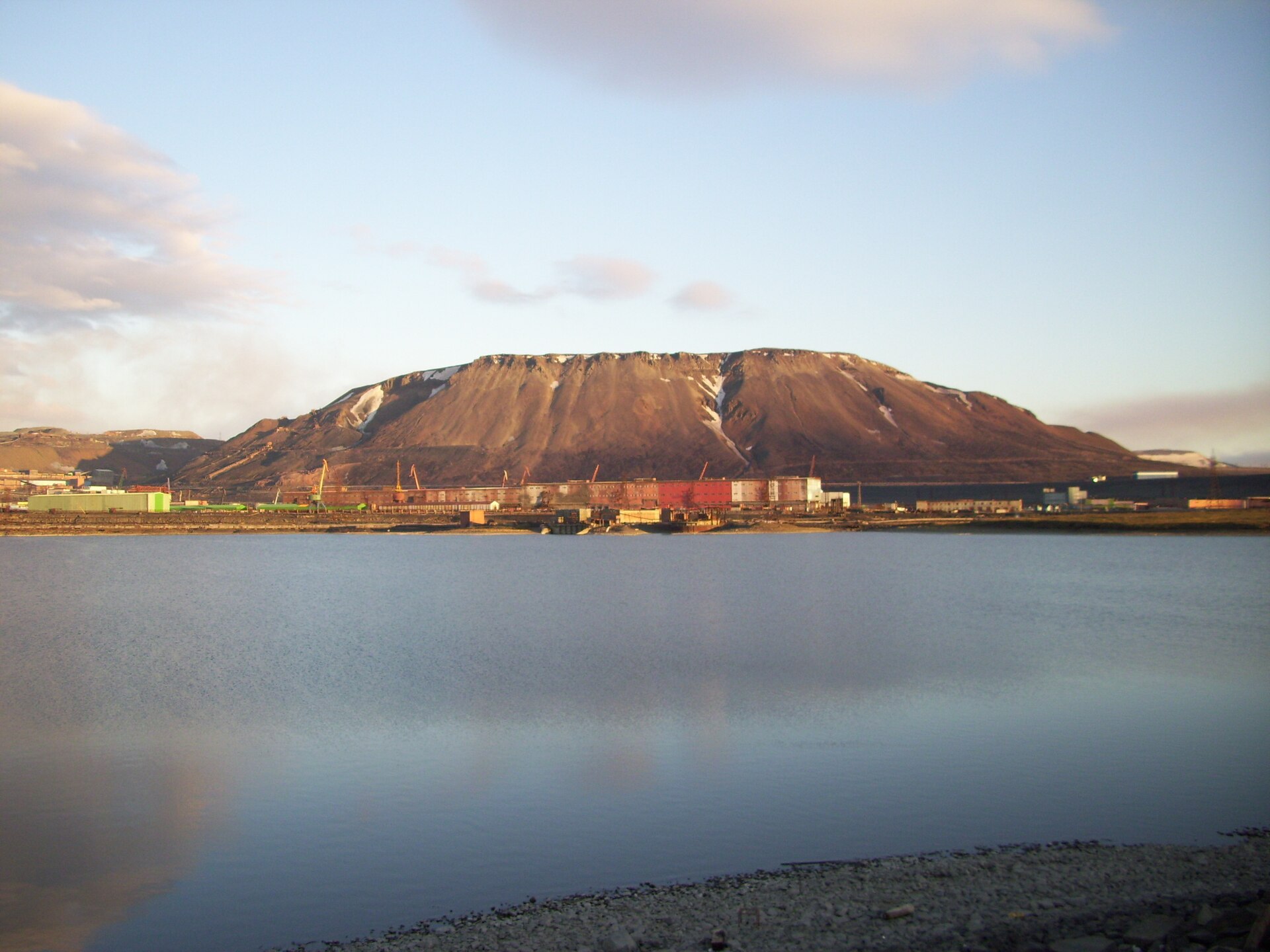
Schmidtikha is one of those places in Norilsk that doesn’t immediately catch your eye, but lingers in your memory long after you’ve left. It’s not a towering peak—barely a hundred meters above the city—but calling it a hill feels like an understatement. This modest elevation holds something far more significant: the quiet pulse of a land where nature and industry have coexisted for nearly a century, each shaping the other in ways both subtle and profound.
The mountain’s name carries the weight of history, though not in the way you might expect. It honors Otto Schmidt, the famed Arctic explorer and scientist who played a pivotal role in the Soviet Union’s push into the Far North during the 1930s. Schmidt never set foot in Norilsk himself, but his legacy became intertwined with the city’s founding. In those early years, when geologists and engineers were carving out a settlement in the permafrost, Schmidtikha served as a natural landmark—a silent guidepost in a landscape where few reference points existed. The name stuck, a small but enduring tribute to the people who dared to build here.
From the summit, the view tells Norilsk’s story better than any guidebook could. To the north, the tundra stretches endlessly, a vast expanse of low shrubs and moss where the horizon blurs into the sky. To the south, the city sprawls in stark contrast: a grid of Soviet-era apartment blocks, the hulking silhouettes of industrial plants, and the ever-present plumes of smoke rising from smelters. The juxtaposition is jarring—raw wilderness on one side, human determination on the other—and yet, somehow, it feels inevitable. This is a place where the land and the people who settled it have reached an uneasy truce.
There’s nothing grand about Schmidtikha’s appearance. No ornate viewpoints, no manicured trails, no monuments to mark its significance. The paths to the top are little more than worn dirt tracks, winding past the occasional rusted relic of Soviet-era experiments—crumbling concrete foundations, half-buried metal frames, the skeletal remains of machinery tested here decades ago. These fragments are now part of the landscape, as much a feature of the mountain as the rocks and lichen. In winter, the slopes are blanketed in snow, making the climb a quiet, solitary effort. In summer, when the tundra thaws into a patchwork of green and gold, the mountain comes alive with locals seeking a moment of respite. Families spread out picnic blankets, while lone walkers pause on the weathered benches to take in the view.
Schmidtikha’s history is inseparable from Norilsk’s own. During the Soviet era, its slopes became an outdoor laboratory for testing equipment built to withstand the Arctic’s extremes. Engineers put early snowcats and all-terrain vehicles through their paces here, pushing materials to their limits in temperatures that could plummet without warning. Some of those experiments failed, leaving behind the scattered debris that still dots the mountainside. Others succeeded, paving the way for the industrial might that would define Norilsk. The mountain, in its quiet way, became a witness to progress—both its triumphs and its missteps.
Today, Schmidtikha is a place where life in Norilsk slows down, if only for a little while. There are no entry fees, no guided tours, no expectations beyond what you bring with you. Locals come here for the simplest of reasons: to walk, to think, to gather cloudberries in late summer or to ski down the gentle slopes when winter sets in. It’s a rare spot in the city where the rhythm of daily life gives way to something slower, something closer to the land itself. Children play in the snowdrifts, while older residents sit on the benches, their breath visible in the cold air, watching the city below.
The mountain is at its most striking during the polar day, when the sun refuses to set for weeks on end. In that endless golden light, Schmidtikha becomes a natural observatory, a place to watch the shifting hues of the tundra and the distant glow of Norilsk’s smelters. But it’s during the polar night, when darkness blankets the region for months, that the mountain takes on a different character. The silence is profound, broken only by the occasional crunch of snow underfoot or the distant hum of the city. The few lights that pierce the gloom feel like beacons, a reminder that even in the depths of winter, life here persists.
Schmidtikha isn’t a destination for those seeking postcard-perfect scenery or grand historical narratives. It’s something far more honest—a place where the raw realities of life in the Far North are laid bare. There are no illusions here, no attempts to soften the edges of a city built on extraction and endurance. Instead, the mountain offers a kind of clarity. It’s a reminder that Norilsk isn’t just a dot on a map above the Arctic Circle, but a living testament to human resilience. Every rock, every slope, every rusted fragment of the past carries a story, and if you take the time to listen, the mountain will tell it to you.