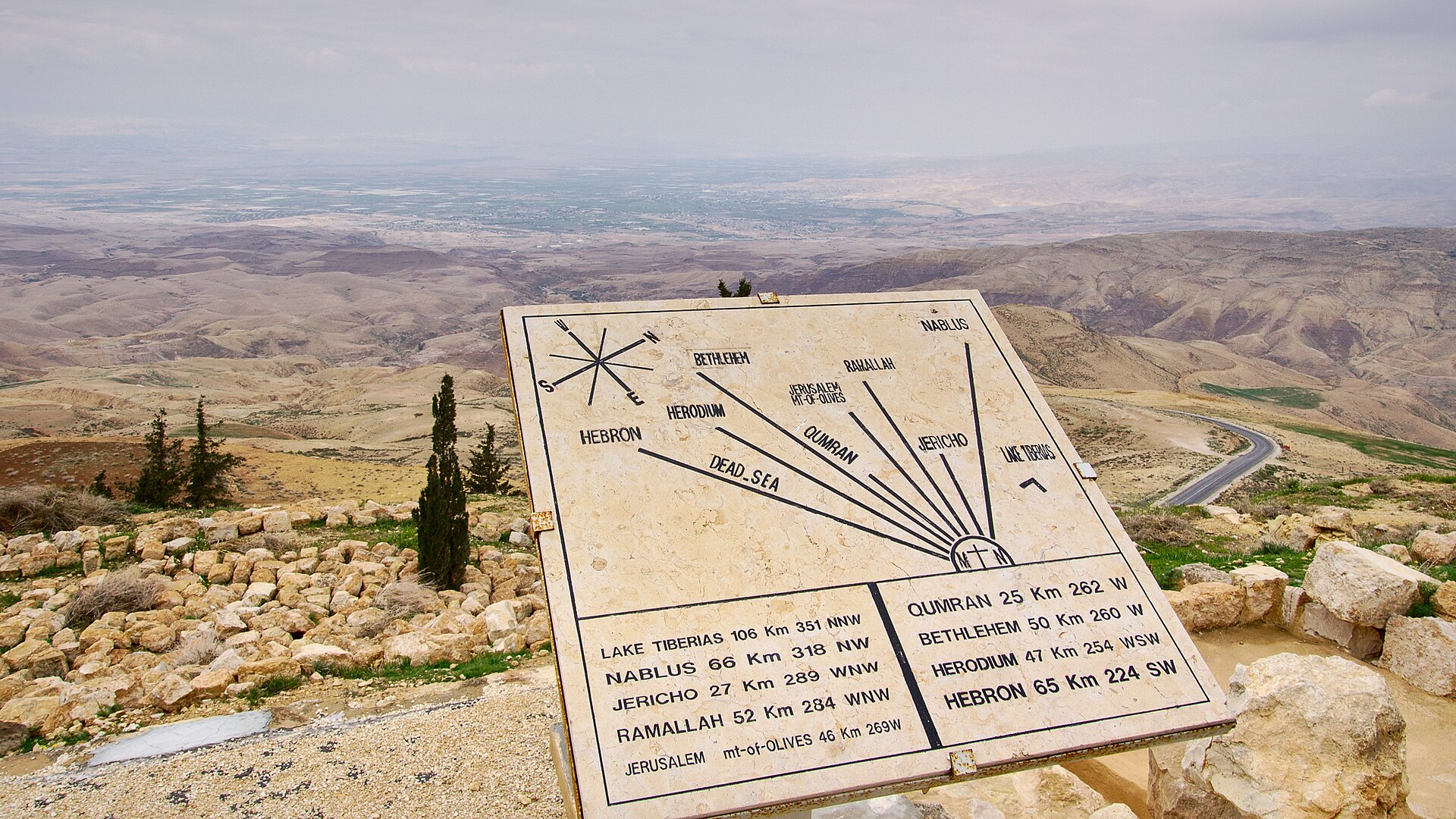
Mount Nebo rises quietly above the Jordan Valley, its slopes reaching 800 meters. On clear days, the summit reveals the Dead Sea, the Jordan River’s winding course, and the distant hills of Jericho. Sometimes, Jerusalem’s faint outline appears in the distance. The air feels unchanged since travelers first stood here, looking toward lands beyond reach.
Deuteronomy says Moses saw the Promised Land from this spot—yet never entered it. Tradition claims he died here, his burial place left unknown. Pilgrims have climbed these slopes for centuries, drawn by the view and the story. By the fourth century, Christians built a small church, later expanded. Today, mosaics remain beneath a modern shelter. Nearly 100 square meters of sixth-century work show hunting scenes, farming, real and mythical animals, fruit-laden trees, and geometric borders. The details—the curl of a lion’s mane, the texture of grapevines—are sharp enough to seem real.
The modern chapel over the mosaics is plain, letting the ancient floors stand out. Visitors walk along raised galleries, looking down at the art below while wind rattles the roof. Nearby, a bronze sculpture depicts a serpent coiled around a staff, linking Moses’ story to the Christian cross. A stone plaque marks Pope John Paul II’s 2000 visit.
The summit offers little shade, but wind cools the air even on hot days.
The viewing platform has a fence, though the drop into the valley is steep. No path leads down—only stillness, only looking out.
The site takes less than an hour to explore. Some stay longer if the weather is clear. Visibility is best from late winter to early spring, when distant hills sharpen. In summer, heat blurs the valley into a mirage. From Amman, the drive takes about 40 minutes, winding through hills before climbing to the summit. Many visit Madaba afterward, where a sixth-century mosaic map of the Holy Land adds another layer of history.
A small shop at the entrance sells postcards, books, and local crafts. A café with a terrace offers a place to sit and watch the view. On busy days, especially during religious holidays, pilgrim groups fill the site, their voices humming against the wind. But quiet moments come when the last bus leaves or when light shifts just right.
Mount Nebo has no grand monuments. Its power is in how it connects geography and faith, history and myth. The mosaics underfoot, the wind in the trees, the Dead Sea’s distant glimmer—all feel like a pause before moving on. Whether you come for the view, the history, or the stories gathered here, the mountain offers a rare sense of standing at the edge of something larger.