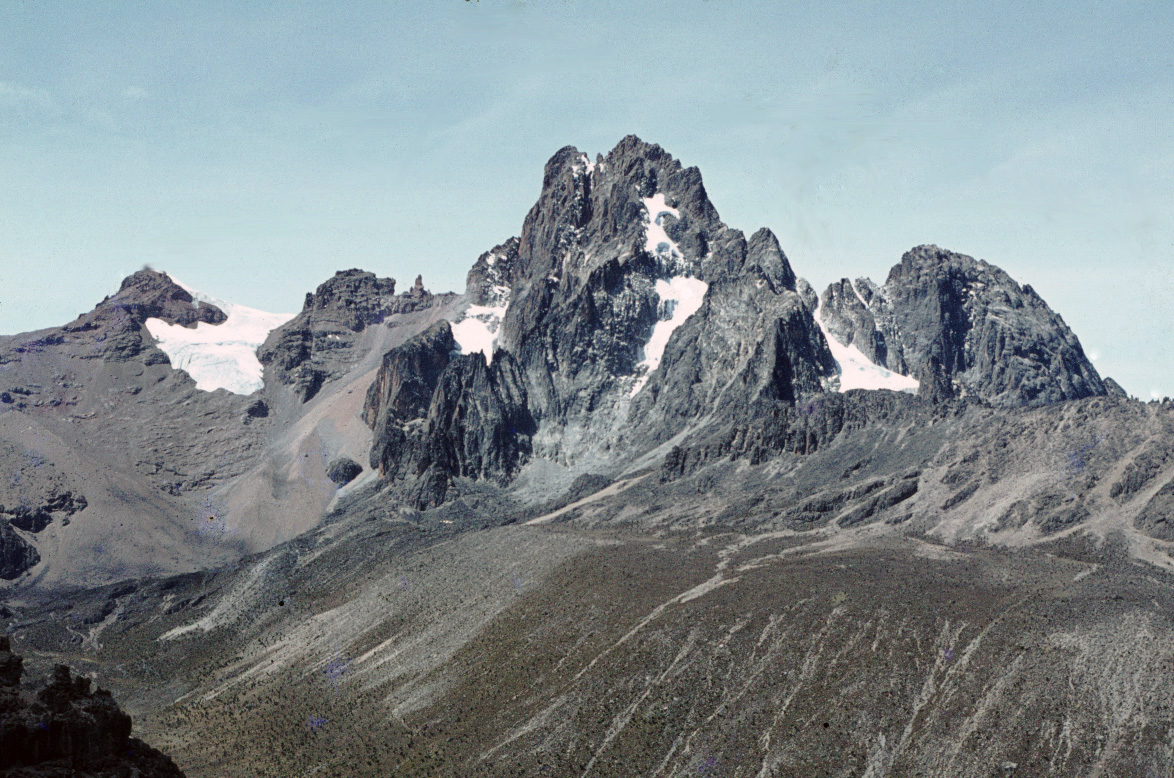
This is the highest point in Kenya and one of East Africa’s most prominent peaks. Its snow-capped summits rise from the equator, where glaciers persist despite the surrounding heat. The mountain’s slopes change with elevation: rainforests give way to alpine meadows, each zone home to species found nowhere else. For the Kikuyu and other local communities, it holds deep spiritual significance. The name *Kirinyaga*—meaning "the place of brightness"—refers to its gleaming peaks, which inspired the country’s name.
Climbing here means passing through distinct ecosystems. The journey starts in savannas where elephants and buffalo graze and ends in thin air near the summit. Batian, the highest peak at 5,199 meters, requires technical skill. Most climbers aim for Point Lenana, where sunrise reveals a vast horizon. On clear days, Kilimanjaro’s outline appears in the distance.
Europeans first documented the mountain in the late 1800s, after hearing accounts of snow on the equator. In 1899, geologist John Walter Gregory confirmed the presence of glaciers. By 1929, Eric Shipton’s team had reached the summit. Unlike Kilimanjaro, Mount Kenya remains less crowded. The trails demand effort, and solitude is easier to find.
The mountain shelters rare plants and animals. Giant lobelias and groundsels grow on its slopes, thriving in few other places. Leopards, bongo antelopes, and birds like the mountain buzzard inhabit the forests and moorlands. The national park, established in 1949, became Kenya’s first UNESCO World Heritage Site. Conservation rules are strict: visitors must stay on marked paths.
The air here feels different. Wind moves through the grass, and at night, lions call in the distance. Local guides, often Kikuyu, share stories of the mountain’s spirits. In nearby villages, rituals continue, and some springs are believed to heal. Small lodges and campsites offer quiet stays, where time slows.
Even without climbing, the mountain has much to offer. Hiking the lower slopes leads to waterfalls, streams, and ancient lava flows. Nearby farms produce coffee and tea, and visitors are often invited to taste fresh fruit or share a meal. Evenings are spent by fires, listening to stories of the mountain’s changes—how glaciers shrink, how life adapts.
Mount Kenya stays with you. It’s not about checking a box. It’s about history, endurance, and the way wild landscapes and human traditions meet. Some places aren’t just seen; they’re remembered.