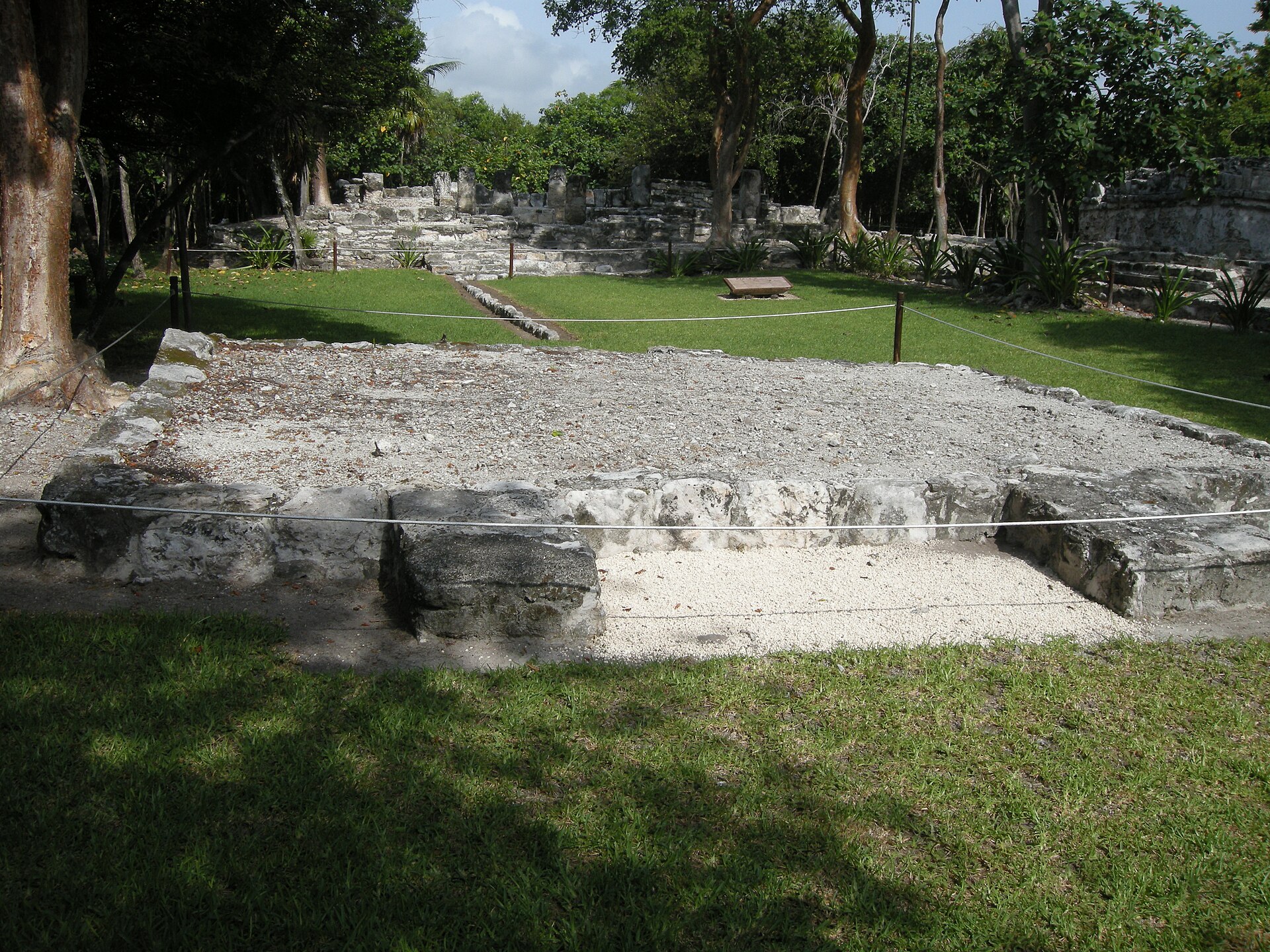
El Meco is one of those quiet discoveries that feels like a secret shared only with those who bother to look beyond the usual tourist trails. Tucked away on the edge of Cancún, far from the resort strips and crowded beaches, this small but remarkably well-preserved Maya site offers something rare: a sense of solitude and connection to the past without the distractions of souvenir stands or tour groups. It’s not as famous as Chichén Itzá or Tulum, and that’s precisely why it feels special. Here, the rustle of palm leaves and the distant cry of gulls are the only sounds competing with your thoughts as you wander among the ruins.
The site dates back to the Classic Maya period, roughly between the 3rd and 6th centuries AD, though the settlement remained inhabited well into the postclassic era, even after the arrival of the Spanish. The centerpiece is El Castillo, a twelve-meter pyramid that rises above the surrounding vegetation. Climbing its steps rewards you with a view of the Nichupté Lagoon and the Caribbean coastline, a reminder that this place was more than just a religious center—it was a landmark for sailors navigating these waters. In its prime, the pyramid would have been visible from far out at sea, a beacon guiding traders and travelers to shore.
The architecture at El Meco is typical of coastal Maya settlements: low structures built from limestone, their once-intricate carvings now worn smooth by centuries of wind and rain. Around the main pyramid, you’ll find the remains of residential areas, smaller temples, and a ball court where the ancient game of pok-ta-pok was played. Many of the buildings are aligned with the cardinal directions, a testament to the Maya’s advanced understanding of astronomy. The layout suggests a community that valued both practicality and ritual, where daily life and spiritual beliefs were closely intertwined.
El Meco’s history is deeply tied to trade. In its heyday, it was a thriving port, a hub where goods from the Yucatán’s interior and beyond changed hands. Salt, honey, cotton, and ceramics were common commodities, but so were more exotic items like quetzal feathers and cacao, brought from distant regions. The sea once lapped much closer to the settlement, making the pyramid an even more prominent feature for arriving ships. The lagoon’s shifting shoreline has since receded, but the site’s role as a commercial crossroads is still evident in the artifacts unearthed here—fragments of pottery, tools, and ornaments that hint at a bustling marketplace long gone.
What remains today are the weathered stones, but they tell a story if you look closely. Some blocks bear the marks of later repairs, evidence of efforts to restore the site during the postclassic period when the Maya sought to revive their cities after a period of decline. Archaeologists have also uncovered burials here, accompanied by ceramic vessels and jewelry, suggesting that El Meco retained some significance even after its population dwindled. It’s a place where layers of history overlap, where the past isn’t just preserved but still faintly alive.
Visiting El Meco is as much about escaping the modern world as it is about stepping into the ancient one. The site is a short drive from downtown Cancún, accessible by taxi or rental car in about twenty minutes. There’s a small entrance fee, but the absence of crowds, vendors, or even a visitor center makes it feel refreshingly unpolished. The best time to go is in the early morning, when the air is cool and the scent of saltwater mixes with the fragrance of tropical flowers. The light is softer then, casting long shadows that make the ruins feel more intimate.
Beyond the archaeological zone, the landscape is a tangle of mangroves and coastal vegetation, home to iguanas, crabs, and the occasional small crocodile. Locals sometimes call El Meco the "little Tulum," and there’s some truth to that—it has the same coastal charm, minus the tourist infrastructure. If you’re lucky, you might see children from nearby neighborhoods climbing the pyramid’s steps, playing in the shade of the ancient stones. It’s a reminder that this place isn’t just a relic; it’s part of the living landscape, a backdrop to everyday life.
There are no grand legends here, no apocalyptic prophecies or dramatic collapses. Instead, El Meco offers something quieter: the chance to stand where Maya traders, priests, and sailors once gathered, where the rhythm of daily life was shaped by the tides and the stars. The pyramid’s steps, worn smooth by time, still invite you to climb, to look out over the water and imagine the world as it was. The ruins aren’t just stones; they’re a bridge to a civilization that thrived here long before Cancún became a name on a map. And in that silence, between the wind and the waves, the past doesn’t feel so distant at all.