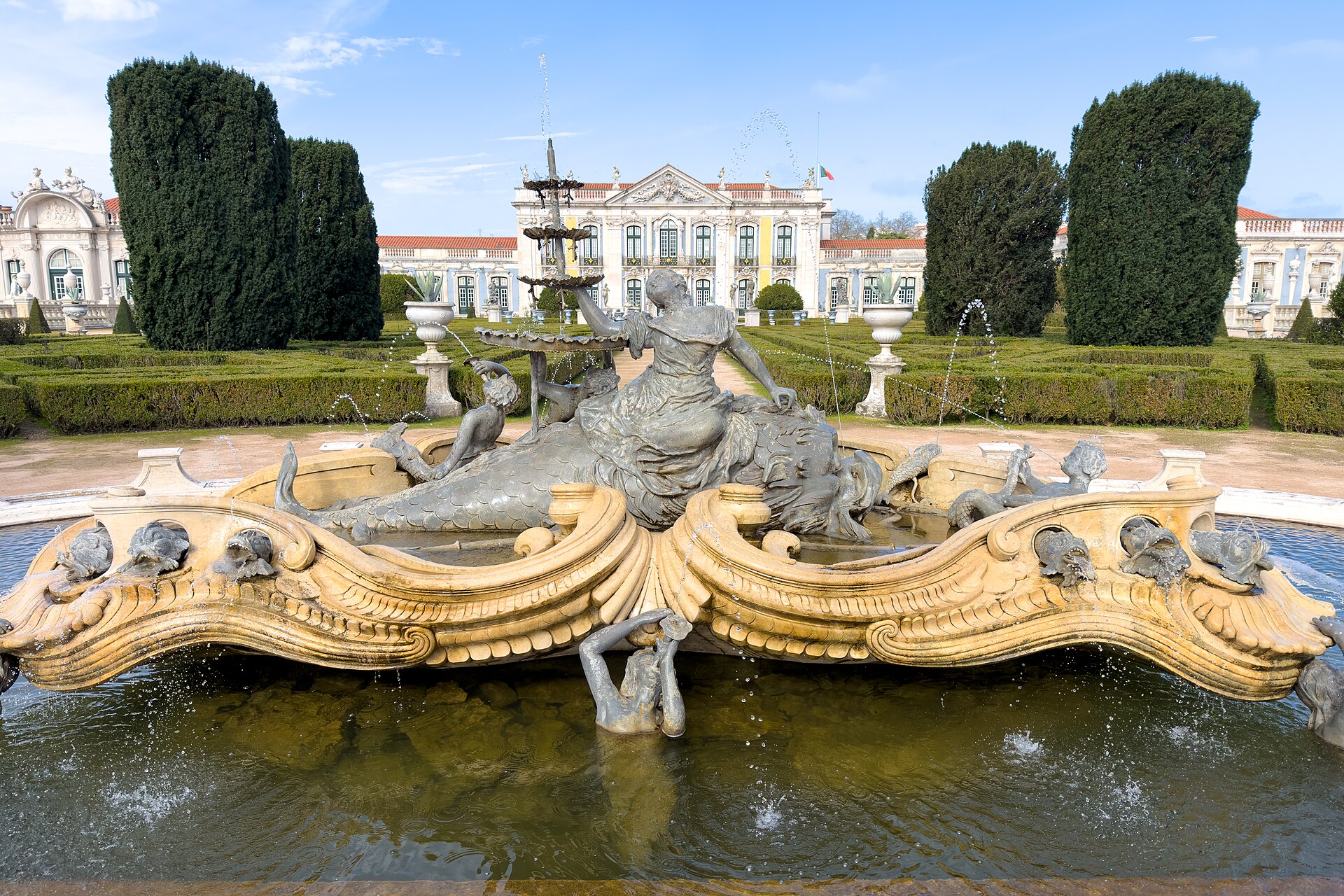
Perched on the gentle slopes outside Sintra, the Palace of Queluz feels like a place where history and fairy tale blur into one. Built in the mid-18th century, it was conceived as a retreat for Portuguese royalty, a stage for their ambitions and a canvas for their tastes. The man who shaped it most was Infante Pedro, son of King João V, who transformed it from a modest hunting lodge into a grand statement of power and culture. Pedro wasn’t just a ruler; he was a patron of the arts, gathering poets, musicians, and thinkers within its walls. The palace became a hub of intellectual and artistic life, where ideas flowed as freely as the wine at royal banquets.
The architecture of Queluz is a conversation between styles, a blend of Baroque exuberance and Neoclassical restraint. The façade is imposing yet elegant, its symmetry broken only by the playful curves of statues and the rhythmic columns that frame the entrance. Inside, the opulence is almost overwhelming—marble floors, gilded ceilings, and frescoes that tell stories of gods and heroes. The Hall of Mirrors, with its endless reflections, feels like a space designed to dazzle, while the Royal Chapel offers a quieter kind of beauty, its intricate woodwork and soft lighting inviting contemplation.
But the palace is only half the story. The gardens are where Queluz truly comes alive. Designed with the same care as the interiors, they unfold in layers of green, punctuated by fountains, pavilions, and hidden grottoes. The famous Hedge Maze is a puzzle of winding paths, a place where visitors can lose themselves in more ways than one. Nearby, a lake with swans glides past a small island, accessible by boat, adding a touch of whimsy to the landscape. The gardens were meant to be explored slowly, each turn revealing something new—a statue half-hidden in the foliage, a bench overlooking a quiet pond, or the distant sound of water trickling from a fountain.
Queluz’s golden age didn’t last. After Pedro’s death, the palace fell into decline, its treasures scattered and its walls left to the mercy of time. By the 19th century, it was a shadow of its former self, its grandeur faded. But in the early 20th century, restoration efforts breathed new life into the estate, returning it to something close to its original splendor. Today, it stands as a reminder of Portugal’s past, not just as a monument to royal excess, but as a testament to the country’s cultural ambitions.
Walking through Queluz is like stepping into a different era. The grand halls, once filled with the murmur of courtiers and the strains of a string quartet, now echo with the footsteps of visitors. Yet the atmosphere lingers—the sense of a place where decisions were made, where art was celebrated, and where the boundaries between public and private life blurred. The palace doesn’t just show how royalty lived; it reveals how they wanted to be seen. The lavish decorations, the carefully curated gardens, the very layout of the rooms—all were designed to impress, to inspire awe, and to leave a legacy.
Sintra has always been a place where myth and reality intertwine, and Queluz is no exception. It sits slightly apart from the more crowded attractions, its quiet dignity drawing those who seek something beyond the usual tourist trail. There’s a timelessness here, a sense that the palace and its gardens exist in their own rhythm, untouched by the rush of the modern world. You can spend hours wandering the grounds, watching the light shift across the façade, or simply sitting by a fountain, listening to the water and the wind in the trees.
What makes Queluz special is its ability to feel both grand and intimate. It’s a place of contradictions—where the opulence of the royal court meets the tranquility of nature, where the echoes of the past coexist with the silence of the present. It doesn’t demand attention; it earns it, slowly, through its beauty and its stories. And perhaps that’s why people return to it, not just to see it again, but to feel that connection to something larger than themselves.
Queluz isn’t just a palace; it’s a piece of Portugal’s soul. It captures the country’s love of beauty, its history of ambition, and its quiet resilience. Whether you come for the architecture, the gardens, or the sense of stepping back in time, it leaves an impression that lingers long after you’ve left. And in a world that moves too fast, that’s a rare and precious thing.