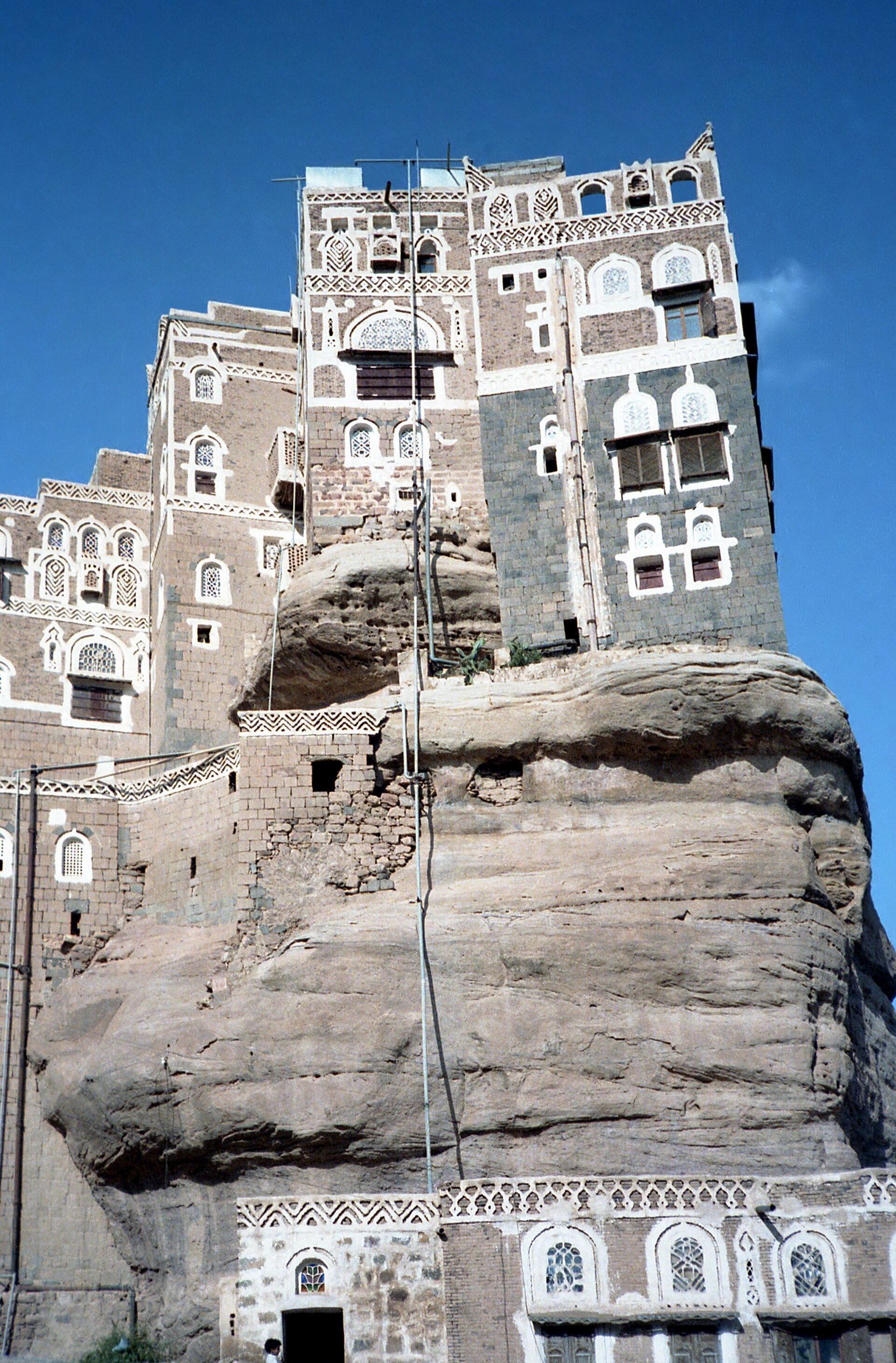
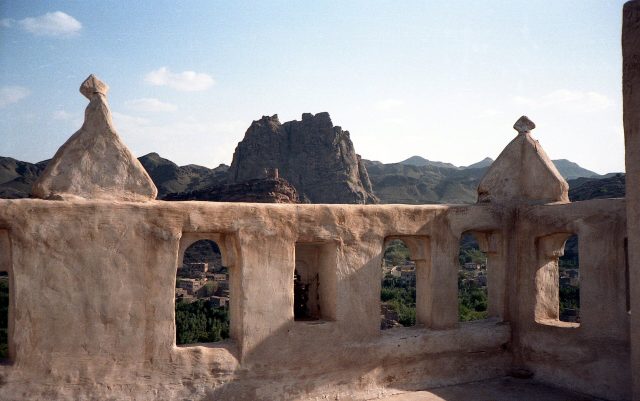
Perched on a rocky outcrop in the heart of Yemen’s Wadi Dhahr, Dar al-Hajjar feels like something plucked from a fable. The palace, often called the Stone Palace, rises from the cliffs as if it has grown there naturally, its whitewashed walls and arched windows blending into the rugged landscape. Built in the 18th century, it was once the summer residence of Imam Yahya, a ruler who sought refuge from the heat of Sanaa in this cooler, more secluded valley. The structure itself is a marvel of traditional Yemeni architecture, where every beam, staircase, and courtyard seems to have been carved with both purpose and poetry.
The approach to Dar al-Hajjar is as striking as the palace itself. The road winds through terraced fields and groves of date palms, where farmers still work the land as they have for centuries. The valley floor is a patchwork of green, contrasting sharply with the arid mountains that frame it. As you draw closer, the palace looms above, its five stories stacked like a child’s building blocks, each level slightly smaller than the one below. The effect is both whimsical and imposing, a testament to the ingenuity of its builders, who managed to create something so grand in such an unforgiving terrain.
Inside, the palace is a maze of narrow staircases, hidden alcoves, and open-air terraces. The rooms are modest by modern standards, but their simplicity is part of their charm. Wooden beams support the ceilings, and the walls are adorned with geometric patterns, a nod to the Islamic art that has influenced Yemeni design for centuries. The most striking feature is the central courtyard, where a single tree stands as a quiet sentinel. From here, the views stretch across the valley, offering a panorama of the surrounding mountains and the patchwork of fields below. It’s easy to imagine the imam and his court gathering here, sipping tea as the evening breeze carried the scent of jasmine and earth.
Dar al-Hajjar is more than just a historical curiosity; it’s a living piece of Yemen’s cultural heritage. The palace has witnessed the ebb and flow of power, from the rule of the imams to the modern era, where it has become a symbol of the country’s resilience. Despite the conflicts that have shaped Yemen’s recent history, the palace remains standing, a reminder of a time when this valley was a place of retreat and reflection. Today, it attracts visitors not just for its beauty, but for the sense of continuity it represents—a bridge between the past and the present.
The surrounding Wadi Dhahr is just as much a part of the experience as the palace itself. The valley is dotted with other historic buildings, including the Great Mosque of Wadi Dhahr, which dates back to the 10th century. The landscape is a mix of cultivated terraces and wild, rocky slopes, where herders graze their goats and the occasional fox can be spotted at dusk. The air is cooler here than in Sanaa, and the light has a soft, golden quality that makes even the simplest scenes feel like a painting.
Visiting Dar al-Hajjar is not just about seeing a historic site; it’s about stepping into a different rhythm of life. The pace here is slower, dictated by the cycles of the sun and the seasons. There are no grand museums or guided tours, just the quiet presence of the palace and the valley it overlooks. For those willing to wander beyond the main structure, there are hidden paths leading to smaller buildings and viewpoints, each offering a new perspective on the landscape. It’s a place that rewards curiosity, where the real discovery is not just the architecture, but the sense of time standing still.
The palace has also become a canvas for local artists and storytellers. Its walls have inspired countless poems, songs, and paintings, each capturing a different facet of its allure. Some see it as a symbol of Yemen’s golden age, while others view it as a reminder of the country’s enduring spirit. Whatever the interpretation, Dar al-Hajjar has a way of lingering in the memory long after the visit is over. It’s the kind of place that feels both ancient and alive, a rare blend of history and immediacy.
For those who make the journey, Dar al-Hajjar offers a glimpse into a Yemen that is often overshadowed by headlines. It’s a place where the past is not just preserved, but still very much present. The palace stands as a testament to the skill of its builders, the vision of its rulers, and the resilience of the people who have called this valley home. In a world that often feels rushed, it’s a reminder of the beauty that can be found in stillness, in the quiet moments when history and landscape come together in perfect harmony.