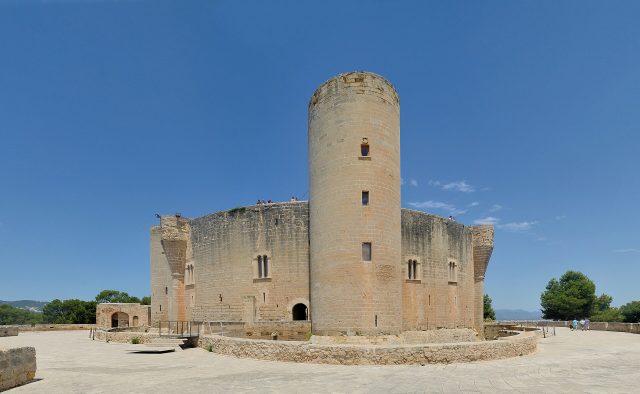
Perched on a rise overlooking Palma’s sweeping bay, the Almudaina Palace is one of those rare places where history isn’t just preserved—it’s still unfolding. The building stands as a silent witness to the city’s transformations, its thick stone walls holding centuries of power, conflict, and cultural exchange. What you see today is the result of layer upon layer of reinvention, each era leaving its mark without erasing what came before. The Romans built the first fortifications here, the Moors shaped it into a palace of fountains and gardens, and the Christian kings later turned it into a seat of royal authority. Now, it serves as both a museum and an active government space, a living bridge between Mallorca’s past and present.
The palace’s origins trace back to the island’s Roman period, when it was little more than a military stronghold guarding against pirate raids. But it was under Moorish rule, from the 10th to the 13th centuries, that the Almudaina took on the form that still defines it. The Moors transformed the Roman ruins into an elegant residence, blending defensive architecture with the refined aesthetics of Al-Andalus. Their influence lingers in the arched doorways, the intricate water systems, and the quiet courtyards where sunlight filters through latticework. Even after the Christian conquest in 1229, these elements weren’t destroyed but adapted, a testament to the pragmatism of the new rulers.
When King James I of Aragon claimed Mallorca for Christendom, he made the Almudaina his royal residence, turning it into the political heart of the island. The palace became a place of judgment, where courts convened and decrees were issued, and a vault for the kingdom’s treasures. Over time, Gothic and Renaissance additions softened its military edges—new halls were decorated with heraldic emblems, frescoes, and tapestries, while the exterior took on a more European character. Yet the Moors’ legacy remained visible, woven into the fabric of the building like threads in a tapestry. The result is a structure that feels both imposing and intimate, a palace that has always been more than just a fortress.
Walking through the Almudaina today is like moving through time. The Gothic halls, where Mallorca’s medieval parliament once met, still echo with the weight of old debates. The royal chambers, furnished with carved wood and faded textiles, offer a glimpse into the private lives of kings and queens. The 13th-century Chapel of Santa Ana, with its simple stone altar, stands in quiet contrast to the opulence of the state rooms. But perhaps the most striking space is the central courtyard, where fragments of Roman columns and Moorish baths sit side by side under the open sky. It’s a place where the layers of history aren’t just displayed—they’re felt.
The palace’s connection to Palma goes beyond its walls. From its elevated position, the views stretch across the old city to the harbor, where ships once arrived from Genoa, Venice, and North Africa. In the Middle Ages, the Almudaina wasn’t just a royal residence; it was a hub of trade and diplomacy. Merchants haggled over silk and spices in its shadow, while ambassadors negotiated alliances in its halls. Today, the narrow streets leading up to the palace still hum with that same energy, as if the past and present are in constant conversation.
What makes the Almudaina unusual is that it hasn’t been relegated to the role of a static monument. While parts of it are open to the public as a museum, the palace remains an active government building. Official ceremonies, state receptions, and even parliamentary sessions still take place within its walls. This dual role gives the place a sense of continuity—it’s not frozen in time but evolving, just as it always has. The same stones that once bore witness to Moorish emirs and Christian kings now host modern politicians, a reminder that history isn’t just something to observe from a distance.
Visiting the Almudaina isn’t just about admiring architecture or ticking off a list of historical sights. It’s an invitation to consider how places absorb the weight of time. Here, every corner tells a story: of Roman soldiers patrolling the walls, of Moorish poets composing verses in the gardens, of medieval kings holding court beneath vaulted ceilings. The palace doesn’t just preserve these moments—it carries them forward, allowing them to resonate in the present. In a city where cultures have always collided and coexisted, the Almudaina stands as proof that history isn’t a single narrative but a conversation, one that’s still being written.