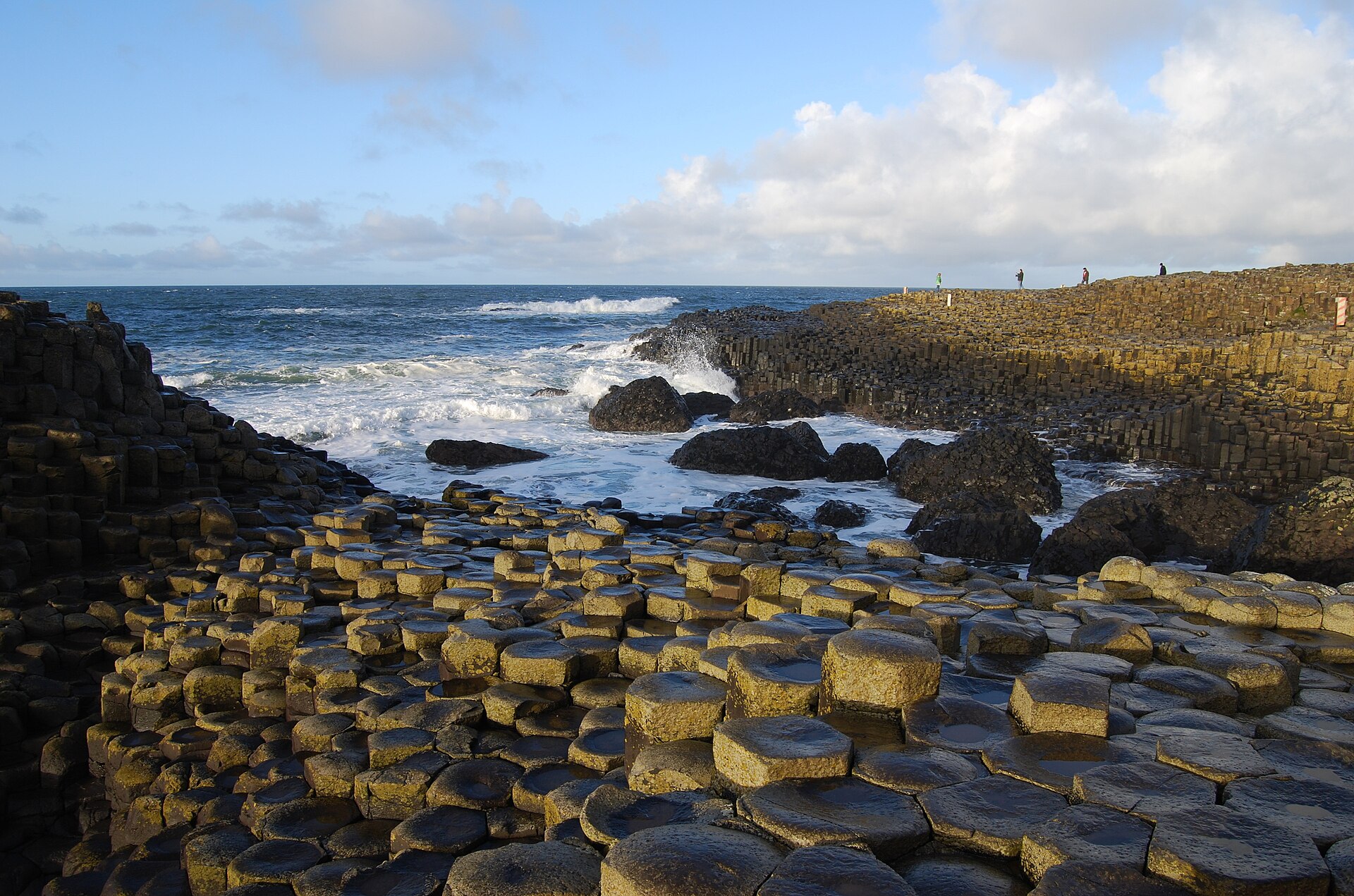
The Giant’s Causeway is one of those rare places where nature seems to have set out to prove just how precise it can be. Stretching along the northern coast of Northern Ireland near the village of Bushmills, this extraordinary formation consists of over forty thousand interlocking basalt columns, their hexagonal shapes so uniform they could almost pass for man-made. They were formed around fifty to sixty million years ago, when molten lava cooled and contracted, cracking into these near-perfect geometric forms. Some of the columns rise as high as twelve metres, while others barely break the surface, yet together they create the illusion of a vast, ancient pavement leading straight into the sea.
Local legends offer a far more colourful explanation for how the Causeway came to be. The most famous tells of Finn McCool, an Irish giant who built the path to cross the sea and challenge his Scottish rival, Benandonner. When Finn saw how enormous his opponent was, he disguised himself as a baby, lying in a cradle, and his quick-thinking wife told Benandonner that this was Finn’s child. Horrified at the thought of how big the father must be, the Scottish giant fled back across the Causeway, tearing it up behind him to prevent pursuit. The story is pure myth, of course, but it has woven itself so deeply into the fabric of the place that it still feels like part of the landscape, as if the stones themselves might whisper it to you on a quiet day.
Geologists know the Causeway as a textbook example of columnar jointing, a phenomenon that occurs when lava cools and fractures in a specific pattern. While similar formations exist elsewhere—on Scotland’s Isle of Staffa or in Iceland, for instance—nowhere else do they appear on such a grand and dramatic scale. The precision of the columns is so striking that for centuries, people debated whether they were natural or the work of human hands. In 1986, UNESCO recognised the site as a World Heritage Site, cementing its status as one of the planet’s most remarkable geological wonders.
Most visitors begin their exploration from the main viewpoint, where the full sweep of the columns comes into view, disappearing into the waves. From here, you can see how the sea has worn away at the basalt over millennia, breaking off chunks and reshaping the edges. At low tide, it’s possible to descend to the water’s edge and walk among the columns, feeling their cool, rough surfaces underfoot. Some are smooth, polished by time and tide, while others are slick with moss or seaweed, especially where the spray regularly reaches them. On a clear day, the sunlight catches the wet stone, turning the Causeway into a shimmering mosaic, and the horizon blurs into the sky.
A short walk from the main formation is the visitor centre, a low-slung building designed to blend into the landscape. Its grass-covered roof and stone walls make it almost disappear into the surroundings, and inside, displays explain the science and history behind the Causeway. There’s also a café serving simple, hearty Irish food—think thick soups, fresh soda bread, and strong tea—and a small shop selling locally made crafts. From here, several walking trails branch out along the coast. One leads to the Amphitheatre, where the columns curve into a natural semicircle, while another takes you to Benbane Head, where the cliffs drop sharply into the ocean and the views stretch for miles.
The Giant’s Causeway isn’t just a geological marvel; it’s part of a broader landscape rich in history and folklore. Nearby, Dunluce Castle clings to the edge of a cliff, its ruins dating back to the 16th century, while Finn McCool’s Cave, named after the legendary giant, offers a glimpse into the myths that still shape the area. Locals are happy to share these stories, often with a dry wit that makes them even more memorable. The coast itself is dotted with traditional pubs where live music spills out into the evening, and a glass of something warm—whiskey, perhaps, or a dark Irish stout—helps take the edge off the sea breeze.
The weather here is famously unpredictable, and the Causeway changes with the seasons. In summer, it’s a bustling place, with visitors from all over the world wandering among the stones. Autumn and spring bring rougher seas, the waves crashing against the basalt with a thunderous roar, while winter transforms the landscape into something stark and solitary. The wind howls through the gaps between the columns, and mist often rolls in, softening the edges of the world. It’s in these quieter moments that the Causeway feels most alive, as if the ancient forces that shaped it are still at work.
For photographers, the Causeway is a dream. Every angle offers something new—the columns might look like a perfectly ordered grid one moment, then like the pipes of a vast stone organ the next. At sunset, the basalt glows in shades of gold and rose, while the shadows stretch long and deep. Many return again and again, chasing the light at different times of year, each visit revealing another facet of the place. Even those who don’t consider themselves photographers often find themselves reaching for their cameras, unable to resist the pull of such a striking scene.
What makes the Giant’s Causeway so compelling isn’t just its beauty, but the way it makes you feel. It’s a place where the past and present collide, where science and myth exist side by side, and where the sheer scale of nature’s work is impossible to ignore. You could spend an hour here, wandering between the columns and listening to the rhythm of the waves, or you could linger for days, exploring the rugged coastline, sampling local food, and soaking in the atmosphere of the nearby villages. Either way, it’s the kind of place that stays with you—not just as a memory, but as a sense of having touched something timeless.