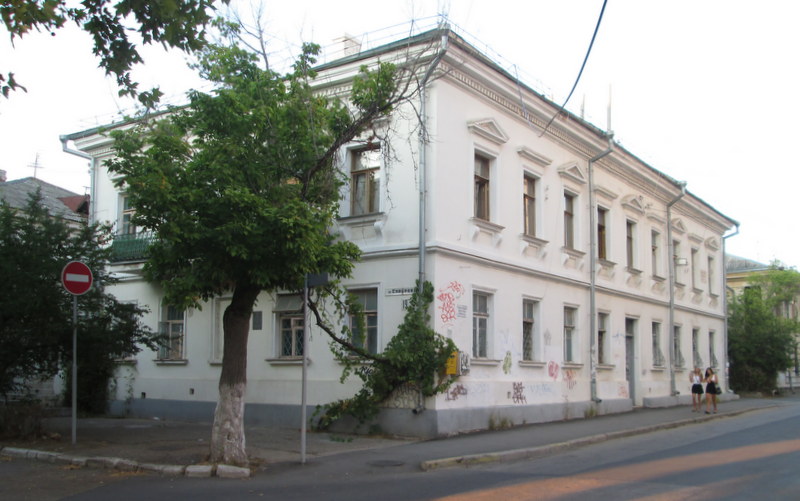
The house on Lenin Street holds stories of the people and events that shaped the city. It isn’t a museum, nor is it crowded with visitors. That’s why it feels different. History here isn’t staged—it clings to the bricks, the cracks in the walls, the stillness of the courtyard. The building stands in Sevastopol’s center, where every stone carries the past, from imperial times to the Soviet era and beyond.
Built between the late 1800s and early 1900s, the house reflects Sevastopol’s growth after the Crimean War. The city was expanding, becoming a major port and resort, and the Volokhov House shows the eclectic style of the period. Classical proportions mix with decorative details: stucco, framed windows, and wrought-iron balconies. Inside, the layout probably followed the standard of the time—high ceilings, marble staircases, and a courtyard with outbuildings and a garden.
The house is named after its first owner, a merchant. The Volokhovs were part of a class that invested in real estate and trade, driving the city’s development. At the turn of the century, Sevastopol was a hub of commerce and leisure, and families like theirs played a key role. The house was built as a rental property, home to naval officers, civil servants, merchants, and later, Soviet bureaucrats. Some say notable figures stayed here, but without records, those stories remain just that.
Like much of Sevastopol, the house suffered in World War II. The city endured two sieges, in the 1850s and the 1940s, and each time, it was rebuilt. The house survived, though not untouched. Some decorative elements were lost, and post-war restoration was practical rather than precise. The stucco was simplified, parts of the facade changed, but the building kept its character. Today, it looks much as it did a century ago, except for modern windows and doors.
In the Soviet era, the house remained a home for sailors’ families, port workers, and officials. Sevastopol was a closed city then, life moving at a slower pace. The Volokhov House was part of that rhythm—people lived, worked, raised children, and celebrated within its walls. Old mailboxes still bear residents’ names, and the walls show layers of repairs from different decades.
What makes the house special now is that it’s still alive. Unlike museums, where everything is polished and curated, this building feels real. History isn’t just preserved here—it’s tangible. You can feel it in the rough walls, the creaking doors, the scent of aged wood and plaster. The courtyard hums with children playing or neighbors returning from the market. It’s not a relic; it’s a home.
For those curious about Sevastopol’s past, the house offers a glimpse of the city’s evolution. It stands at the intersection of eras—imperial, wartime, Soviet, and modern—each layer visible if you look closely. The house doesn’t tell its story outright. You piece it together from memories, old photos, and traces left behind. It invites observation, not explanation. The past isn’t recounted here; it’s felt.
Many old buildings in Sevastopol have similar stories. Tenement houses, mansions, and barracks survived wars and revolutions. What sets this one apart is that it hasn’t become a museum exhibit. It’s still a home, even if life has changed. That authenticity makes it worth noticing.
Walk down Lenin Street and look for this unassuming building. It doesn’t demand attention. It exists quietly, as much a part of the city as the people inside. That’s the beauty of such places—they don’t just tell history. They let you experience it.