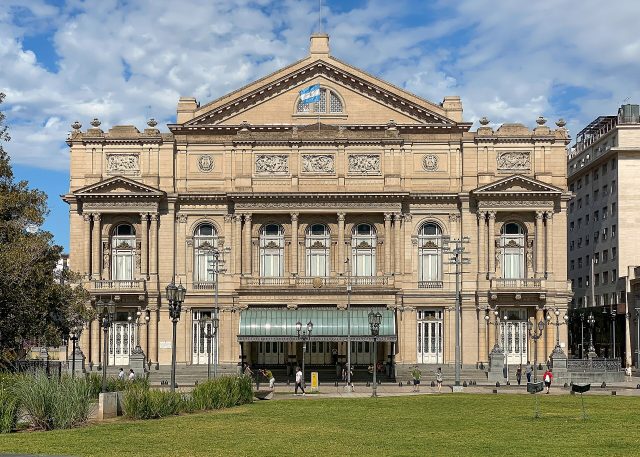
The Casa Rosada, or Pink House, stands on the eastern side of Buenos Aires’ main square, a striking presence in the heart of the city. Its unusual color is the first thing that catches the eye—an unexpected choice for a presidential residence. There are two explanations for the hue. The practical one dates back to the nineteenth century, when paint was mixed with bull’s blood to protect the plaster from damp. The political version is more symbolic: pink was created by blending the red and white of Argentina’s once-rival factions, a gesture of unity chosen by President Domingo Sarmiento in the 1860s.
The building itself is a patchwork of history. It began as two separate structures—the old colonial fort and the post office—merged in the 1880s with an arch that still defines its asymmetrical facade. The fort, built in the late sixteenth century, was the seat of Spanish colonial power before Argentina’s independence. Over time, it was expanded, demolished, and rebuilt, leaving behind layers of stone and brick that tell a story of shifting authority. The post office, added later, was designed in the grand European style of the era, with high ceilings and ornate details that contrast with the fort’s more austere origins.
One of the most famous features of the Casa Rosada is its balcony, a stage for history. It was from here that Eva Perón addressed the crowds in the 1940s and 50s, her speeches becoming legendary moments in Argentine politics. The image of her standing there, surrounded by supporters, has been immortalized in films and musicals, turning the balcony into a symbol of both populism and the country’s turbulent political past. Other presidents have used it too, though none with quite the same dramatic flair.
Inside, the building houses a museum that offers a glimpse into Argentina’s political life. The rooms are filled with portraits of past leaders, their stern expressions watching over visitors as they move through the grand halls. The presidential office, preserved as it was in the early twentieth century, feels like a time capsule, with heavy wooden furniture and gilded accents. The ceremonial staircases, wide and imposing, lead to the upper floors where official business once took place. But the most intriguing part of the museum lies below ground. Here, archaeologists have uncovered the foundations of the old fort and the nineteenth-century customs house, their stone walls still intact beneath the modern structure. It’s a rare chance to see the layers of history that lie beneath the city’s surface.
Visiting the Casa Rosada isn’t as straightforward as walking in off the street. The presidential residence itself is only open for guided tours on weekends, and spots are limited. You’ll need to book in advance and bring your passport—no exceptions. The tours are free, but they fill up quickly, so it’s worth planning ahead. The underground museum, however, is more accessible. It’s open from Wednesday to Sunday, with no need for reservations, and entry is free. The entrance is tucked away on the river side of the building, not the main square, so it’s easy to miss if you’re not looking for it.
Security is tight, as you’d expect for a working government building. Bags are checked at the entrance, and tripods aren’t allowed inside. Photography is permitted, though, so you can capture the details of the architecture and the artifacts on display. Outside, the building is always visible, its pink facade glowing under the evening lights. On days when protests or demonstrations take place, the area around the square is often cordoned off, so it’s worth checking ahead if you’re planning to visit.
The Casa Rosada isn’t just a museum or a government office—it’s a living piece of Argentina’s history. The building has witnessed coups, elections, and countless political dramas, its walls absorbing the weight of the country’s past. Even if you don’t go inside, standing in the square and looking up at its facade is a reminder of how deeply history is woven into the fabric of Buenos Aires. The pink color, the uneven lines of the architecture, the echoes of speeches from the balcony—it all adds up to a place that feels both grand and deeply human.