The Quinta de San Pedro Alejandrino in Santa Marta is one of those rare places where history feels immediate, almost tangible. This unassuming single-story house, with its whitewashed walls and terracotta roof, was the final refuge of Simón Bolívar, the man who shaped the destiny of much of Latin America. It stands in a quiet part of the city, away from the usual tourist paths, preserving the atmosphere of the early 19th century when Bolívar, exhausted and ill, arrived here seeking rest and recovery. Today, it is more than a museum—it is a memorial to the fragility of human life and the enduring legacy of those who alter the course of history.
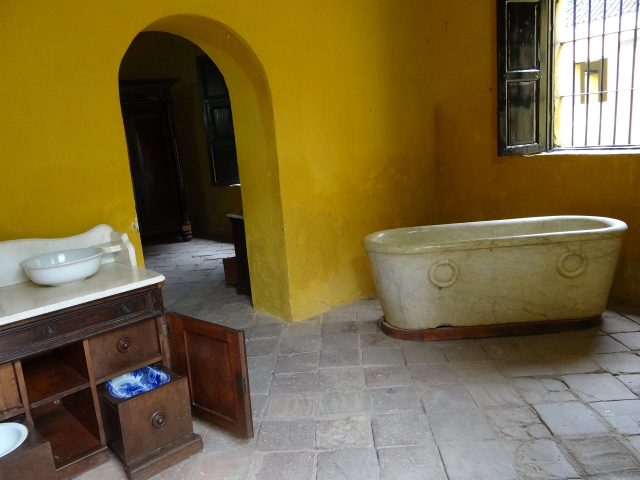
The building itself is modest, yet its significance is immense. Constructed in the colonial style typical of Colombia’s Caribbean coast, it features thick walls to keep out the heat, high ceilings for airflow, and small windows with wooden shutters. Inside, the furnishings remain simple, much as they were in Bolívar’s time: basic furniture, household items, documents, and personal effects. Each room tells a part of the story—where he dictated letters, received visitors, and ultimately died on December 17, 1830. The museum avoids grandeur, and that is its strength. It doesn’t celebrate pomp but rather the humanity behind the legend.
Bolívar arrived in Santa Marta in December 1830, already gravely ill. Years of war, political betrayals, and personal disillusionment had taken their toll. He had liberated vast territories—modern-day Colombia, Venezuela, Ecuador, Peru, Bolivia, and Panama—from Spanish rule, only to see his dream of a united Gran Colombia crumble. His final months were marked by bitterness and regret. It was here, in this house, that he wrote his famous lament: *I sowed dragons and reaped fleas.* Those words capture the tragedy of a man whose vision of a free and united Latin America remained unfulfilled.
The museum does more than document Bolívar’s last days. It also offers a broader perspective on his life, the independence movement, and the people who stood beside him. Exhibits include battle maps, copies of letters, portraits of allies and adversaries, and weapons of the era. The displays place Bolívar’s story in context, showing what life was like in the early 1800s, the ideas that inspired people, and the hopes they held for the future. Together, these elements paint a vivid picture not just of Bolívar himself, but of an entire era.
Santa Marta, the oldest city in Colombia, founded in 1525, is a living museum in its own right. Its streets blend colonial history, Indigenous traditions, and African influences brought by enslaved people. The Quinta de San Pedro Alejandrino sits near the historic center, where churches, plazas, and colonial mansions still stand. Walking through the city after visiting the museum helps explain why Bolívar chose this place for his final days. Santa Marta was more than a refuge—it was a place where he could reflect on his life, the lands he had freed, and the people he had fought for.
Today, the house serves as both a memorial and a space for reflection. Lectures, exhibitions, and discussions on Latin American history, culture, and politics are often held here. For many visitors—Colombians and foreigners alike—it becomes a place to connect with the past, to ponder the cost of freedom, the role of individuals in history, and what remains after great figures are gone. The quiet of the museum’s halls carries echoes of the past, as if the walls still hold the sound of Bolívar’s footsteps.
This is not a typical museum visit. There are no flashy displays or interactive exhibits, but there is something far more meaningful: a sense of authenticity. Every object, every inscription, every corner of the house reminds you that history is not just dates and facts—it is made up of real lives. Bolívar, despite his greatness, was a man who grew tired, fell ill, doubted himself, and ultimately died far from home. That humanity makes his story relatable, even intimate.
For those interested in Latin American history, the Quinta de San Pedro Alejandrino is a must-visit. But even if you’re not a history buff, there is something here for everyone. Perhaps it’s the stillness of the inner courtyard where Bolívar once walked, or the view from the windows onto streets that have changed little in two centuries. Or maybe it’s the realization of how fragile yet powerful a single life can be—how one person’s struggles and dreams can shape the fate of nations. Whatever it is, leaving this house, you understand that history isn’t just something that happened long ago. It lives on, in the places we preserve and the stories we tell.