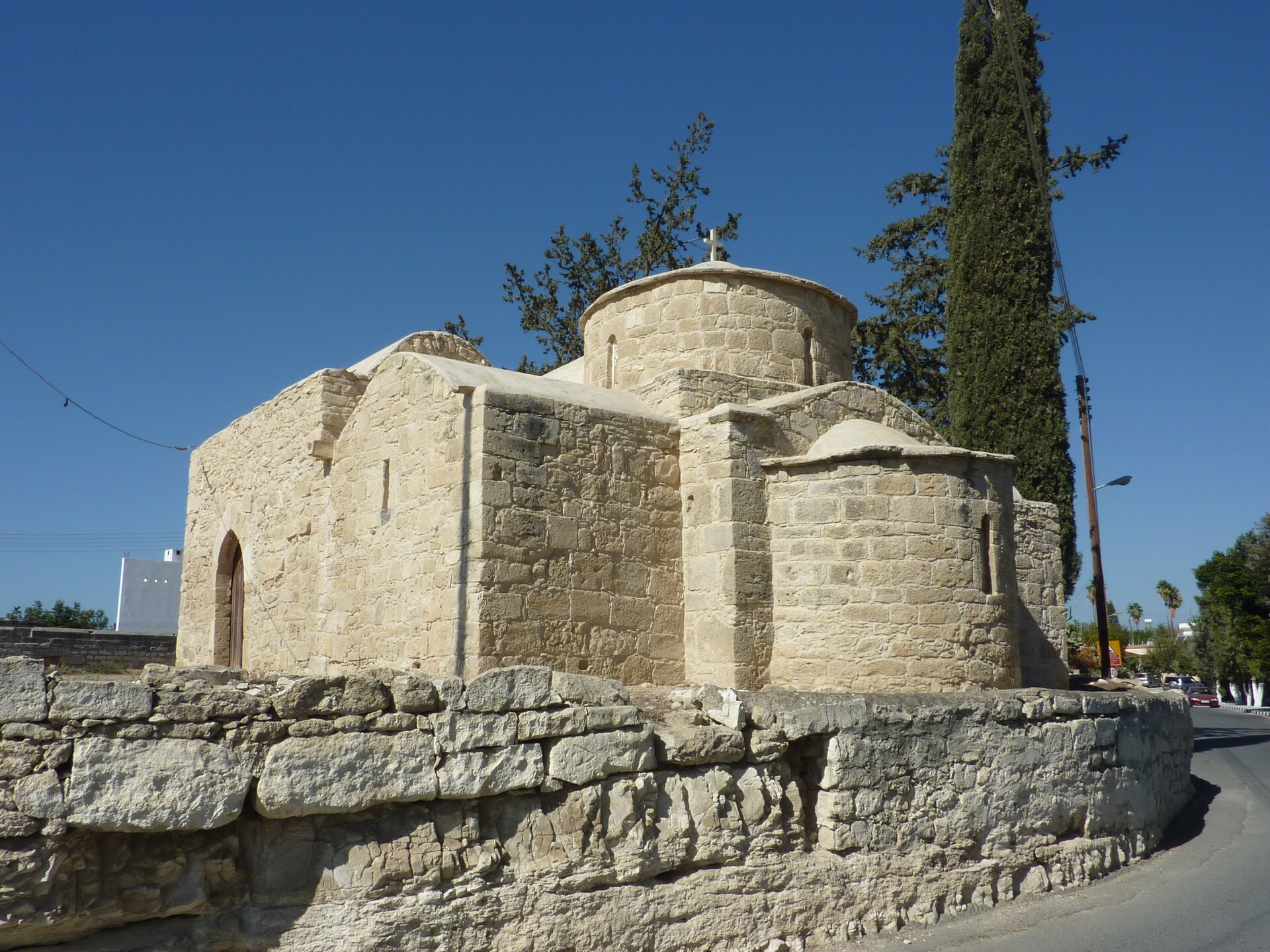
The Church of Saint Eustathios in Colossi is one of those quiet places in Cyprus that feels suspended in time, untouched by the rush of the modern world. Tucked away on the edge of the village, it stands surrounded by olive groves and vineyards that have been cultivated here for centuries. Unlike many of Cyprus’s churches, famous for their frescoes or mosaics, this small structure draws visitors not for its interior decoration but for its understated presence—a building that has become part of the landscape itself, as if it grew from the earth rather than being built upon it.
The church dates back to the 13th century, a time when Cyprus was under the rule of Frankish kings and part of the Crusader Kingdom of Jerusalem. These lands belonged to the Knights Hospitaller, a military order that did more than protect pilgrims; they also constructed fortresses, hospitals, and churches across the island. Saint Eustathios likely served as a chapel for the knights stationed at nearby Kolossi Castle, one of the most formidable strongholds of the era. The castle still looms in the distance, a reminder of when this region was a frontier of the Christian world in the East.
The architecture is distinctly Gothic, a style brought to Cyprus by the Crusaders. Built from local limestone, the stone has mellowed over the centuries into a warm golden hue. The facade is simple: narrow pointed windows, a sturdy door with a rounded arch, and a small bell tower above the entrance. Inside, the church is modest—a single nave with a semicircular apse where the altar once stood. The walls are bare, without paintings or elaborate carvings, yet the space feels far from empty. Sunlight filters through the slender windows, casting long, soft shadows across the stone floor, creating an atmosphere of quiet reflection.
What makes Saint Eustathios remarkable is how it has survived the centuries almost unchanged. While many medieval structures on the island were rebuilt, repurposed, or left to ruin, this church has retained its original form. Perhaps its survival is due to its unassuming role—it was never a cathedral or a monastery, so it escaped the attention of conquerors and reformers. Even during the Ottoman period, when many Christian churches were converted into mosques, Saint Eustathios continued to serve the local community as a place of worship.
Today, the church is open to visitors, though it sees far fewer tourists than the island’s more famous sites. Its value lies in its stillness, in the way it offers a glimpse into the past without the crowds or fanfare. The surrounding fields and orchards stretch out in every direction, with the Troodos Mountains rising in the distance, their slopes covered in pine forests. Colossi itself is a quiet place, where the only sounds are the occasional passing car or the crow of a rooster at dawn. Those who make the journey here often remark on the sense of continuity—the feeling that the church still holds the memories of those who prayed within its walls centuries ago: knights, farmers, pilgrims whose names are long forgotten but whose presence lingers in the stones.
Saint Eustathios, the martyr after whom the church is named, was a figure revered in both the Eastern and Western Christian traditions. According to legend, he was a Roman general who converted to Christianity after witnessing a vision of Christ between the antlers of a stag. He and his family later suffered martyrdom for their faith. While his name isn’t as widely recognized on Cyprus as those of other saints, here in Colossi, it has found a quiet home.
A visit to the church pairs naturally with a trip to Kolossi Castle, just a short walk away. Built in the same era, the castle was the residence of the Grand Commander of the Knights Hospitaller and played a crucial role in defending Cyprus’s southern coast. Its massive walls and tower remain well-preserved, with traces of medieval frescoes and inscriptions still visible inside. Together, the church and castle offer a complete picture of the region’s history—a time when these lands were a crossroads of cultures, religions, and power struggles.
Colossi itself is a small village, but its history is deeply tied to the production of wine and sugar. In the Middle Ages, the area was home to sugarcane plantations, and later, vineyards that produced Commandaria, a sweet dessert wine known since the time of the Crusaders. This wine, still made in the surrounding hills using ancient methods, was once enjoyed by knights and merchants alike. Some local wineries offer tastings, and if you’re lucky, you might sample a glass of the same wine that has been produced here for centuries.
The Church of Saint Eustathios isn’t a place for grand gestures or Instagram-worthy moments. It’s for those who seek stillness, who want to feel the weight of history without the noise of tourist crowds. There are no guides here, no loud explanations, no queues. Just stone, light, and the wind rustling through the olive trees. Perhaps that’s why the church retains its quiet magic—the kind that makes you want to return, not for something new, but for the sense of timelessness it offers.