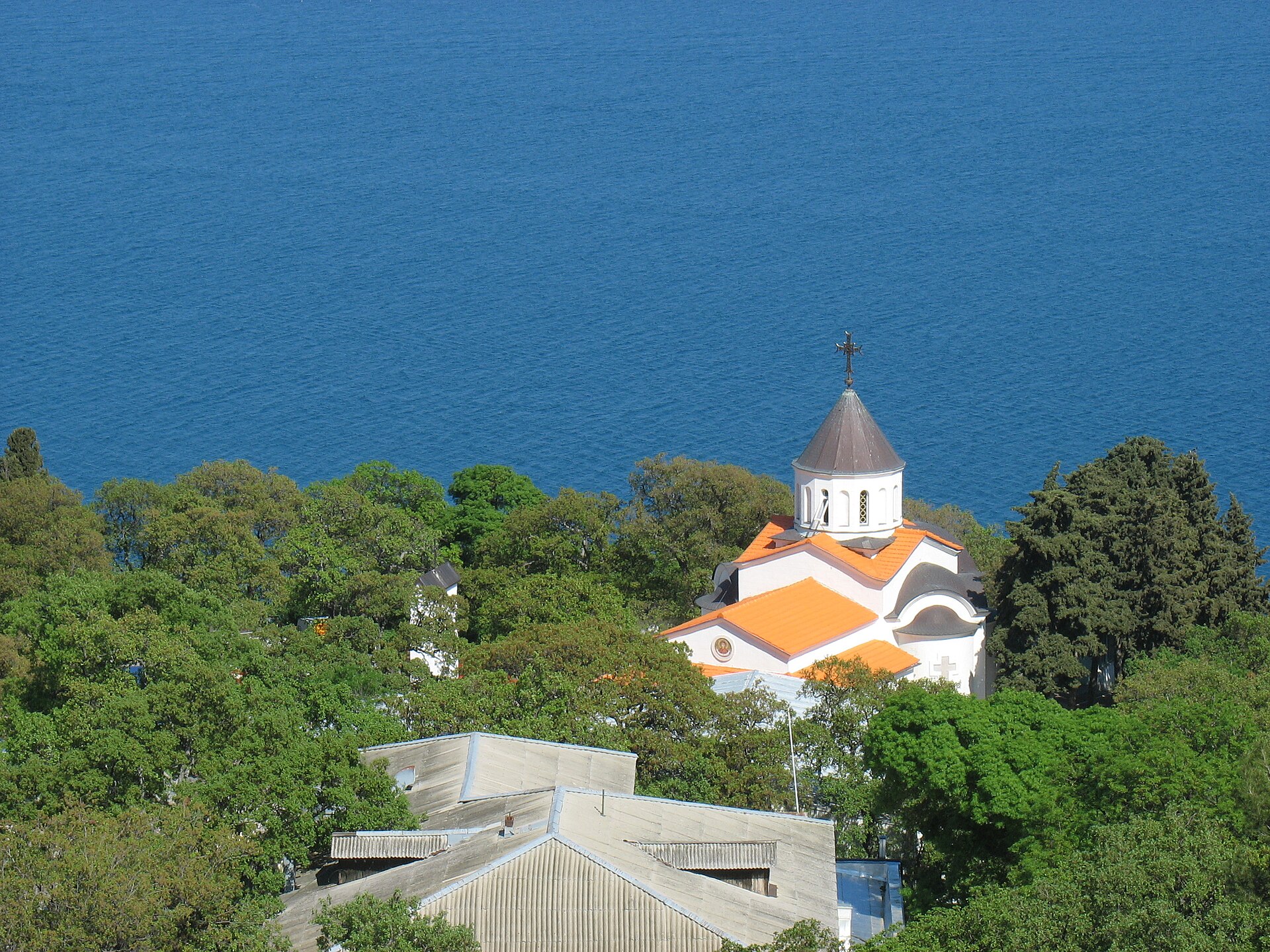
Photo: Сергій Криниця (Haidamac), CC BY-SA 3.0
Church of the Intercession of the Holy Virgin
out of 5 0 ratingsPerched on a gentle hill along Crimea’s southern coast, the Church of the Intercession of the Holy Virgin feels like a quiet guardian of time. Surrounded by greenery and the distant murmur of the sea, it occupies a spot where the land seems to breathe—where the mountains soften into the shore and the air carries the scent of pine and salt. The church is small, almost unassuming at first glance, yet its presence lingers in the way only places steeped in history can. Built in the mid-19th century, it emerged during an era when Crimea was transforming into a retreat for Russia’s elite, a place where aristocrats, artists, and the imperial family sought refuge from the capital’s formality.
The church’s architecture blends the elegance of Neo-Byzantine design with the understated grace of traditional Russian ecclesiastical buildings. Its proportions are harmonious, with a single dome rising above slender arches, evoking the simplicity of early Christian structures while still feeling distinctly of its time. Inside, the space is intimate, almost austere, but the lack of ornate decoration only amplifies the sense of tranquility. The iconostasis, crafted in a restrained classical style, draws the eye without overwhelming, its wooden panels and icons bathed in the soft, filtered light that spills through narrow windows. There are no grand frescoes or gilded excesses here—just the quiet dignity of craftsmanship that has endured.
The church’s origins are closely tied to Emperor Nicholas I, who frequented Oreanda and took a personal interest in its construction. Local lore suggests he himself chose the site, envisioning it as a spiritual anchor for the region’s residents and visitors. The architect’s name has been lost to time, but their skill is evident in the way the building sits upon the hill, as if it grew naturally from the earth rather than being placed there. Consecrated in 1844, the church quickly became more than a place of worship—it was a landmark in a landscape that was rapidly filling with villas, palaces, and the trappings of imperial leisure. Oreanda in those years was a playground for the privileged, a place where writers like Anton Chekhov and painters like Ivan Aivazovsky might have crossed paths with nobility, all drawn by the same sea and sky.
Today, the church remains active, though its services are infrequent. Visitors come not just to pray but to step into a slower rhythm, where the heat of the day feels distant and the only sounds are the rustle of leaves and the occasional chime of a bell. The surrounding park, once part of a grand estate, invites wandering. Paths wind through old trees—some of them contemporaries of the church itself—leading to viewpoints where the Black Sea stretches out in shades of blue and green. On clear days, the horizon blurs into the sky, and the distant shapes of capes and bays become part of the scene. The park is a quiet witness to the past, too, with the faint outlines of long-gone structures still visible beneath the undergrowth, hinting at the opulence that once defined Oreanda.
What makes the Church of the Intercession special isn’t just its age or its architecture, but the way it holds the past without letting it overshadow the present. It stands as a bridge between eras, a place where the grandeur of imperial Russia meets the timeless beauty of the Crimean coast. There’s a sense of continuity here, as if the land itself remembers the footsteps of those who came before. For many, the church is a place of reflection, a spot where the noise of modern life fades into the background. It doesn’t demand attention; it simply offers a moment of stillness, a chance to look out at the sea and feel connected to something larger than oneself.
If you find yourself in Oreanda, the church is worth seeking out—not for the sake of ticking off a sight, but for the way it slows you down. Take a few minutes to sit on one of the benches in the park, or step inside and let the cool, dim interior settle around you. The views from the hill are reason enough to visit, but it’s the atmosphere that lingers. There’s no fanfare here, no crowds jostling for the best photo. Just the quiet persistence of a place that has seen empires rise and fall, yet remains, steadfast and serene. In a region often defined by its dramatic landscapes, the Church of the Intercession of the Holy Virgin is a reminder that some of the most enduring beauty lies in the spaces between history and the present.
Day around this place
Where else to go on the same day
Building the day…
Where it is
44.45930, 34.14251