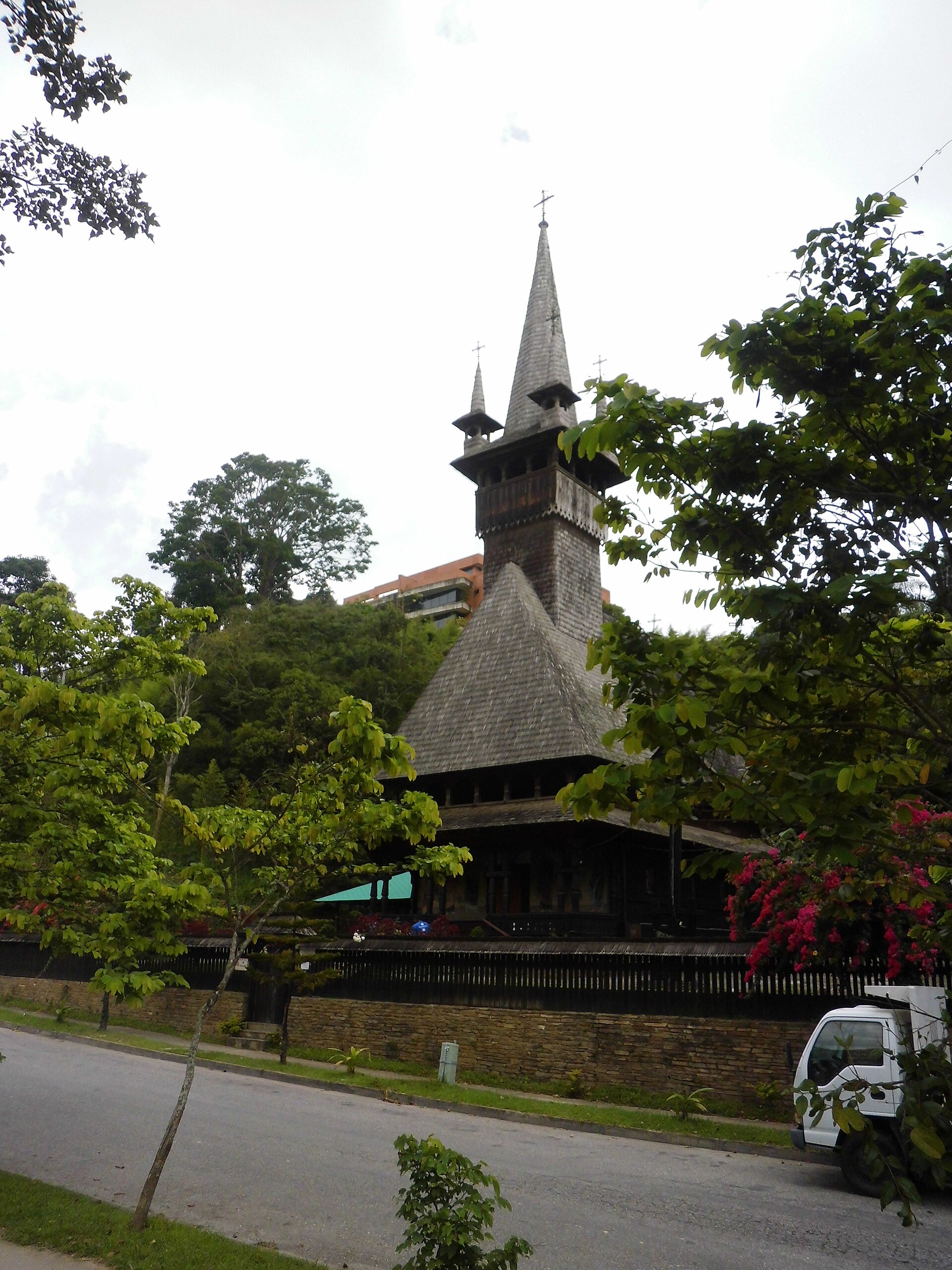
Caracas is a city of contrasts, where modern energy meets quiet corners that feel untouched by time. On Avenida Sur, the Church of Saints Constantine and Helena doesn’t call for attention but stays with you after you leave. It stands as a remnant of an era when the city moved slower, shaped by tradition rather than progress. In a country where Catholicism is dominant, this small Orthodox church is an exception—a piece of Byzantine spirituality in an unexpected place.
The church’s history ties into Russian emigration to Latin America. After the revolution in the early 20th century, many Russians found refuge in Venezuela, bringing customs and a need to preserve their spiritual heritage. The church was built in the 1930s by the local Russian community as a way to keep their roots alive. Its architecture reflects that purpose—modest but distinctly Orthodox, with domes, arches, and frescoes that connect to a distant past.
The church doesn’t stand out from the outside. Its light stone facade and low arches blend into the cityscape, nearly hidden by taller buildings. But inside, the space feels different. Soft light from narrow windows illuminates the interior, where silence feels heavier than outside. The iconostasis, painted in the traditional style with golden halos and solemn faces, creates a quiet reverence. The frescoes, though not old, carry the same weight as those in older Russian churches, telling stories that don’t need words.
This was never built for tourists or pilgrims. The church follows its own rhythm, rooted in Orthodox tradition. Services are held in Church Slavonic, a language most Venezuelans don’t know, yet the liturgy has a calming effect, even for those who don’t understand. The congregation is small—mostly people seeking peace, a pause from the city’s pace. There’s no crowd, no spectacle, just quiet devotion.
The church has become more than a place of worship for Caracas’ Russian community. It hosts gatherings, concerts of sacred music, and exhibitions on Russian history and art. For descendants of emigrants, it’s a link to their heritage—a place to speak their language, share memories, and feel connected. It serves as both a spiritual sanctuary and a bridge between generations.
The Church of Saints Constantine and Helena doesn’t aim for grandeur. It doesn’t compare to the cathedrals of Moscow or St. Petersburg, and that’s part of its appeal. There’s no showiness, just quiet dignity in its small domes and modest bell tower, which rings out over the city. Inside, the simplicity—uncluttered spaces, muted colors, candlelight—lets the mind settle. It doesn’t try to impress; it offers comfort in its quietness.
Caracas holds old and new in uneasy balance. The church exists in that space, neither resisting the modern world nor surrendering to it. It doesn’t compete with grand Catholic cathedrals or busy tourist spots. Instead, it offers something slower, a story of persistence rather than spectacle. For those who find it, the church feels like a discovery—a quiet moment in a city that rarely stops.
The Russian community in Venezuela is smaller now, but the church remains active. It hasn’t faded into the past; it still gathers those who value its atmosphere. There are no crowds, no pressure. Just quiet, light, and the sense that some things endure, no matter how much changes. In a city that never stops, the Church of Saints Constantine and Helena offers stillness—a place to pause and remember that not everything needs to be loud to matter.