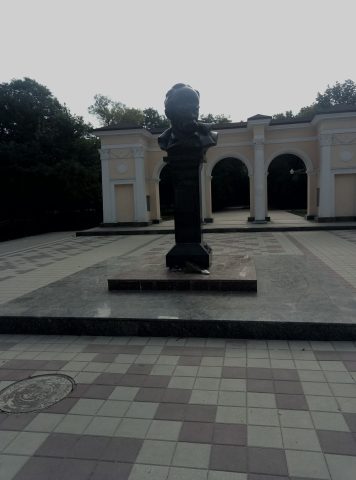
Great Znamyanka’s Central Square is one of those places where a town’s quiet rhythm feels most alive. It isn’t grand or flashy, nor does it try to be. Instead, it exists as a natural gathering point, a space where the everyday unfolds without pretense. The square doesn’t demand attention—it simply is, and that’s what makes it special. Here, the pulse of the village slows just enough to let you notice the small things: the way sunlight falls on the pavement in the late afternoon, the murmur of conversations from the benches, the occasional laughter of children playing nearby. This is where the real life of the town happens, unfiltered and unhurried.
The architecture around the square reflects the unassuming character of southern Ukrainian settlements. Most buildings are low, two or three stories at most, their facades weathered by time but still sturdy. Some retain traces of Stalinist neoclassicism, their symmetrical lines and modest decorative elements hinting at a past era, while others bear the plain, functional look of later Soviet construction. There’s no attempt at grandeur, just a sense of practicality and endurance. The local council building stands out slightly, not because it’s particularly striking, but because it has long served as a quiet anchor for the community—a place where decisions are made, disputes settled, and announcements posted on the old bulletin board by the entrance.
At the heart of the square, a small open space remains mostly bare, save for a few trees or flowerbeds that change with the seasons. In summer, the shade offers relief from the heat, while in winter, the expanse feels bright and open, the snow untouched except for the tracks of passersby. This is where people naturally congregate—elderly men playing dominoes on a bench, mothers pushing strollers, teenagers lingering after school. On weekends, the square comes alive in a different way. Vendors set up stalls with fresh produce, homemade preserves, or hand-knit scarves. A makeshift market takes shape, not the kind designed for tourists, but one that serves the people who live here. Children dart between the stalls, kicking a ball or chasing each other, while the scent of grilled corn or fried dough lingers in the air.
The history of Great Znamyanka is tied to the broader story of Ukraine’s southern steppes. The village began as a Cossack settlement in the late 18th century, later becoming a stop along trade routes connecting larger towns. The square itself emerged much later, as the settlement grew and took on the shape of a proper village. Over the decades, it has witnessed fairs, political rallies, and festive gatherings. During World War II, like much of the region, it suffered damage, but in the postwar years, it was rebuilt, its layout largely unchanged. The square has always been a stage for the village’s public life, a place where collective memory is preserved in the simplest of ways—through the stories told on its benches, the events held on its open ground, and the quiet continuity of daily routines.
Today, the square remains both an administrative and cultural hub. Local events—concerts, exhibitions, holiday celebrations—often take place here, drawing people of all ages. The most lively of these is the annual Village Day, when the square transforms into a festival ground. Stages are set up, music plays, and families gather to eat, dance, and catch up with neighbors. For a few hours, the usual quiet gives way to something more vibrant, a reminder of how deeply this place matters to those who call it home. It’s not about spectacle; it’s about belonging.
For travelers, the square offers something rare: a glimpse of life as it’s actually lived, without the polish of tourist brochures. There are no souvenir shops, no guided tours, no crowds jostling for the best photo. Instead, there’s the unhurried pace of a community that doesn’t perform for outsiders. Some might find it uneventful, but those who appreciate authenticity will recognize its value. This is a place where time moves differently, where the past isn’t just preserved in museums but woven into the fabric of everyday existence.
In winter, the square takes on a particularly serene quality. Snow blankets the rooftops, bare branches stretch against the pale sky, and the air carries the faint scent of woodsmoke from nearby chimneys. The cold doesn’t deter people from gathering—bundled-up figures still linger on benches, chatting or watching the world go by. Summer brings a different kind of charm. The trees provide shade, the flowerbeds bloom, and the square becomes a cool refuge from the midday heat. Evenings are especially pleasant, with the golden light softening the edges of the buildings and the sound of crickets filling the air.
Central Square isn’t the kind of place you visit to check off a list. It doesn’t have famous landmarks or dramatic history, and it won’t leave you breathless with its beauty. What it does offer is something more subtle: a sense of place, a feeling of stepping into a world that operates by its own rules. Here, life isn’t staged or hurried. It simply is, in all its ordinary, unvarnished reality. If you ever find yourself in this part of Ukraine, take a moment to stop. Walk across the square, sit on one of the benches, and watch. You might not leave with a story to tell, but you’ll carry something quieter and more lasting—a sense of having touched the real.