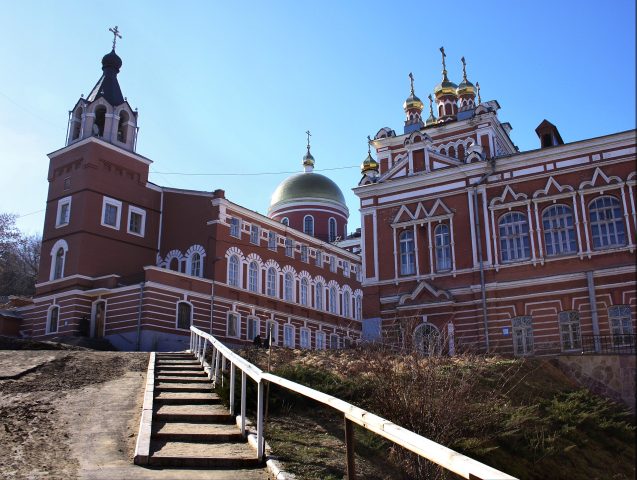
The Chapel of St. Alexander Nevsky in Samara is one of those quiet places that might easily go unnoticed amid the city’s hustle. Tucked away at the intersection of Molodogvardeyskaya and Frunze streets, it stands near the Volga’s gentle curve, where the riverbank once bustled with activity. Long ago, this spot was home to a busy pier, and the chapel served as a welcoming sight for steamboats arriving in the city—a small reminder of something enduring in the midst of everyday life.
Built in 1889, the chapel was dedicated to St. Alexander Nevsky, a revered figure in Russian history known for his role as a protector and unifier. The project was designed by architect Alexander Shcherbachev, whose work left a mark on Samara’s growing skyline during a time of rapid urban expansion. The chapel wasn’t funded by the state or the church alone; instead, it was made possible by donations from merchants and ordinary citizens. This collective effort gave the building a deeper meaning—it wasn’t just a place of worship but a symbol of the community’s shared faith and resilience.
The chapel’s architecture is simple yet elegant, blending seamlessly with the traditions of Russian Orthodox design. Its octagonal structure is crowned with a steep, tent-like roof topped by a small onion dome, a hallmark of the style. The exterior is modest, adorned with brickwork patterns, decorative kokoshnik arches, and narrow arched windows that lend the building a sense of lightness. Inside, the space is even more unassuming—no grand frescoes or gilded iconostases, just a quiet simplicity that feels warm and inviting. Sunlight filters through the windows, softly illuminating the icons and wooden benches, creating an atmosphere of calm reflection.
Like many religious sites in Russia, the chapel’s history was turbulent in the 20th century. During the Soviet era, it was closed and repurposed for secular use. Over the years, it served as a storage room, a workshop, and even a bottle return depot. Fortunately, the building survived, and in the 1990s, it was returned to the faithful. Restoration efforts brought back its original appearance, though some details, like the interior decor, had to be recreated from scratch.
Today, the Chapel of St. Alexander Nevsky remains an active place of worship, drawing visitors who come not only to pray but also to find a moment of peace away from the city’s noise. Tourists often stop by to admire the architecture or photograph the icons inside. The chapel is especially striking in the evening, when the glow of streetlights reflects off the Volga’s surface, casting a warm light on its silhouette. On religious holidays, people gather outside to attend services or light a candle, adding to the sense of community.
The location itself carries its own history. The area was once a lively hub of river trade, with piers, warehouses, and markets shaping the neighborhood’s character. The chapel was an integral part of this world, standing as a quiet witness to the comings and goings of merchants and travelers. While much of that bustle has faded, the chapel’s position by the water still gives it a special charm. In summer, people stroll along the embankment or sit by the river, while in winter, the snow-covered chapel resembles a fairy-tale cottage, blending into the serene landscape.
For Samara, the Chapel of St. Alexander Nevsky is more than just an architectural landmark—it’s a piece of the city’s collective memory. It serves as a reminder of how the city has evolved, how traditions have shifted, and yet how some things remain unchanged. Here, the past feels tangible: from the merchants who donated to its construction to the modern-day visitors seeking solace or a quiet moment. The chapel bridges generations, offering a sense of continuity in a city that has seen so much change.
Despite its small size, the chapel holds a meaningful place in Samara’s spiritual life. It lacks the grandeur of cathedrals, but that’s part of its appeal. There are no crowds, no pomp—just a quiet space where time seems to slow down. Perhaps that’s why locals and travelers alike return to it, drawn by the stillness and the chance to pause, even briefly, and reflect on something beyond the everyday.