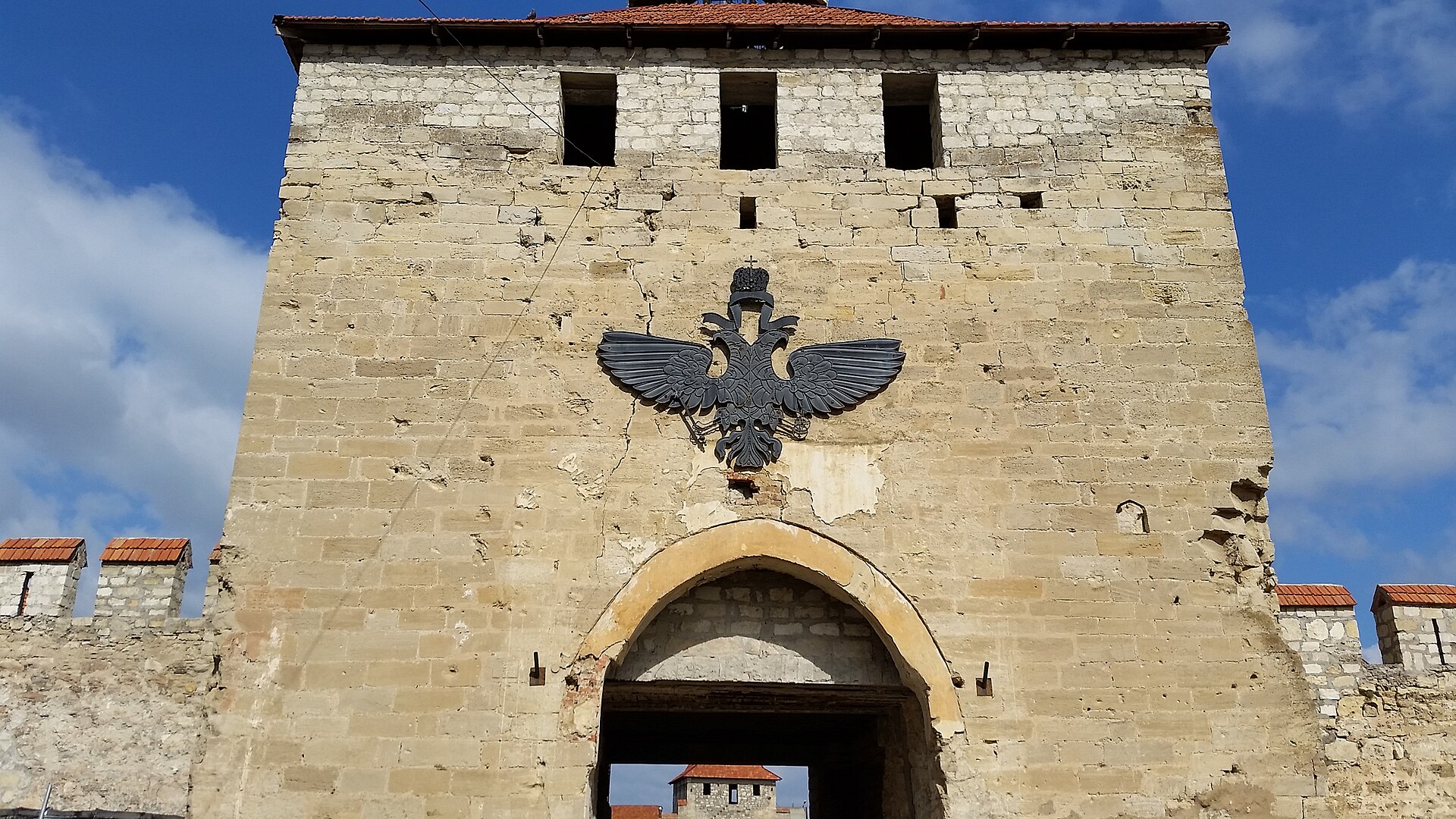
Bender Fortress overlooks the Dniester River from its high right bank, where the river curves before flowing south. The site was selected for its natural defenses: steep slopes on three sides and the water on the fourth. For centuries, it has guarded the river crossing, witnessing the shifting borders and conflicts that defined this corner of Eastern Europe.
The Dniester was never just a river. It served as a frontier, a trade route, and at times, a boundary between empires. The fortress above it holds layers of history in its stone and earth.
The fortress dates to the late 15th century, when the Principality of Moldavia ruled the region. Early fortifications were likely wooden, built to protect Tighina, a key trading post between the Black Sea and Europe’s interior. By the 16th century, the Ottomans took control, reinforcing the walls with stone, expanding the bastions, and turning Tighina into a strategic stronghold. The name Bender—from the Turkish *bender*, meaning "port"—reflects its role as a river crossing.
The fortress you see today took shape in the 18th century, particularly under Ottoman military engineer Luigi Vanvitelli. He redesigned the medieval structure into a star-shaped bastion fortress, a style common in European military architecture of the time. The thick, sloping walls were built to resist artillery, while the angular bastions allowed defenders to cover every approach with crossfire. Inside, the fortress had an upper citadel and a lower courtyard, with barracks, storerooms, and a mosque. The layout was practical—built for defense and daily life.
Walk through the arched gateways and along the ramparts, and you’ll feel its original purpose. This was a place of endurance, not grandeur.
Bender Fortress has seen its share of battles. In the 18th century, it became a focal point during the Russo-Turkish Wars, changing hands as Russian and Ottoman forces fought for control. In 1711, Peter the Great’s forces besieged it during the Pruth River Campaign. Though the Russians failed to capture it, the campaign marked the start of a long conflict that eventually brought the region under Russian rule. After the 1812 Treaty of Bucharest, Bender and its fortress became part of the Russian Empire, and Ottoman influence waned.
Under Russian rule, the fortress lost its military importance. The border shifted south, and the Dniester was no longer a contested frontier. It became a garrison, then a prison—a role it kept well into the 20th century. During the Soviet era, it served as a military base, with parts modified for modern needs. The mosque inside was turned into a warehouse, and Soviet renovations obscured Ottoman details. Yet the fortress endured.
Today, Bender Fortress is one of the few surviving examples of Ottoman military architecture in the region. Some walls have been restored; others crumble, with wild vegetation reclaiming the ramparts. No longer an active military site, it’s open to visitors. The upper citadel offers views of the Dniester winding through low hills. Inside, old barracks and storerooms hold small exhibits on the fortress’s history—modest displays focused on the structure itself.
The fortress feels quiet, resilient. It was never meant to impress with beauty. Its strength is in its simplicity—a fortress built to last, to withstand sieges, to house soldiers who lived and died within its walls.
There’s a melancholy here, a sense of time passing over the stones. The Dniester still flows below, as it has for centuries. The fortress stands as a reminder of the lives that intersected here: Ottoman janissaries, Russian soldiers, Moldavian peasants, Soviet conscripts. Each left their mark in the weathered walls.
For those drawn to military history, Bender Fortress offers a direct link to the past. The star-shaped bastions, thick walls, and courtyard layout show how fortifications were designed to counter gunpowder. You can walk where soldiers once stood guard, watching for enemies or enduring the long, uneventful days of garrison life. The fortress also reveals the region’s broader history—where empires rose and fell, and borders shifted with each conflict.
Beyond its historical role, the fortress is a local landmark. Residents of Bender come here to walk, take photographs, or enjoy the view. On weekends, families stroll the ramparts, and children play in the open spaces where soldiers once drilled. The fortress has become part of the city’s daily life—no longer just a relic, but a living presence.
There are no grand ceremonies or tourist crowds. Just a quiet, enduring structure that has outlasted the empires that built it. In that way, Bender Fortress is more than a historical site. It’s part of the landscape, as much a fixture of the Dniester’s banks as the river itself.