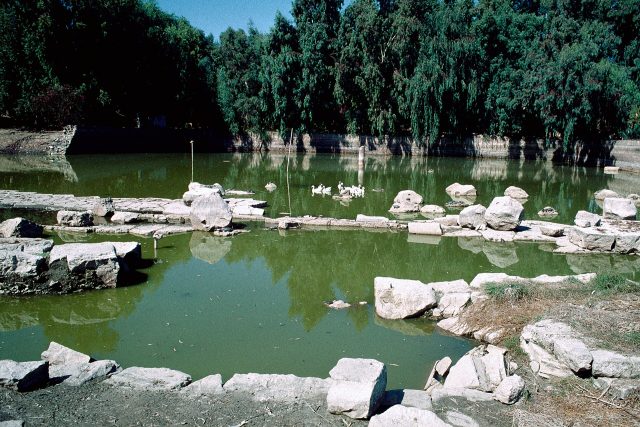
Perched on Ayasuluk Hill above the modern town of Selçuk, the ruins of the Basilica of St. John offer a quiet counterpoint to the more famous remnants of nearby Ephesus. This was once one of the most sacred sites in the Christian world, built in the 6th century by Emperor Justinian over what was believed to be the final resting place of the apostle John. In its prime, the basilica drew pilgrims from across the Mediterranean, standing as a spiritual beacon in a city already steeped in history. Today, the stones that remain tell a story not just of faith, but of the slow passage of time and the layers of history that have settled here like dust.
The basilica’s design reflected the architectural transition of its era, blending the grandeur of late Roman traditions with the emerging Byzantine style. It was conceived as a cross-shaped structure crowned by six domes, their weight borne by thick columns that once supported walls clad in marble and floors inlaid with intricate mosaics. The central nave led to an altar built directly above the crypt where John was said to be buried, a focal point for worship and devotion. Though much of the decoration has long since vanished, fragments of the original splendor remain—particularly in the surviving sections of the apse, where the echoes of ancient prayers might still linger if you listen closely.
By the Middle Ages, the basilica had taken on a new role beyond its religious significance. As Ephesus declined under shifting empires, the structure was repurposed, its stones eventually scavenged to build homes and mosques in Selçuk after the Ottoman conquest. What was left crumbled into ruin, a shadow of its former self by the time travelers began documenting the site in the 19th century. It wasn’t until the early 20th century that archaeologists began piecing together its layout, revealing just how vast and imposing the basilica had once been. Even now, the ruins feel more like a discovery than a monument, as if the past is still being uncovered, one stone at a time.
Visiting the basilica today is less about spectacle and more about atmosphere. The site is modest—low walls, scattered columns, and the occasional arch—but that simplicity is part of its appeal. Wild grasses grow between the stones, and the air carries the scent of olive trees that have taken root among the ruins. From the hill, the view stretches across the valley where Ephesus once thrived, its ancient streets now buried beneath fields and modern roads. On clear days, the shimmer of the Aegean Sea is visible in the distance, a reminder of how this place was once connected to the wider world.
The basilica is often visited alongside other nearby sites, like the fortress of Ayasuluk or the Ephesus Museum, where artifacts from the ancient city are displayed. But it’s worth lingering here on its own. There’s no grand narrative to follow, no dramatic reenactments of history—just the quiet weight of centuries pressing down on the stones beneath your feet. The wind moves through the ruins, carrying with it the faintest suggestion of voices from another time, though whether they’re real or imagined hardly matters. What lingers is the sense of standing in a place where history isn’t just remembered but felt.
This isn’t a site that demands attention in the way more famous ruins do. There are no towering columns or perfectly preserved mosaics to photograph, no crowds jostling for the best view. Instead, the basilica offers something rarer: a connection to the past that feels unfiltered, almost intimate. It’s the kind of place that stays with you long after you’ve left, not because of what it once was, but because of what it still is—a quiet witness to the passage of time, where the boundaries between then and now seem to blur just a little. Maybe that’s why people return, not for the sights, but for the chance to sit among the stones and listen.