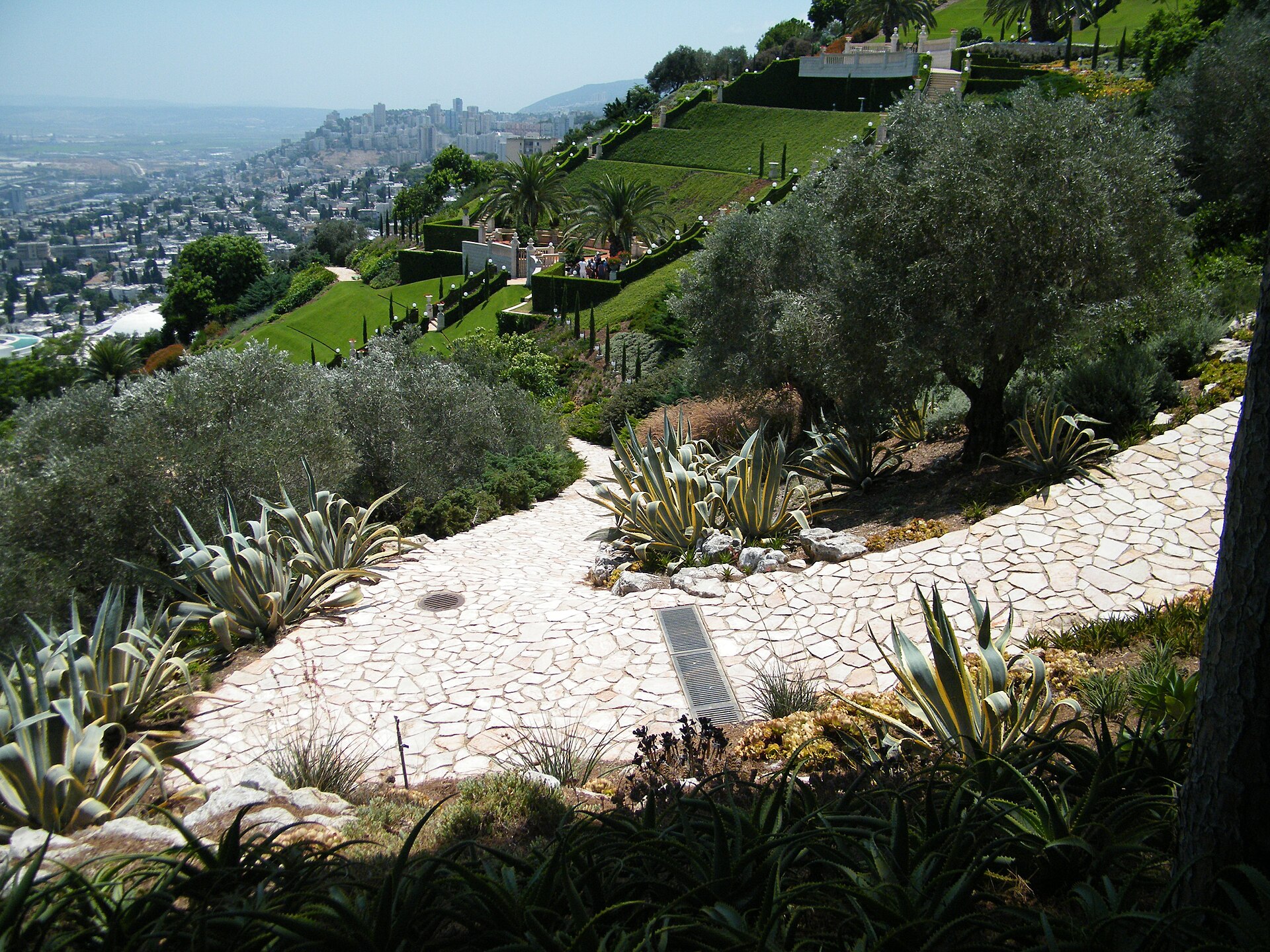
Haifa is a city where the Mediterranean meets the Carmel Mountains, where modern neighborhoods blend with ancient hills, and where the sea breeze carries the scent of salt and pine. Perched on the slopes of Mount Carmel, the Bahá’í Gardens are one of Israel’s most striking landmarks—a place that transcends mere beauty to become something deeper. For followers of the Bahá’í Faith, which emerged in 19th-century Persia, these gardens are a spiritual heart, a symbol of unity and peace. But even for those who come without religious intent, the gardens offer a rare sense of harmony, a quiet invitation to pause and reflect.
The gardens are not just a collection of plants and pathways but a meticulously designed terraced landscape, cascading down the mountainside in nineteen levels. Each terrace holds its own significance, representing key figures in Bahá’í history, with the central and most expansive one leading to the Shrine of the Báb, the faith’s holiest site. From a distance, the gardens appear to stretch endlessly, though in reality, they occupy a relatively compact space. The illusion is deliberate, creating a sense of descent that feels both grand and intimate. From the upper terraces, the view unfolds over Haifa’s port, the shimmering sea, and on clear days, the distant outline of Acre. The perspective shifts with every step, revealing new angles of the city and the landscape beyond.
The origins of the gardens trace back to 1891, when Bahá’u’lláh, the founder of the Bahá’í Faith, designated Mount Carmel as the location for its spiritual center. Yet it wasn’t until the early 20th century, under the guidance of his son ‘Abdu’l-Bahá, that the vision began to take shape. The first major structure, the Shrine of the Báb, was completed in 1909, its golden dome becoming an instant landmark. The terraces themselves, however, were a later addition, conceived in 1987 and only fully realized by 2001. What started as a modest plot of land evolved into one of the most intricate landscape projects in the world, a testament to patience and devotion.
Every detail of the gardens reflects intentionality, from the precise alignment of the central axis with the cardinal directions to the symmetry of the terraces. Pathways wind through manicured hedges and flowerbeds, where plants are chosen for year-round bloom, ensuring the gardens never lose their vibrancy. Water plays a central role, flowing through channels and fountains, its movement a quiet reminder of life’s continuity. At night, the gardens transform under soft illumination, their terraces glowing like a staircase of light against the dark slope of the mountain. The effect is both serene and awe-inspiring, a balance of human craftsmanship and natural beauty.
At the heart of the gardens stands the Shrine of the Báb, its golden dome gleaming above white marble columns. Inside, the atmosphere is one of stillness, broken only by the murmur of water and the rustle of leaves. There are no ornate decorations or overt religious symbols, just an open space filled with light. For Bahá’ís, this is a place of pilgrimage, but its tranquility resonates with all who visit. Surrounding the shrine are smaller gardens, where benches invite visitors to sit and absorb the surroundings. The absence of noise or distraction makes it easy to lose track of time, to simply be present in the moment.
The gardens are open to everyone, free of charge, though certain areas have restrictions. Photography is not allowed inside the shrine, and some sections are accessible only during specific hours. In summer, the terraces can be crowded, especially on weekends, when tourists and locals alike come to escape the heat. Winter brings a different kind of beauty—rain-slicked leaves, cooler air, and a quieter atmosphere. The gardens feel more intimate then, as if the city has receded just a little, leaving space for reflection.
Beyond their spiritual significance, the Bahá’í Gardens have become an integral part of Haifa’s identity. The city has grown around them, and their presence is woven into daily life. Couples pose for wedding photos on the terraces, musicians perform in the open-air spaces, and festivals occasionally spill into the gardens. Guided tours, offered in multiple languages, delve into the history of the Bahá’í Faith and the architectural nuances of the site. For many residents, a walk through the gardens is a routine pleasure, a way to reconnect with the city’s quieter side.
The Bahá’í Faith teaches the unity of all religions and peoples, and the gardens embody this principle in their very design. There are no barriers here, no divisions between visitors—only a shared space where people come for different reasons. Some seek inspiration, others solitude, and many simply want to capture the beauty in photographs. Yet almost everyone leaves with a sense of calm, a rare commodity in a fast-paced world. The gardens don’t preach; they simply exist, their layout and atmosphere speaking to the possibility of harmony.
Haifa is a city of layers—historical, cultural, and religious—and the Bahá’í Gardens are one of its most eloquent expressions. They remind visitors that beauty can bridge differences, that a place can hold meaning for many without losing its essence. Walking the terraces, it’s hard not to think about the common threads that connect people, despite their varied beliefs. Perhaps that’s why the gardens draw so many. They are more than a tourist attraction; they are a space where each person can find something personal, whether it’s a moment of peace, a spark of curiosity, or simply the pleasure of being in a place that feels both extraordinary and deeply human.