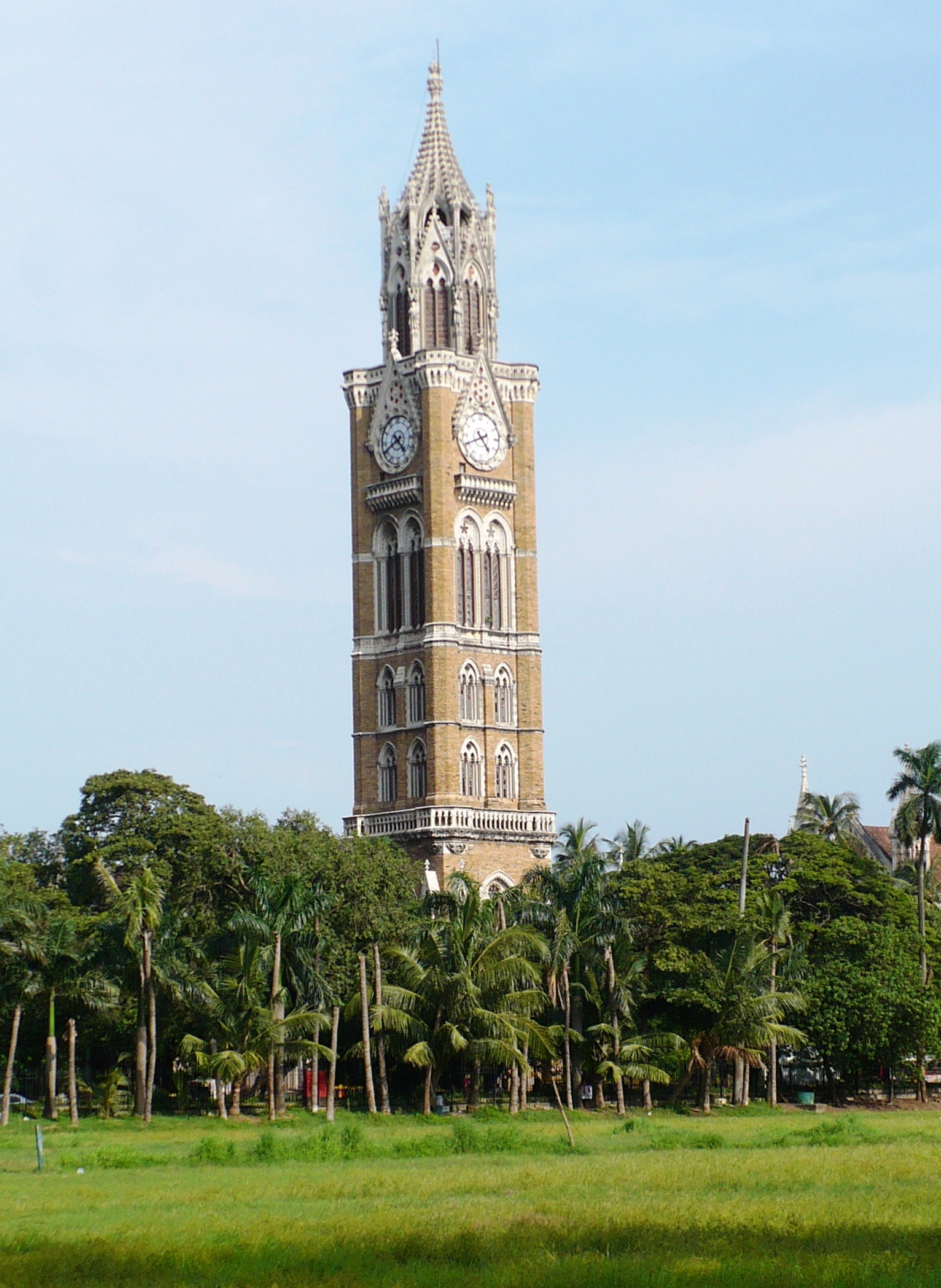
Rajabai Tower stands quietly in the heart of Mumbai’s university campus, a graceful relic of a time when the city was still called Bombay. Built in the mid-19th century, it was conceived as both a tribute and a functional space—a clock tower, library, and observatory rolled into one. The man behind it was Premchand Raichand, a local businessman who wanted to honor his mother, Rajabai, by creating something that would outlast him. The design came from Sir George Gilbert Scott, a British architect known for his grand Victorian projects, though here he blended European Gothic with subtle Indian touches. The result is a structure that feels both familiar and distinct, as if it belongs to another era yet refuses to fade into the background.
The tower’s architecture tells a story of its own. Its white stone facade, punctuated by dark window frames and delicate tracery, reflects the Victorian Gothic style that was fashionable in Britain at the time. But there’s something undeniably local in the way the light plays off its surfaces, or how the intricate carvings echo traditional Indian motifs. The clock at the top, once one of the most precise in Asia, still keeps time, its chimes drifting over the campus below. Inside, the tower once housed one of India’s largest university libraries, filled with rare manuscripts and early printed books. Though the library has since moved, the tower retains a sense of quiet purpose, as if it still holds the echoes of students climbing its spiral staircase to study under the glow of stained-glass windows.
For decades, Rajabai Tower was more than just a landmark—it was a part of the city’s rhythm. In the 19th century, sailors approaching Bombay’s bustling harbor would spot its silhouette against the skyline, a reassuring sign that they had reached their destination. For locals, its clock was a reliable timekeeper in an era before wristwatches became common. The tower stood as a symbol of the progress that British rule brought to the city, though its meaning has shifted over time. Today, it’s less a reminder of colonial power and more a testament to Mumbai’s layered history, where the past and present coexist in unexpected ways.
The area around the tower hums with life. The university campus is a microcosm of the city itself—busy, diverse, and full of energy. Students rush between lectures, debates spill out of classrooms, and the occasional protest or gathering adds to the sense of constant motion. Yet the tower itself feels apart from the chaos, a still point in the middle of it all. The trees around it are old, their branches casting dappled shadows on the ground, and in the early mornings, the sound of birdsong competes with the distant roar of traffic. It’s a place where the city’s frenetic pace slows just enough to notice the details—the way the stone has weathered over time, or how the light changes as the day wears on.
Rajabai Tower isn’t the kind of monument that demands attention. It doesn’t dominate the skyline like the modern skyscrapers that have sprung up around it, nor does it have the imposing presence of Mumbai’s grander colonial buildings, like the High Court or Chhatrapati Shivaji Terminus. Instead, it has a quiet elegance, a sense of being exactly where it belongs. It doesn’t try to compete with the new; it simply endures, a reminder that history isn’t just something that happened—it’s something that’s still here, shaping the city in ways both seen and unseen.
For visitors, the tower offers a glimpse into Mumbai’s past without the need for grand narratives. It’s a place to pause, to look up at the clock face and wonder about the people who once relied on its chimes, or to imagine the scholars who once filled its library. The campus around it is open, and while access to the tower’s interior is limited, its exterior is enough to spark curiosity. Nearby, other remnants of the colonial era stand in contrast—the heavy stone of the High Court, the ornate chaos of the railway station—but Rajabai Tower feels lighter, almost delicate by comparison. It’s as if it was designed to be admired from a distance, a fleeting beauty in a city that moves too fast to notice.
What makes the tower special isn’t just its history or its architecture, but the way it fits into the everyday. Students walk past it on their way to class, tourists snap photos, and locals sometimes sit on the benches beneath its shadow, lost in thought. It doesn’t need to be the center of attention to matter. In a city where the new constantly overshadows the old, Rajabai Tower persists, a quiet witness to the changes that have swept through Mumbai over the past century and a half. It’s not a place you’d plan a trip around, but it’s the kind of spot that lingers in your memory long after you’ve left—proof that even in a city as vast and chaotic as Mumbai, there are still moments of unexpected grace.