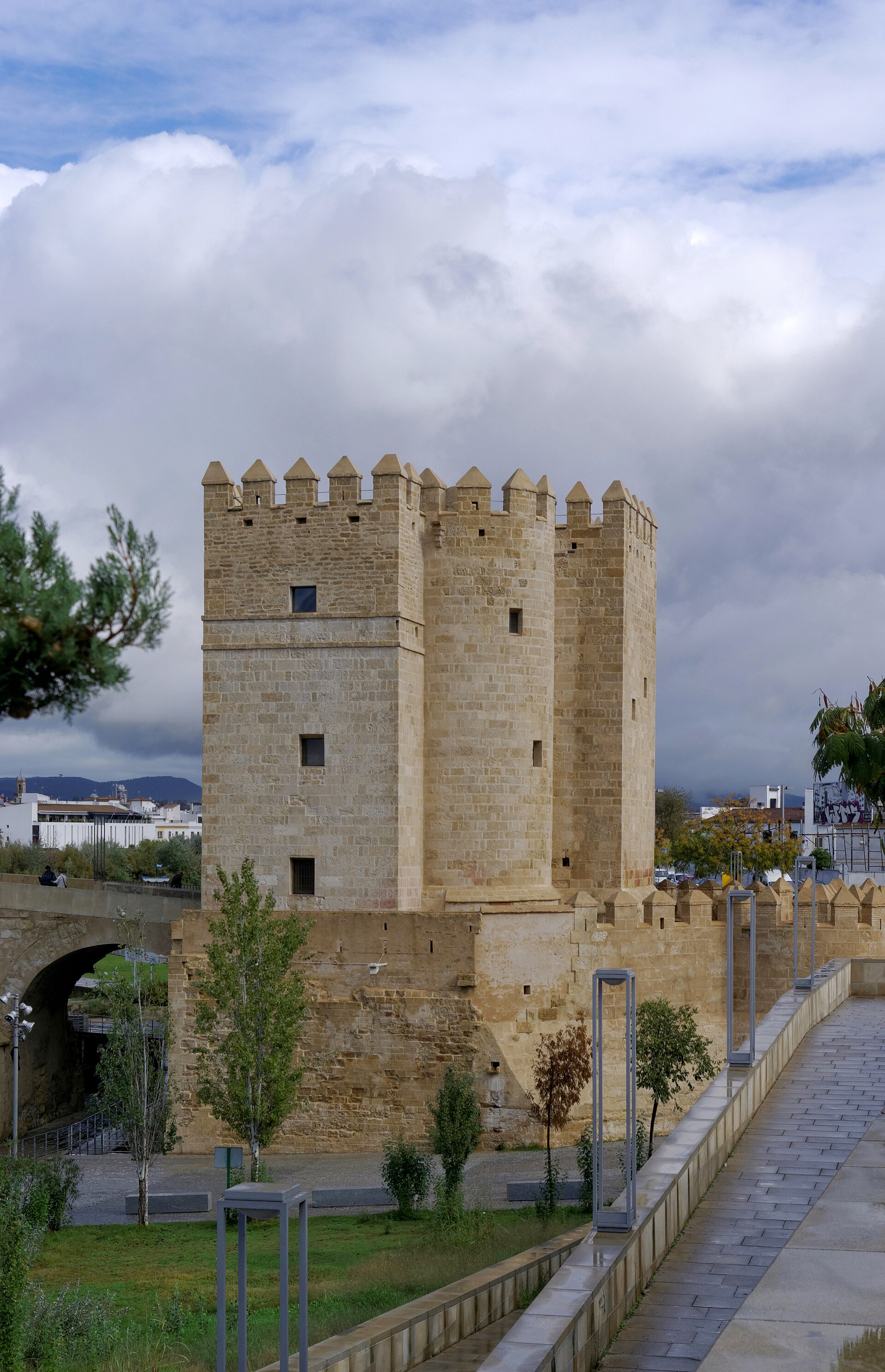
Calahorra Tower stands at the southern end of Córdoba’s Roman Bridge, where the old city once began. Its thick walls have witnessed centuries of change—from the rule of Moorish caliphs to the reign of Christian kings—and today it remains one of the few surviving fragments of the medieval fortifications that once encircled the city. More than just a monument, the tower feels like a silent guardian of history, its stones bearing the weight of merchants, pilgrims, soldiers, and travelers who passed through its gates over the ages.
Built in the 12th century as part of Córdoba’s defensive system, the tower was both a military stronghold and a symbol of power. At the time, the city was one of Europe’s largest, and its bridge across the Guadalquivir was the only crossing for miles in any direction. The tower controlled this vital route, its walls serving as the last line of defense against invaders. Climbing its narrow spiral staircase, you can almost hear the echoes of sentries keeping watch while the life of the medieval city bustled below.
The architecture reflects its Moorish origins, though later modifications were made. The thick stone and brick walls, narrow arrow slits, and vaulted ceilings speak to its military purpose. Yet there’s more to it than just fortifications. The interior, once used as barracks or storage, now houses a museum dedicated to Córdoba’s golden age under Moorish rule. Exhibits include scale models of the city, ancient maps, everyday objects, and even reconstructions of scientific instruments—testament to the era when Córdoba was renowned not only for its military strength but also for its advancements in medicine, astronomy, and philosophy.
One of the museum’s most compelling sections explores the coexistence of three cultures—Muslim, Christian, and Jewish—that shaped medieval Córdoba. The city was a rare place where people of different faiths lived side by side, exchanging knowledge and creating a shared culture. Calahorra Tower, standing at the boundary between the old Moorish quarter and the Christian districts, embodies this intertwining of traditions. Manuscripts in Arabic, Latin, and Hebrew, religious artifacts, and household items serve as reminders that Córdoba’s history wasn’t just about conquest—it was also about long periods of peaceful coexistence.
From the tower’s upper terrace, the view alone justifies the climb. The Roman Bridge stretches across the wide river with its sixteen arches, while the Mezquita’s famous red-and-white striped arches rise in the distance. The rooftops of the old city blend Moorish courtyards with Christian bell towers, creating a scene that feels suspended in time. The light is especially magical at sunset, when the stones of the bridge and the tower glow golden, and the shadows stretch long and soft across the river.
Today, Calahorra Tower is more than just a museum. It hosts temporary exhibitions, lectures, and cultural events, weaving itself into the fabric of the city’s daily life. Locals often come here simply to sit on the benches at its base, watching the river flow by. For visitors, it’s one of those places where history isn’t just read about—it’s felt. The sound of water, the scent of orange blossoms in the air, the echo of footsteps on stone—all of it pulls you into the past.
Córdoba is a city that keeps its secrets well, and Calahorra Tower is one of them. It doesn’t demand attention like the grand cathedrals or palaces, but that’s precisely why it feels so authentic. There are no crowds here, no rush for the perfect photo—just a quiet space where the past lingers in every stone. If you listen closely, the wind and the river seem to carry whispers of those who once passed through these gates, unaware that their footsteps would become part of the city’s enduring story.