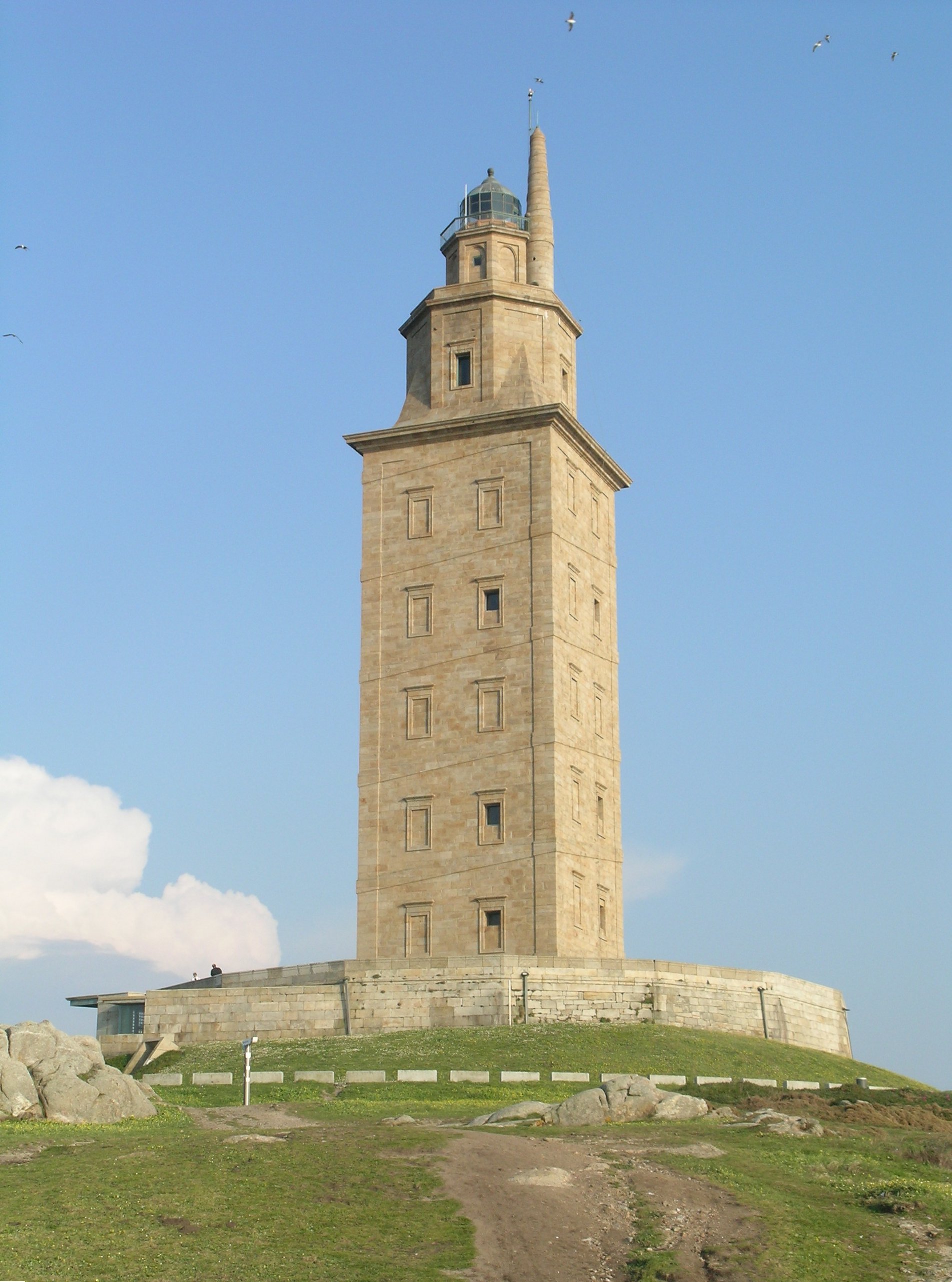
Perched on a windswept headland where the Atlantic crashes against jagged granite, the Tower of Hercules has watched over these shores for nearly two millennia. It’s the last surviving Roman lighthouse still in operation, its beam cutting through the night for thirty nautical miles, a silent sentinel for sailors who’ve called it simply Hercules, as if the tower itself were alive. The waves that batter its base today are the same ones that guided Phoenician traders and Roman galleys to this coast, long before the city of A Coruña grew around it.
The Romans built the lighthouse sometime between the late first and early second century, on land once known as Brigantium. Local legend credits Hercules himself with its construction, claiming he raised it after defeating the giant Geryon in one of his twelve labors. Whether myth or memory, the tower endured where empires did not. It weathered the fall of Rome, the Middle Ages—when it served as a fortress and gunpowder store—and the slow creep of time. In the 18th century, King Charles III ordered its restoration, and the architects of the day gave it the neoclassical facade it wears now, with its columns and balustrade. Yet beneath that more recent skin, the original Roman stonework remains, a quiet testament to its age.
Climbing the tower is like stepping through layers of history. The spiral staircase is narrow, the ceilings low, the air thick with the weight of centuries. At the top, the view stretches across the ocean and the city, a reminder of how small human endeavors are against the vastness of time and tide. The lower levels still bear the marks of their Roman origins, while the upper sections reflect the 18th-century restoration. It’s a rare place where two eras exist side by side, not as ruins or relics, but as something still very much alive.
A Coruña has grown up around the tower, and though the city now sprawls beyond it, the lighthouse remains its heart. Locals come here to walk along the promenade, watch the sunset, or sit on the rocks with the wind in their faces. The park surrounding the tower is dotted with sculptures and winding paths, a quiet counterpoint to the wild energy of the ocean below. Unlike the crowded streets of Barcelona or Madrid, this corner of Galicia feels untouched by the rush of modern tourism. There’s a sense that the place moves to its own rhythm, one shaped by the tides and the turning of the seasons.
The Atlantic here is restless. In winter, storms send waves crashing against the cliffs, spray reaching as high as the observation deck. Even in summer, the wind rarely lets up, though the sun warms the stones until they hold the day’s heat long into the evening. On clear days, the horizon blurs into the sky, and it’s easy to imagine this is the edge of the world. The tower has seen it all—the rise and fall of empires, the ebb and flow of trade, the endless cycle of the sea.
People come to the Tower of Hercules for different reasons. Some seek solitude, a place to think with only the sound of the waves for company. Others come for inspiration, drawn by the stories embedded in its walls. There’s the tale of a British king who sailed here in search of a bride, or the legend of pirate treasure buried somewhere beneath the cliffs. The most persistent story, though, is the one about Hercules himself, who lit a torch on this spot after his victory over Geryon, a flame that has never gone out. Whether truth or myth, the tower’s light has burned for two thousand years, a constant in a world that has changed beyond recognition.
Inside, the tower now houses a small museum, a collection of artifacts that tell the story of navigation through the ages. There are models of ancient ships, fragments of Roman masonry, and maps that trace the routes of those who once relied on this beacon. The exhibits are modest but evocative, a reminder of how this stretch of coast has shaped—and been shaped by—the people who passed through. For those who love history, it’s a chance to stand where countless others have stood, to touch the same stone that has endured for centuries.
A Coruña is a city that moves slowly, and the Tower of Hercules embodies that pace. There’s no rush here, no need to fill the silence. You can climb the tower, wander through the park, or simply sit on the rocks and watch the ocean. In the evening, the lighthouse is lit from within, its glow reflected in the dark water. Time feels different here, stretched thin by the weight of history and the endless motion of the sea.
The tower has outlasted wars, empires, and the slow decay of centuries. It still stands, still serves its purpose, a rare thing in a world that so often discards the old in favor of the new. There’s something timeless about it, something that makes you feel, just for a moment, like you’re part of a story much larger than yourself. And perhaps you are. After all, everyone who climbs those steps leaves their own mark on the place, however small. The tower doesn’t just preserve history—it lets you step inside it.