The Arg, or Presidential Palace, stands at the heart of Kabul, a building that has witnessed Afghanistan’s turbulent modern history unfold within and around its walls. Its origins trace back to the late 19th century, when Emir Abdur Rahman Khan, known as the "Iron Emir" for his ruthless consolidation of power, commissioned its construction as a royal fortress. The palace was designed to project strength, a symbol of centralized authority in a country still grappling with tribal divisions and foreign interference. Over the decades, it evolved from a royal residence into the political nerve center of the nation, adapting to each new regime that claimed it as their seat of power.
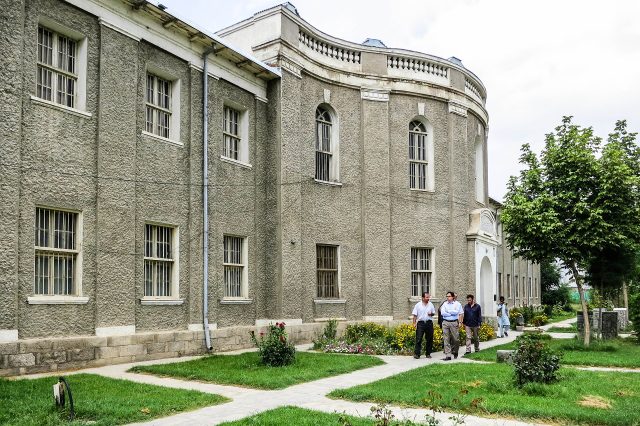
The architecture of the Arg reflects the layers of history it has absorbed. The original structure, built in the late 1800s, followed traditional Afghan design principles, with thick walls, arched windows, and courtyards that offered both security and respite from the harsh climate. Later additions, particularly during the 20th century, introduced European influences—neoclassical columns, grand halls, and formal gardens—mirroring the country’s shifting alliances and aspirations. The palace complex sprawls across a significant portion of central Kabul, its high perimeter walls enclosing not just the main buildings but also administrative offices, barracks, and even a mosque. From the outside, it appears imposing, almost fortress-like, a deliberate choice to convey stability in a region where power has often been fragile.
For much of the 20th century, the Arg was the backdrop to Afghanistan’s attempts at modernization. Under King Amanullah Khan in the 1920s, the palace became a stage for ambitious reforms, though his efforts to rapidly Westernize the country ultimately led to his downfall. Later, during the Cold War, it was here that Soviet-backed leaders and, later, mujahideen factions vied for control, each leaving their mark on the building’s function and symbolism. The palace survived the civil war of the 1990s, though not unscathed; parts of it were damaged during the factional fighting that reduced much of Kabul to rubble. When the Taliban took control in 1996, they repurposed the Arg as their administrative headquarters, further embedding its role in the country’s cycles of conflict and governance.
After the U.S.-led invasion in 2001, the Arg was restored to its function as the presidential palace, though its meaning had shifted once again. It became a symbol of the fragile democracy that emerged in the early 2000s, hosting international delegations and serving as the official residence of Afghanistan’s elected leaders. The building’s interiors, though not open to the public, were said to blend traditional Afghan craftsmanship with modern statecraft—carved wooden panels alongside secure communications rooms, ornate chandeliers hanging above conference tables where critical decisions were debated. Yet even in these years, the palace remained a target, its security a constant concern in a city where violence was never far from the surface.
The Arg’s significance extends beyond its physical presence. It is a place where Afghanistan’s contradictions are laid bare: the tension between tradition and progress, the struggle for sovereignty amid foreign influence, the fragility of institutions in a land shaped by war. For Kabul’s residents, the palace is both a landmark and a reminder—a structure that has endured while the city around it has been repeatedly torn apart and rebuilt. Its high walls, visible from many parts of the capital, serve as a boundary between the governed and those who govern, a separation that has often felt both necessary and insurmountable.
Today, the Arg remains at the center of Afghanistan’s political life, though its future, like that of the country itself, is uncertain. The palace has seen empires rise and fall, ideologies come and go, and leaders enter and exit under vastly different circumstances. What remains constant is its role as a stage for history, a place where the decisions made within its walls ripple outward, shaping the lives of millions. For visitors to Kabul, the Arg is not a tourist site but a silent witness to the forces that have defined Afghanistan. Its story is still being written, one chapter at a time, in a city where the past is never truly past.