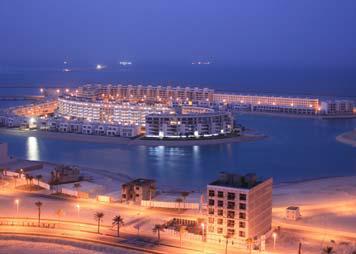
Amwaj Islands feel like a place where the future arrived a little ahead of schedule. This man-made archipelago off Bahrain’s northeastern coast was designed not just as another luxury development, but as a statement about what modern living in the Gulf could look like—sustainable, self-contained, and seamlessly connected to both land and sea. The islands emerged from the shallow waters of the Persian Gulf in the early 2000s, shaped by dredging and land reclamation, a process that turned empty seabed into a network of residential, commercial, and leisure spaces. Today, they stand as one of Bahrain’s most ambitious urban experiments, a place where glass towers, marinas, and artificial lagoons coexist with a surprisingly relaxed pace of life.
The layout of Amwaj is deliberate, almost geometric. Six islands form a loose ring around a central lagoon, with bridges and causeways linking them to the mainland and to each other. The largest island, Amwaj Island itself, is where most of the activity happens—hotels, shopping malls, and apartment complexes line the waterfront, their facades reflecting the changing light of the Gulf. The architecture leans toward contemporary, with clean lines and an emphasis on water views, though there’s a nod to regional aesthetics in the occasional arched window or wind tower. Unlike the dense, labyrinthine streets of Manama, Amwaj feels open and airy, designed for cars but also for pedestrians, with wide promenades and shaded walkways that encourage people to linger.
What makes Amwaj different from other planned communities in the region is its relationship with the water. The islands were built with marine life in mind, incorporating artificial reefs and protected shorelines to encourage biodiversity. The lagoon at the center isn’t just decorative—it’s a functional part of the ecosystem, with tidal flows that help keep the water clean. Kayaking and paddleboarding are common here, and on weekends, you’ll see families picnicking along the shore or fishing from the jetties. The sea is never far away, and neither is the sense that this place was built to coexist with it, rather than dominate it.
The islands have a quiet, almost suburban feel, especially in the residential areas. Villas and low-rise apartments cluster around landscaped gardens and communal pools, with names like *The Lagoon* or *Marina Heights* hinting at their waterfront appeal. There’s a sense of order here, but not sterility—children play in the parks, expats walk their dogs, and the occasional food truck sets up near the beach. The community is diverse, a mix of Bahraini families, Gulf Arabs, and international professionals, all drawn by the promise of a modern, hassle-free lifestyle. It’s not a place for those who crave the chaos of a traditional souk or the historic weight of a centuries-old fort, but for those who want a slice of contemporary comfort, it works.
Commercially, Amwaj is a hub for businesses that cater to both locals and visitors. The *Amwaj Rotana* is one of the most visible landmarks, its curved glass facade rising above the marina. The hotel isn’t just for tourists—it’s a social space, with restaurants and bars that attract Bahrainis from across the island. Nearby, the *Lagoon Park* shopping center offers a mix of high-street brands and local boutiques, while the *Floating City* complex, with its cluster of cafes and offices, gives the area a slightly more urban edge. There’s no grand bazaar here, no historic market—just the quiet hum of a place designed for convenience.
The islands also serve as a gateway to Bahrain’s less-visited northeastern coast. From Amwaj, it’s a short drive to the *Al Dar Islands*, a pair of small, rocky outcrops that feel worlds away from the man-made precision of Amwaj. The Dar Islands are popular for day trips, with snorkeling, jet skiing, and beachside grills drawing crowds on weekends. Closer to Amwaj, the *Tubli Bay* mangroves offer a glimpse of Bahrain’s natural side, a rare patch of green where herons and flamingos sometimes appear at dawn. These contrasts—between the engineered and the organic, the urban and the wild—are part of what makes the area interesting.
For all its modernity, Amwaj isn’t without its contradictions. It’s a place that was built to be self-sufficient, yet it still relies on the mainland for much of its infrastructure. The roads leading to and from the islands can get congested, especially during rush hour, a reminder that even the most carefully planned developments are subject to the realities of geography and traffic. There’s also the question of what happens to a place like this over time—whether it will age gracefully or become a relic of a particular moment in Gulf urbanism. For now, though, it feels alive, a work in progress rather than a finished product.
What lingers after a visit to Amwaj is the sense of possibility. It’s a place that doesn’t pretend to be anything other than what it is—a carefully constructed environment where people come to live, work, and unwind. There’s no ancient history here, no grand monuments, just the quiet ambition of a project that set out to redefine what a modern Gulf community could be. Whether that ambition will endure is an open question, but for now, Amwaj remains one of Bahrain’s most intriguing experiments in urban living. It’s not for everyone, but for those who appreciate its particular blend of order, water, and light, it offers something rare in the region—a sense of place that feels both intentional and effortless.