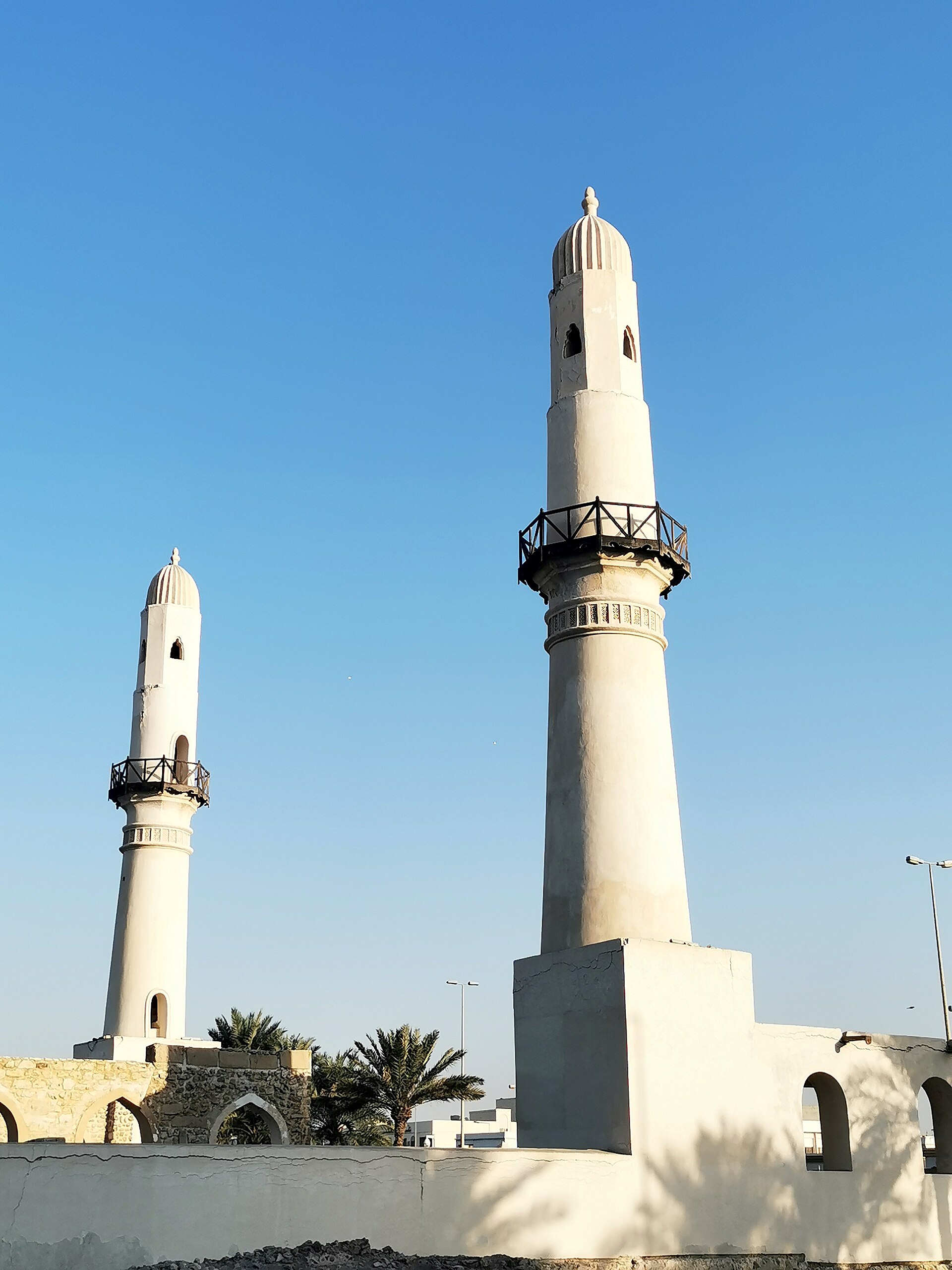
Al-Khamis Mosque stands on the island of Sitra as one of Bahrain’s oldest surviving religious sites, a quiet witness to centuries of history. Its origins trace back to the early days of Islam’s expansion beyond the Arabian Peninsula, though scholars continue to debate its exact age. Some attribute its construction to the Umayyad period, while others place it later, during the Abbasid era. Regardless of the precise date, the mosque has played a central role in shaping the region’s religious and cultural identity. Over time, it has been rebuilt and restored, yet it retains the essence of early Islamic architecture, bridging the gap between past and present.
The mosque’s design is simple but striking, defined by its two minarets, which rise above the low-slung structure. These towers were built in different eras—the first, more robust one, dates to the 11th century, while the second was added in the 14th. Both are constructed from local limestone, which has weathered into a warm, golden hue, blending seamlessly with the island’s landscape. The mosque’s inner courtyard is framed by low arcades supported by stone columns, their unadorned lines reflecting the modesty of early Muslim communities. Unlike the ornate mosques of later periods in the Gulf, Al-Khamis carries a restrained beauty, free from excessive decoration.
Perched on a slight elevation away from Sitra’s busier roads, the mosque is surrounded by palm trees that lend an air of seclusion. Nearby, old cemeteries stretch across the land, their weathered gravestones marking the resting places of generations past. Some of these tombs date back to the medieval period, their inscriptions in Arabic carved with quiet dignity. In the late afternoon, when the sun dips low, the minarets cast long shadows over the sand, and the stillness feels almost timeless. The rustle of palm fronds and the distant sound of waves from the bay add to the sense of stepping outside the rush of modern life.
For Bahrain, Al-Khamis Mosque is more than a historical monument—it’s a symbol of continuity. In a country where gleaming skyscrapers stand alongside ancient forts, this mosque serves as a reminder of the nation’s roots. While it no longer functions as a daily place of worship like the mosques of Manama, its significance remains undiminished. Locals visit during religious holidays to honor their ancestors, and travelers with an interest in Islamic history come to connect with the origins of a faith that has shaped the region for centuries.
Sitra itself is far removed from Bahrain’s tourist hubs. There are no luxury hotels or bustling souks here, only quiet fishing villages where life moves at the pace of the tides. The island was once a center of the pearl diving trade, and traces of that era linger in the old houses with their carved wooden balconies and the crumbling docks along the shore. Al-Khamis Mosque seems to hold the memory of those times, when Sitra was a vital part of the Gulf’s trade routes and its people were renowned for their skill as divers and sailors.
Visiting the mosque is as much about experiencing its atmosphere as it is about admiring its architecture. Inside, fragments of old mihrabs—niches pointing toward Mecca—remain, along with remnants of intricately carved wooden ceilings that once adorned the prayer hall. The stone floors, worn smooth by centuries of footsteps, still echo with the presence of those who came before. On hot days, the thick walls keep the interior cool, while during the rare rains, the air fills with the scent of damp stone and salt. If you’re lucky enough to encounter a local guide, they might share stories of how the mosque withstood Portuguese invasions in the 16th century, how it was rebuilt after earthquakes, and how it became a place of pilgrimage for those seeking a spiritual connection to the past.
Today, the mosque is carefully preserved by the Bahraini government, which recognizes its cultural importance. A small area around the site features informational displays about its history and significance. Yet visitors are few—mostly those with a specific interest in early Islamic architecture or the region’s heritage. This makes a visit all the more rewarding; there’s no need to rush. You can wander the courtyard, watching how the light plays across the walls, or stand beneath the minarets, listening to the wind carry the mingled scents of the sea and the desert.
Al-Khamis Mosque is more than just a structure of stone and clay. It’s a place where history isn’t confined to the past but continues to resonate, reminding us of how faith and culture have shaped a nation. In a country where modernity presses in from all sides, the mosque remains an oasis of calm and reflection, inviting visitors to consider the threads that connect us to those who stood here centuries ago. There are no grand ceremonies or crowds of worshippers, but perhaps that’s what makes it so meaningful—not just for Bahrain, but for anyone seeking authentic stories beyond the usual tourist paths.