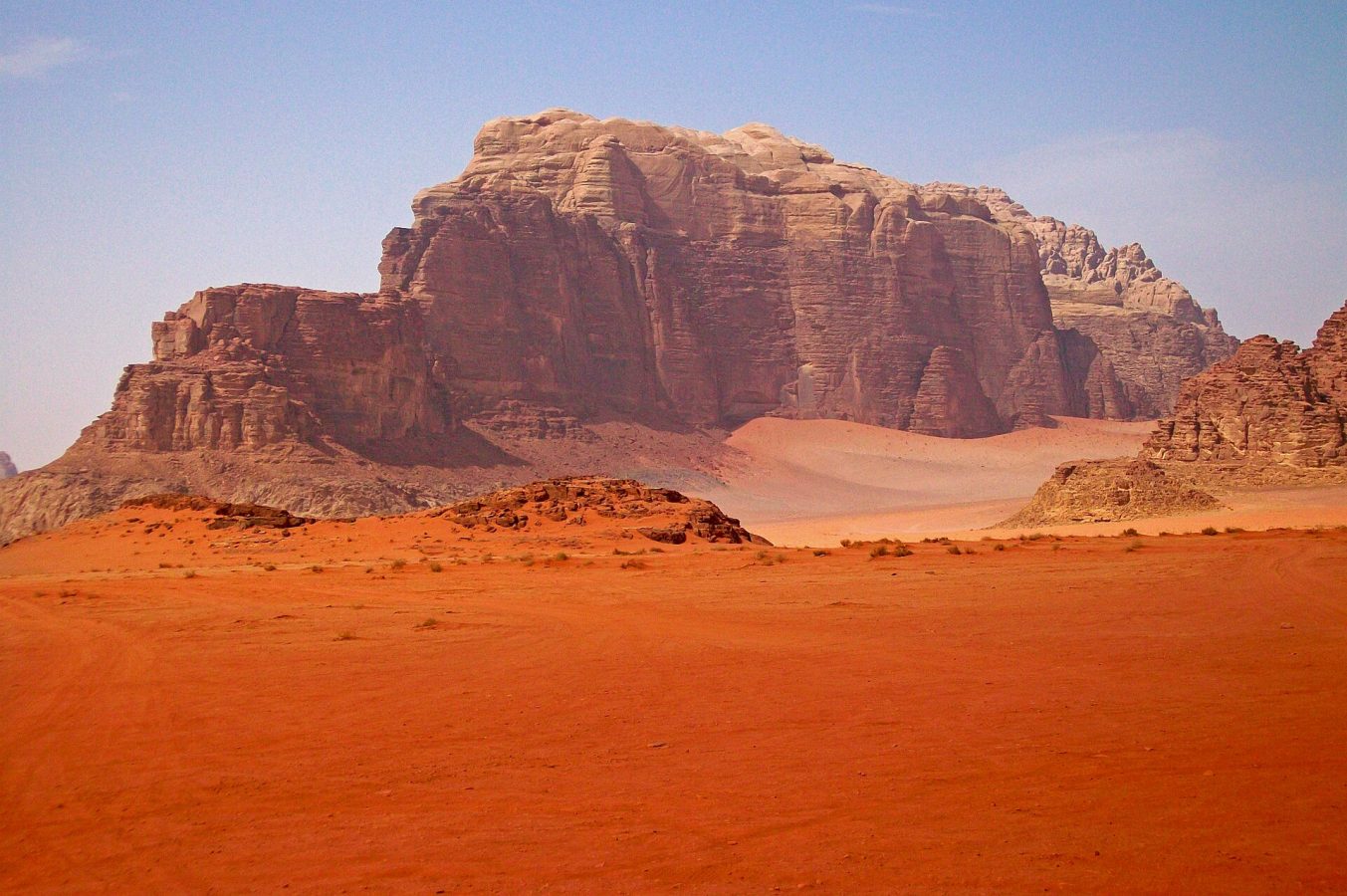
Wadi Rum
Jordan · 6 places
Photo: Daniel Case, CC BY-SA 3.0
Wadi Rum is a place where the desert doesn’t just stretch endlessly—it rises, folds, and towers in great waves of red sandstone and granite. The landscape shifts with the sun: soft pink at dawn, blinding gold by midday, deep crimson as the light fades. The Bedouin call it the Valley of the Moon, and it’s easy to see why. The silence, the vastness, the way the rocks seem to float in the heat—it feels like another world.
This is the desert that has stood in for Mars, for Arrakis, for the sweeping dunes of Lawrence of Arabia. But you don’t need Hollywood to understand its pull. The moment you step onto the sand, the wind carries away everything but the present. There are no distractions here, no noise, no rush—just the weight of the earth beneath your feet and the sky pressing down.
The Bedouin have lived in these canyons for generations, learning to read the land like a map. Some still do, moving with the seasons, while others have settled into small villages. But the old ways haven’t disappeared. If you stay in one of their camps, you’ll be offered sage tea before you’ve even sat down, stories by the fire before the stars come out, and a bed in a goat-hair tent—now with proper mattresses and hot water, though the warmth of the welcome hasn’t changed. It’s the kind of place where strangers become friends over a shared meal, where time slows just enough to let you breathe.
There are plenty of ways to explore. You can race across the dunes in a jeep, climb Jordan’s highest peak, or follow ancient caravan routes on camelback. Some try sandboarding down the slopes, while others simply walk, letting the silence settle around them. At night, the temperature drops, and the sky opens up. Without city lights to dull the view, the Milky Way hangs so close it feels like you could reach up and touch it.
The desert has always been a crossroads. Nabatean inscriptions mark the rocks, their carved figures of hunters and animals still sharp after centuries. There are remnants of a Roman temple, too, half-buried in the sand. These stones have seen empires rise and fall, traders pass through, and travelers leave their marks. The past isn’t just preserved here—it’s alive, humming beneath the surface if you know how to listen.
What draws people back is the way Wadi Rum strips things down to what matters. There’s no pretending, no performance—just the land, the light, and the quiet. The wind erases footprints by morning, but the memory of the place lingers. Maybe that’s why so many return, as if trying to hold onto something simple and true. Or maybe it’s just that once you’ve stood in a place like this, the rest of the world feels a little too loud.
Eat & Drink
0 placesNothing in this category yet — the catalogue is still growing.
All placesPlaces on the map
Marker colour follows the categoryClimate and weather
Detailed weather: Wadi Rum- Average temperature
- 21 °C
- Precipitation per year
- 0 mm
Average air temperature
°C
11
11
15
20
24
28
30
29
28
23
17
12
Jan
Feb
Mar
Apr
May
Jun
Jul
Aug
Sep
Oct
Nov
Dec


